
2D/3D Animator
Last updated · Confirm dates, fees and eligibility on the official website before you apply.
Brings characters and objects to life frame by frame or on a rig, for film, television, games or advertising. Judged on a showreel, and studios test for timing above everything else.
- Route in
- Earliest entry: Certificate. Also entered at: Certificate, Diploma. Direct entry. 2 courses lead here
- Entry pay
- ₹15,000 – ₹30,000 / monthly 0–2 yrs
- Where you work
- Animation and VFX studios, Advertising agencies, Gaming companies, OTT content producers
- Experienced
- ₹180,000 / monthly Animation Supervisor
How people get in
Getting in
Earliest entry point. Certificate level.
Other levels people enter from. Certificate, Diploma.
Where people work
Outlook
Animation and VFX studios, Advertising agencies, Gaming companies, OTT content producers.
Indicative starting salary
Understand the role
15,000 - 30,000 per month at entry level.
This is an indicative range, not a quote. Actual pay varies with employer, city, sector and the specific role.
What this work actually is
Understand the role
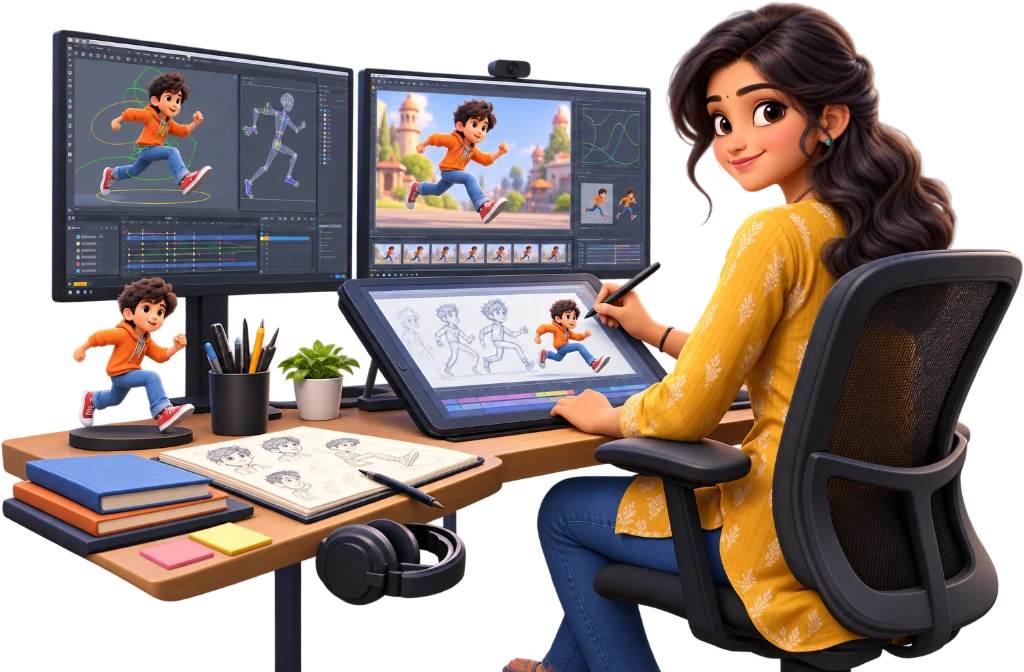
You make movement look believable and intentional. Unlike an illustrator who creates a still image, you decide how a character turns, pauses, lifts a hand or reacts to a hit. In 2D work, you draw or pose frames. In 3D work, you use a rig and adjust timing, weight and facial expression. Your output is shots that fit the storyboard and are ready for the next stage of production.
You usually work at an animation or VFX studio, gaming company, advertising agency or OTT content producer. A junior animator may spend most of the day at a workstation, reviewing a shot, fixing notes and exporting versions. You work with storyboard artists, modellers, riggers, lighting artists, compositors, editors and directors. Clear written notes matter when a shot moves between teams.
Your showreel gets you noticed, but timing decides much of your progress. Studios often test whether you understand weight, spacing and acting, not whether you know many software tools. Much of the work is repeated correction: changing a walk cycle, matching a director’s reference, or fixing a shoulder that breaks when a rigged arm rises. People who practise short, polished shots usually do better than those with long reels full of unfinished work.
What you actually do
Day to day
You spend much of the day making movement look believable, then revising it after feedback from a lead, director or client.
- Open the assigned scene and check the storyboard, reference video and director’s notes.
- Pose a character at key frames so a walk, jump or turn has clear weight and balance.
- Adjust a character rig so elbows, shoulders and facial controls move cleanly.
- Animate objects such as vehicles, props or product packs for an advert or game scene.
- Preview the shot repeatedly and fix pops, sliding feet or awkward spacing between frames.
- Export a playblast or preview of the shot for the team review.
- Explain the action in a short note and flag any missing asset or unclear instruction.
- Apply feedback on timing, acting, camera framing or lip-sync.
- Compare the revised shot with earlier versions so a requested change has not broken another part.
- Submit the approved file using the studio’s folder and naming rules.
- Check with rigging artists when a control bends badly or a costume clips through the body.
- Ask the layout or lighting team for the latest camera, set or asset update.
- Research real movement, using video reference for actions such as lifting a bag or climbing stairs.
- Watch teammates’ shots and give specific notes on timing, arcs or character poses.
- Update your task status and estimate how long unfinished shots will take.
- Prioritise shots that block the edit or need approval before other teams can continue.
- Make quick fixes to match an updated voice track, camera cut or client comment.
- Check that every assigned shot has the correct frame range, version and output settings.
- Stay organised across many small revisions instead of polishing one shot for too long.
The part people are surprised by. A large part of the job is watching the same few seconds again and again, then making tiny timing changes that most viewers will never notice.
Who this suits
Fit
This work suits you if you enjoy making movement believable, then revising the same few seconds until the timing feels right.
- You notice when a character’s weight looks wrong, such as feet sliding on the floor or a jump that seems too light.
- You can spend hours adjusting poses, spacing and timing frame by frame, even when most viewers will only see a three-second shot.
- You like observing people and animals. You might watch how someone shifts weight while carrying a bag, then use that detail in a walk cycle.
- You are comfortable being judged through a showreel and a studio test. In junior work, your timing and clean execution matter more than how confidently you talk about animation.
- You do not mind repetitive production work, such as fixing a hand pose across many frames, matching an existing character style, or revising a shot after feedback.
- You can explain an idea in writing and research references before animating. A short scene often needs notes, story context and careful observation, not only software practice.
- This is probably not for you if you want each task to be new and quickly finished. Animation involves long stretches of correction, feedback and patient polishing.
Skills that actually matter
Capability
Studios judge your reel by timing first: an action must have weight, pauses and clear intent before it looks polished.
You need to place poses and in-between frames so a jump feels heavy, a blink feels natural, and a comic pause lands at the right moment.
How to build it. Use a free animation app or pencil-and-paper flipbook to animate a bouncing ball, pendulum and walk cycle. Export each version, compare it with real video shot on your phone, then cut the best three shots into a short reel.
Good character work starts with noticing how people shift weight, hesitate before speaking, or hide anger through a small hand movement.
How to build it. Record family members or friends doing simple actions, with permission, such as lifting a bag or waiting for a bus. Thumbnail the main poses, then animate only those poses before adding in-betweens.
You need to turn a brief into a clear action, understand why a character moves, and explain your choices in notes or during a studio review.
How to build it. Write ten short scenes of 3 to 5 lines, each with one character objective, such as trying to hide a broken phone. Storyboard one scene with stick figures and animate it without dialogue.
You must find reliable visual reference for movement, clothing, tools and places instead of guessing details that make a shot look false.
How to build it. For every practice shot, make a reference folder using your own phone clips, public videos and still images. Add brief notes on weight, speed, joint movement and camera angle before you start animating.
You need confidence in one animation program, including keyframes, graph editor controls, layers, rigs, constraints and clean file naming. In 3D, you must avoid breaking a rig while posing it.
How to build it. Choose one software with a free learning version or free alternative and finish its basic lessons. Download a permitted practice rig, animate a 5-second shot, and keep separate folders for scenes, renders and versions.
For 2D work, clear drawings help you show force, balance and expression. In 3D, quick sketching still helps you plan stronger poses before touching the rig.
How to build it. Draw 20 gesture sketches a day from people at home, sports clips or your own video. Limit each sketch to 30 or 60 seconds, then pick one action each week to turn into animation thumbnails.
Most of the job involves changing shots after a lead, director or client points out unclear acting, uneven timing or a missed brief.
How to build it. Share one unfinished shot in a student group or with a teacher and ask for feedback on one point, such as weight or eye direction. Make the change, save both versions, and write down what improved.
What separates the well paid from the average. Better-paid animators make shots read clearly on the first viewing, take feedback without defending weak work, and deliver clean files that need fewer rounds of fixes.
The honest part
Read this one
The hard part is not learning software. It is making a movement feel right, then fixing it after feedback. In a studio, you may spend hours adjusting a walk cycle, lip-sync, or hand pose by a few frames. Timing matters more than fancy effects. Your showreel gets attention, but tests often check whether you understand weight, spacing and acting. You also need to read briefs carefully, research references and explain your choices clearly.
Your first two years as a junior animator often mean production work under close review. You may handle small shots, revisions and file clean-up while learning a studio’s pipeline. Deadlines for advertising, games or OTT work can tighten near delivery. Some people leave because they dislike repeated corrections, long screen hours or contract uncertainty. Others move towards illustration, graphic design, video editing, game art, VFX or freelancing when they find they prefer a different kind of creative work.
What people get wrong
Read this one
Animation work is judged mainly by your showreel and your sense of timing, not by the name of your course.
- “You need an expensive degree to enter animation.” No. People enter through a certificate, diploma, or direct self-learning, but you still need to show solid work in a demo reel.
- “Animation is only drawing cartoons.” 3D animators often work on rigs, making a character walk, lift an arm, or react without joints and shoulders looking wrong. The job also covers film, games, advertising and OTT content.
- “Good software skills are enough.” Studios test timing closely. You need to learn the twelve principles of animation and practise one software well, rather than collecting many course certificates.
- “The work is all creative fun.” A lot of junior work means fixing small movement problems, matching shots to feedback, and revising the same scene several times. Writing and research also matter when you need to understand a brief or a character.
- “There is no path after junior animator.” You can specialise or move towards a lead role after studio experience. Your reel and the quality of your shots will matter at each move.
Working reality
Read this one
Work-life balance scores lowest because studio deadlines often bring late hours and weekend work, especially near a delivery date.
What it pays
Indicative
Studio animation pay usually starts at ₹15,000 to ₹30,000 a month, and your showreel, shot quality and city decide how quickly it rises.
What decides where you land in the range. A strong showreel, clean timing and acting, 3D rig experience, city, studio size, freelance versus payroll work, and your ability to handle revisions without heavy supervision decide where you land in these ranges.
The route in, step by step
6 steps from where you are now.
Class 12, any stream Required
No stream requirement. Drawing ability helps for 2D; for 3D it matters far less than people assume.
Learn animation - course or self-taught Required
A certificate or diploma in animation, a B.Sc in animation and multimedia, or disciplined self-teaching. Studios hire on the reel, so the course is a way to learn, not a credential you are buying.
Master the twelve principles and one software Required
Timing, weight, anticipation and follow-through are the craft; Maya or Blender is only the tool. Animators who learn software without principles produce work that looks wrong and cannot say why.
Build a demo reel Required
Sixty to ninety seconds of your best work only. A reel is judged on its weakest shot, so cut anything you are unsure about. This is the actual gate into the industry.
Join a studio as a junior animator Required
Indian studios do large volumes of outsourced work for international clients. It is production discipline, deadlines and revisions - and it teaches you more in a year than three years of courses.
Specialise, or move to lead Optional
Character animation, creature work, or games. Senior animator and animation lead follow from consistent shot quality and from being easy to direct.
Courses that lead here
2 mapped routes into this career.
The roles this becomes
7 lanes out of the same starting point.
What it pays
Indicative bands, 3 ways to read them.
| Stage | Pay band | What changes |
|---|---|---|
| 0–2 yrs | ₹15,000 – ₹30,000 / monthly | Junior studio work, usually tested through a showreel |
| 2–4 yrs | ₹25,000 – ₹50,000 / monthly | Completes shots with senior review |
| 4–7 yrs | ₹45,000 – ₹85,000 / monthly | Owns harder character or acting shots |
| 7–12 yrs | ₹75,000 – ₹150,000 / monthly | Lead or supervisor work, with team reviews and deadlines |
| Specialisation | Pay band | What changes |
|---|---|---|
| 2D Animator | ₹25,000 – ₹60,000 / monthly | Complete 2D shots, with stronger drawing, posing and timing |
| 3D Animator | ₹30,000 – ₹75,000 / monthly | Works on rigged character or object shots |
| Character Animator | ₹40,000 – ₹90,000 / monthly | Character acting, body mechanics and facial performance raise the range |
| Animation Lead | ₹70,000 – ₹130,000 / monthly | Assigns shots and gives practical feedback to animators |
| Animation Supervisor | ₹90,000 – ₹180,000 / monthly | Sets shot standards across sequences and manages revisions |
| City | Pay band | What changes |
|---|---|---|
| Kochi | ₹15,000 – ₹50,000 / monthly | Smaller studio market and fewer senior openings |
| Hyderabad | ₹18,000 – ₹70,000 / monthly | Studio and VFX work, with wide project-to-project variation |
| Pune | ₹18,000 – ₹65,000 / monthly | Gaming, advertising and studio roles |
| Chennai | ₹18,000 – ₹65,000 / monthly | Animation and media studios, including contract roles |
| Mumbai | ₹20,000 – ₹80,000 / monthly | More film, advertising and content-production work |
| Bengaluru | ₹20,000 – ₹75,000 / monthly | Large studio, gaming and advertising market |
These are ranges, not offers. Pay varies by city, employer size, sector and your own skill more than by job title. Treat the band as the shape of the market, not as a number you can hold anyone to.
Common questions
The ones people actually ask about this work.
What qualification do you need to become a 2D/3D Animator?
The earliest entry point is certificate level. People also enter from: Certificate, Diploma.
Where does a 2D/3D Animator usually work?
Animation and VFX studios, Advertising agencies, Gaming companies, OTT content producers.
What does a 2D/3D Animator earn to start?
15,000 - 30,000 per month is a typical entry-level range. Pay varies with employer, city and sector.
Test this against your own priorities
Pay, hours and entry route matter differently to different people. Compare this against the alternative you are actually weighing, rather than against the average.