
Agri drone & precision farming
Last updated · Confirm dates, fees and eligibility on the official website before you apply.
DGCA drone pilot + agronomy
- Route in
- Typically B.Tech Agricultural Engineering. 1 course lead here
What the work involves
Day to day
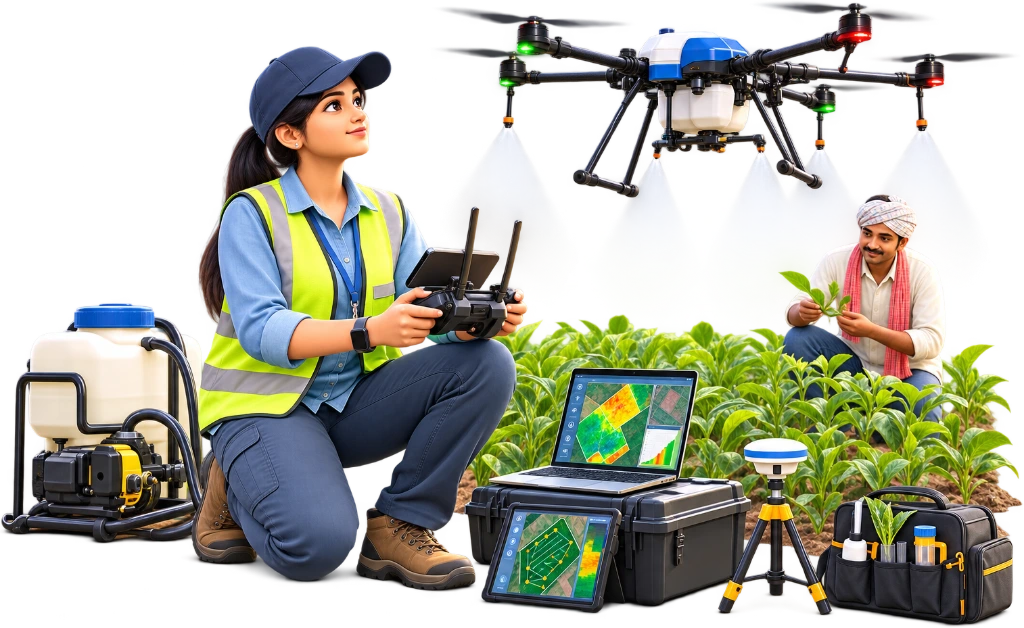
Using drones and data in farming - aerial spraying, crop health imaging, field mapping and variable-rate input recommendations. The role combines certified drone piloting with agronomy interpretation.
Who this suits
Fit
Agriculture graduates willing to become technically certified in a genuinely new field. Drone spraying services can be run as a business serving many farms, and government support for agricultural drone adoption has been substantial.
The honest reality
Read this one
Equipment is expensive and the regulatory framework for drone operation and aerial spraying continues to evolve, which creates real business uncertainty. Service demand is seasonal and concentrated in a few weeks of spraying. Many operators have entered on subsidy and struggle to find enough paying work to cover the asset. The genuinely valuable skill is interpreting the data into an agronomic recommendation - flying the drone is the easy part and is becoming a commodity.
What this work actually is
Understand the role
You do more than fly a drone over a field. You turn aerial images, maps and spray plans into advice or field work that helps a farmer treat the right area. A drone operator may handle spraying and mapping jobs. A precision agriculture specialist also studies crop condition, soil variation and data to plan where water, fertiliser or pesticide should go.
The work happens in farms, orchards, nurseries and village clusters, often outdoors in heat, dust and changing weather. You may work for an agri-tech company or service provider, or take contract jobs as a self-employed operator. On a typical day, you speak with farmers, farm managers and agronomists, check the drone and batteries, mark the field, collect images, then process maps using GIS or remote-sensing tools.
Your flying skill gets you started, but agronomy and reliable field work decide who does well. A farmer will judge you by crop results, safe spraying and whether your map leads to a useful action. Much of the job is planning routes, charging batteries, cleaning equipment, keeping records and travelling between farms. The usual route includes a DGCA Remote Pilot Certificate, but a strong understanding of crops and local farming practices gives you better work over time.
Skills that actually matter
Capability
You need to understand the crop and the field before your drone images or spraying plan will help a farmer.
You need to read crop stage, pest pressure, nutrient stress and water needs. A drone cannot tell you the right spraying decision on its own.
How to build it. Take crop-production modules during B.Tech Agricultural Engineering or B.Sc Agriculture. Spend one crop season with a farm, FPO or agricultural service provider, and keep notes on one crop from sowing to harvest.
You must fly steadily, plan a safe route, check batteries and weather, and keep people, animals and power lines away from the aircraft. Spraying flights need extra care because the payload changes the drone's behaviour.
How to build it. Obtain the DGCA Remote Pilot Certificate, then train under an experienced operator. Start with field mapping and empty-tank practice before handling spraying work.
Farmers need a clear answer on what you will spray or map, what it costs, and what result they should realistically expect. You also need to explain when a flight should be postponed.
How to build it. Join field demonstrations through a college extension activity, FPO or local service provider. Practise explaining one spray plan in Hindi, English or the local language without technical jargon.
You need to set nozzle flow, flight height, speed and spray volume so the chemical reaches the crop evenly. Poor calibration wastes chemical and can damage a crop.
How to build it. Learn with a trained spraying team for at least one season. Compare the planned area, tank volume and actual coverage after every job, and record what changed with each crop and nozzle setting.
You use maps and aerial images to mark field boundaries, spot uneven growth and prepare a useful report. Clear maps matter more than attractive images.
How to build it. Use free GIS software and publicly available satellite imagery to map fields near your college or home. Then compare the map with a walk through the field and note where the image was misleading.
You need to inspect propellers, motors, pumps, filters, batteries and connections before work. Many field delays come from simple faults, dirty filters or poorly charged batteries.
How to build it. Work with a service provider where you help clean, inspect and pack equipment after each flight. Learn to follow a written pre-flight and post-flight checklist rather than relying on memory.
You need to turn flight logs, acreage, spray records and crop observations into a report a farmer or company can use. Accurate records also help you price future work.
How to build it. Use a spreadsheet to record date, village, crop, area, battery cycles, chemical volume, weather and outcome for practice jobs. Make one-page reports with the field map and the main finding.
What separates the well paid from the average. The better-paid operators earn repeat work because they give reliable field results, keep equipment working, and communicate honestly when a drone job will not solve the farmer's problem.
How people actually get in
Getting in
Most people enter through agricultural engineering or agriculture, then add a DGCA Remote Pilot Certificate and practical spraying and mapping work.
After Class 12 science, take B.Tech Agricultural Engineering. Then obtain a DGCA Remote Pilot Certificate and spend 6 to 12 months learning field spraying, mapping, machine operation, GIS and remote sensing. Many people begin with a drone service provider or agri-tech company before taking contract work or starting their own service.
Usually takes About 5 to 6 years after Class 12.
A B.Sc Agriculture gives you the crop and soil knowledge needed to make useful farm recommendations, not simply fly a drone. Add the DGCA Remote Pilot Certificate, then learn spraying and mapping properly. This route suits work as a precision agriculture specialist or with a service provider.
Usually takes About 5 to 6 years after Class 12.
Some entrants first join a farm-drone service provider after getting their Remote Pilot Certificate. You will spend long days travelling to farms, checking batteries, planning flights, handling records and working around weather and crop schedules. Agronomy and GIS skills make it easier to move beyond basic flying.
Usually takes 1 to 3 years to build solid field experience after pilot training.
After 2 to 3 years with a service provider or company, some people take paid spraying or mapping jobs in their district or nearby blocks. You need repeat farmer clients, reliable equipment handling and enough agronomy knowledge to understand what the data or spraying job means on the ground.
Usually takes Usually after 2 to 3 years of work experience.
What people get wrong
Read this one
This work sits between farm knowledge, drone flying, mapping and practical service work.
- “You only need to know how to fly a drone.” Flying is one part; you also need agronomy, safe spraying practice, GIS, remote sensing and enough data analysis to explain what the maps show.
- “It is a desk job with satellite maps.” Much of the work happens in fields, often travelling across villages, checking crops, planning flight paths, carrying equipment and working around weather.
- “A drone will find every crop problem by itself.” Images show patterns, but you must inspect the field and understand soil, irrigation, pests and crop stage before giving useful advice.
- “This is only a small self-employment job.” Some people run local drone services, while others work as precision agriculture specialists with agri-tech firms or service providers after gaining field experience.
- “An agriculture degree alone is enough.” The usual route adds a DGCA Remote Pilot Certificate and hands-on learning in spraying and mapping; clients will judge you by safe, accurate work in their fields.
Where this leads
Outlook
Most people start by flying, spraying and mapping for farms, then move towards advisory work, operations, sales support or their own drone service.
| Who employs | What it is like |
|---|---|
| Agricultural drone service providers | You travel to farms for spraying and mapping jobs, often around crop seasons. Early work may be a contract role, with long field days and pay linked to jobs completed. They want safe flying, machine care and reliable farmer communication. |
| Agri-tech companies | These teams combine farm data, sensors, GIS and drone images. The pace is faster than a farm service team, and they look for someone who can turn a map into a useful crop recommendation, not only fly a drone. |
| Farm equipment and drone distributors | Work often includes demonstrations, operator training, basic servicing and sales support across a district or state. Pay may include a fixed amount and incentives. Travel, follow-up calls and paperwork take a large share of the week. |
| Large farms, plantations and horticulture businesses | You may monitor crop health, plan spraying runs and keep records for one farming operation. Work is more seasonal and site-based. They want agronomy knowledge, careful data records and practical judgement about weather and crop stage. |
| Farmer producer organisations and cooperatives | You support groups of farmers who share services or arrange spraying and crop monitoring. Budgets may be tight and jobs may depend on project funding, but you learn local crops, farmer needs and district-level operations quickly. |
| Government agriculture departments and agricultural universities | Work can involve demonstrations, trials, training and extension programmes. Government posts usually follow formal recruitment routes and offer stronger security; project roles are often fixed-term. Clear reporting and working with farmers matter as much as flying. |
Working reality
Read this one
Job availability scores 2 because you need both DGCA drone-pilot training and practical agronomy, spraying and mapping skills before most service providers will hire you.
The route in, step by step
6 steps from where you are now.
Class 12 with science Required
The science base for an agriculture or engineering degree.
B.Tech Agricultural Engineering, or B.Sc Agriculture Required
Four years. Engineering suits the equipment side; agriculture suits the agronomy and advisory side. Both work.
Obtain a DGCA Remote Pilot Certificate Required
Training at a DGCA-authorised Remote Pilot Training Organisation, then the certificate through the Digital Sky platform. Flying commercially without it is illegal, and agriculture graduates spraying without one are operating outside the law whatever their agronomy qualification.
Learn spraying and mapping properly Required
Spray drone calibration, droplet size and drift, plus multispectral imaging, NDVI interpretation and variable rate application. Pesticide handling rules apply in the air exactly as on the ground.
Work with a service provider or a company Required
Drone service companies, agri-input firms running spray services, or government-supported Kisan Drone programmes and custom hiring centres.
Run a drone service business, or move into agri-tech Optional
Your own spraying and mapping service, or a technical role with a precision agriculture company. Equipment finance and utilisation across a season are the commercial constraints.
Courses that lead here
1 mapped route into this career.
The roles this becomes
2 lanes out of the same starting point.
Common questions
The ones people actually ask about this work.
Is drone spraying a real business in India?
<p>Yes, and it is one of the more genuine agricultural technology opportunities. Spraying by drone is faster and uses less water than manual spraying, government schemes have supported drone purchase and training, and farmers pay per acre for the service. The demand is seasonal and follows the crop calendar.</p>
What do I need to start?
<p>A remote pilot certificate from a DGCA-approved training organisation, an agricultural drone, and the ability to service it. The equipment is a significant investment, so check current subsidy and scheme support before buying — several schemes have supported drone purchase for individuals and farmer producer organisations.</p>
How do I find customers?
<p>Through farmer producer organisations, large individual farmers, agri-input dealers who already advise growers, and cooperative societies. One demonstration on a visible field does more than any advertising, because farmers watch what happens on their neighbour's land.</p>
What is the risk?
<p>Seasonality and utilisation. The drone earns only during spraying windows, and it must earn enough in those weeks to cover the whole year. Plan for a mix — spraying, crop monitoring, survey work — rather than relying on one season, and be realistic about how many acres you can genuinely reach.</p>
Test this against your own priorities
Pay, hours and entry route matter differently to different people. Compare this against the alternative you are actually weighing, rather than against the average.