
Agri journalism & advisory content
Last updated · Confirm dates, fees and eligibility on the official website before you apply.
farmer-facing media
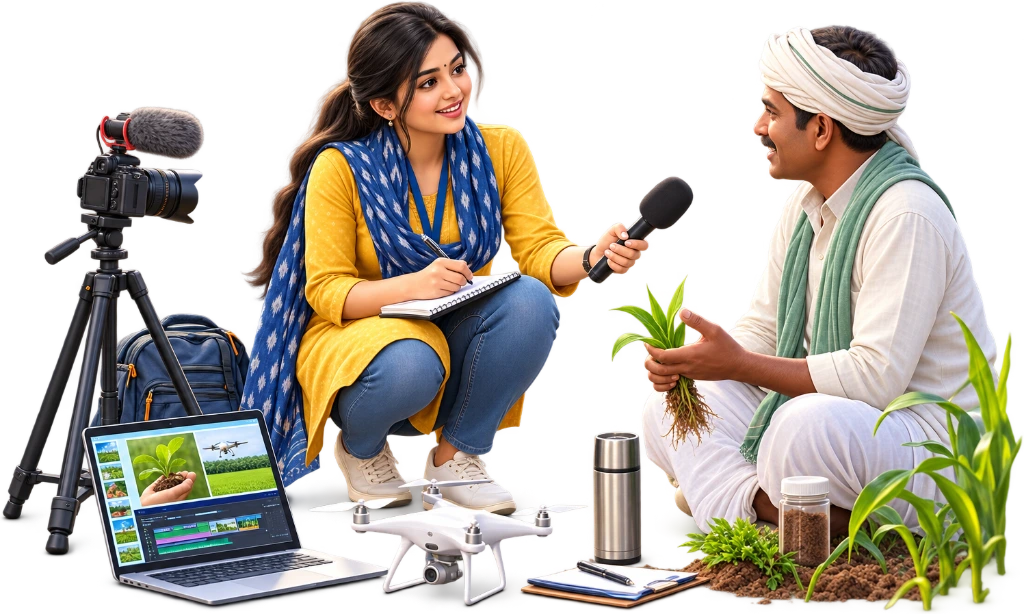
- Route in
- Typically B.Sc Agriculture or BA Journalism / Mass Communication. 2 courses lead here
What the work involves
Day to day
Producing farmer-facing information - advisory content on crops, inputs, weather and prices, and reporting on agricultural policy and markets, delivered increasingly through regional-language video and messaging rather than print.
Who this suits
Fit
Agriculture graduates who communicate well, particularly in an Indian language. Farmers are now reachable directly through their phones, agri-input companies and platforms fund advisory content, and technically accurate material in regional languages is genuinely scarce.
The honest reality
Read this one
Much of the funding comes from input companies, which means advisory content and product promotion blur together, and keeping that boundary honest is a real professional problem rather than a hypothetical one. Bad advice reaches people whose livelihood depends on it. The independent journalism side is poorly paid with few employers. Regional language ability largely determines whether the work exists for you.
What this work actually is
Understand the role
You turn farm information into advice a farmer can use. Unlike a general reporter who mainly covers events, you explain what a pest alert, rainfall change, seed update or market development means for a crop and its timing. Your work might include articles, scripts, short videos, crop calendars and advisories in simple language. You check facts carefully, because a wrong spray dose or late recommendation can cost a grower money.
The work happens in agri media teams, advisory content units and digital platforms serving farmers. Some days you work from a desk, reading research, government notices and field reports. On other days you visit farms, mandis, demonstrations or district-level agriculture events. You work with agronomists, editors, video teams and farmers who tell you what failed on the ground.
The strongest writers do not write about farmers from a distance. They understand one crop, season or region well enough to spot advice that sounds neat but will not work locally. Much of the job is research, checking terms, simplifying technical language and revising drafts. Good writing matters, but trust comes from accurate agronomy and advice that respects a farmer’s actual costs, weather and risk.
Skills that actually matter
Capability
You need enough crop knowledge to avoid bad advice, and the plain writing to make that advice useful to a farmer on a phone.
Write and speak in the words farmers use, with the crop stage, local problem and next action clear. A useful advisory says what to check in the field, not only the name of a disease.
How to build it. Visit a mandi, farm or Krishi Vigyan Kendra in your district and listen to the questions people ask. Turn one question each week into a 150-word Hindi, English or local-language advisory, then ask a farmer or agriculture student what was unclear.
You need to understand sowing, irrigation, nutrient use, pests, weather risk and harvest well enough to avoid giving harmful or vague advice.
How to build it. Use your B.Sc Agriculture notes, state agriculture department bulletins and agricultural university material to make crop calendars for two crops grown near you. For each stage, write the common field problem, what to observe and the source for your advice.
Advisory content needs current, checked facts. You must separate a verified recommendation from a rumour, an old post or a claim made to sell an input.
How to build it. For every draft, keep a simple source sheet with the date, crop, state and original government or university source. Compare advice from two reliable sources and flag differences instead of copying the first result you find.
You will write short articles, scripts, captions and advisory messages. The work includes cutting jargon, checking units and making each instruction easy to follow.
How to build it. Rewrite one agriculture news item each week for a farmer audience in 200 words. Read it aloud, remove long sentences, and ask someone outside agriculture to point out words they did not understand.
The same crop advice changes with rainfall, soil, irrigation access, season and state guidance. A writer who knows one crop belt or region well produces more useful work.
How to build it. Choose one district or crop cluster and track its sowing dates, rainfall, market arrivals and recurring pest issues for a season. Build a small portfolio of five location-specific advisories with dates and sources.
Good stories and advisories come from listening to farmers, field staff and researchers without forcing their words into a pre-written angle.
How to build it. Ask permission to record three short interviews with farmers, agriculture students or extension workers. Practise follow-up questions such as what happened after the spray, how much it cost and what stopped them from acting sooner.
Farmer-facing content often appears as short videos, voice notes, infographics and phone-friendly posts. You need to plan a clear message before adding visuals.
How to build it. Make three 60-second advisory videos using a phone: one crop-stage tip, one pest observation checklist and one weather precaution. Add large captions, name the crop and state, and cite the source in the description.
What separates the well paid from the average. The better-paid writers pair trusted field contacts and a crop or district specialism with the discipline to turn technical advice into clear, timely content for several formats.
How people actually get in
Getting in
Most people enter through B.Sc Agriculture, then learn to turn crop advice into clear words, scripts or videos that farmers can use.
Take science in Class 12, complete B.Sc Agriculture, and build writing alongside it. Write crop notes, pest-management explainers or mandi-price stories in plain language. Entry work often includes researching official advisories, checking facts with agronomy sources, and rewriting technical material for articles, WhatsApp posts or short videos.
Usually takes About 4 years after Class 12, then entry-level work.
This route suits you if reporting, editing, video or digital publishing interests you first. You will still need to learn agronomy well enough to avoid giving unsafe or vague advice. Build a body of work on farming in your district or state, such as interviews with farmers, irrigation reports and seasonal crop explainers.
Usually takes About 3 years after Class 12, plus time to build agriculture knowledge.
Many people begin as an Agri Content Writer or Advisory Content Specialist. The less visible work includes reading research, checking crop stages, editing drafts, translating jargon, and updating old advice when the season changes. After two to three years, people often focus on a crop, region, language or format such as video advisory.
Usually takes 2 to 3 years to build a useful specialism.
After you have proved that your advice is accurate and easy to understand, you may edit other writers, plan video advisories or build your own farmer-facing channel. This route depends on a reliable body of published work and trust with the audience, not on a separate formal qualification.
Usually takes Usually after 2 to 3 years of content experience.
What people get wrong
Read this one
This work sits between crop knowledge and clear communication, so both matter every day.
- “You only need to write well.” Clear writing is not enough if you cannot check a pest claim, read crop advice, or understand why a recommendation differs by district.
- “It is just reporting on agriculture.” Many roles involve advisory content: turning agronomy information into articles, scripts, posts or video guidance that farmers can use in the field.
- “A B.Sc Agriculture is the only route.” It is the main route, but a BA in Journalism or Mass Communication also leads here if you build real agriculture knowledge and farmer-facing communication skills.
- “Farmers will understand any Hindi or English content.” Advice has to fit the crop, season, region and local terms. Writing about farmers instead of speaking in language they use makes content less useful.
- “This is a dead-end writing job.” After experience, you can build a crop or region specialism and move towards editing, video advisory work or an independent channel.
Where this leads
Outlook
Your next move usually comes from knowing one crop, one region or one content format well enough that farmers find your advice usable.
| Who employs | What it is like |
|---|---|
| Agri media publishers | You write articles, crop calendars, newsletters or scripts for farmer-facing websites and print products. Deadlines are tight around sowing, pest outbreaks and harvest; editors want clean copy backed by field reporting and reliable sources. |
| Agricultural advisory platforms | Here you turn agronomy inputs into short advisories, often by crop, district and season. The work is repetitive at times, with frequent updates, and accuracy matters because a wrong pest or spray message affects farm decisions. |
| Agri-input companies | Seed, fertiliser and crop-protection sectors use content teams for product education, field campaigns and dealer material. Pay often follows private-sector bands, while content needs careful review and must not make claims the technical team cannot support. |
| Farmer producer organisations and rural development programmes | You may write training material, case studies, videos and market updates for member farmers. Work often involves travel to villages, local-language communication and project deadlines; contract roles are common. |
| Agricultural universities, Krishi Vigyan Kendras and government extension bodies | These organisations publish extension material and support demonstrations, training and outreach. Jobs may sit within projects or communications units, with more formal approval processes and steadier schedules than newsroom work. |
Working reality
Read this one
Job availability scores 2 because farmer-facing content teams are small, and entry roles usually need both agriculture knowledge and clear writing.
The route in, step by step
6 steps from where you are now.
Class 12 with science Required
The science base for an agriculture degree.
B.Sc Agriculture Required
Four years. The agricultural knowledge is the whole basis of this career - anyone can write, but very few writers understand cropping systems.
Learn to communicate with farmers, not about them Required
Regional language fluency, and writing or presenting at the level of a working farmer. This is agricultural extension in a media form, and the register matters enormously.
Work in agri media or advisory content Required
Agricultural publications, farm television and radio, agri-input company advisory content, or agri-tech platform content teams.
Build a crop or region specialism Required
Advice that ignores agro-climatic zone is useless, and farmers know it immediately. Specificity is credibility here.
Editor, video advisory, or your own channel Optional
Editorial leadership, video advisory work - which reaches farmers far better than text - or an independent channel, where regional-language agricultural content has genuine audiences.
Courses that lead here
2 mapped routes into this career.
The roles this becomes
2 lanes out of the same starting point.
Common questions
The ones people actually ask about this work.
Is there real work in agricultural journalism?
<p>More than there was, and mostly not in traditional journalism. Digital agricultural advisory — crop guidance, market prices, weather, scheme information delivered to farmers through apps, video and messaging — has become a substantial industry, and it needs people who understand agriculture and can communicate clearly.</p>
What background helps?
<p>An agriculture degree plus writing or video ability is the strong combination, and it is uncommon enough to be an advantage. Agricultural knowledge matters because farmers immediately detect advice from someone who has never stood in a field, and credibility is the whole asset in this work.</p>
Does language matter?
<p>Enormously, and it is the single biggest advantage available here. The audience is overwhelmingly not English-speaking, and content in Hindi, Marathi, Telugu, Punjabi, Kannada or Bengali reaches people that English content never will. Someone who can explain agronomy well in a regional language is genuinely scarce.</p>
Who employs people to do this?
<p>Agri-technology companies with advisory products, input companies producing farmer education material, agricultural media and publications, government extension and scheme communication, NGOs and development organisations, and independent creators — farming channels in regional languages have built large followings and commercial support.</p>
Test this against your own priorities
Pay, hours and entry route matter differently to different people. Compare this against the alternative you are actually weighing, rather than against the average.