
Agri-tech startup roles
Last updated · Confirm dates, fees and eligibility on the official website before you apply.
DeHaat, Ninjacart, drone cos
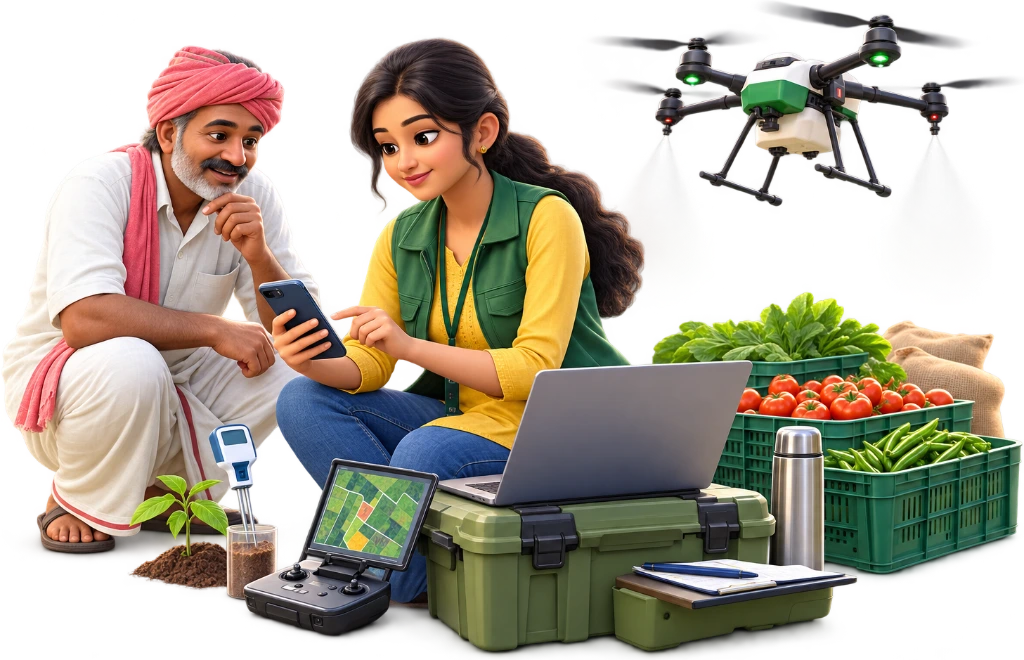
- Route in
- Typically B.Sc Agriculture. 1 course lead here
- Entrance
- Common Admission Test
- Entry pay
- ₹15,000 – ₹35,000 / monthly Any experience
- Experienced
- ₹120,000 / monthly 6–12 yrs
What the work involves
Day to day
Working in agriculture technology companies - farmer onboarding, supply chain and sourcing operations, agronomy advisory content, or product roles connecting farms to markets and credit.
Who this suits
Fit
Agriculture graduates who want the sector without the government examination route, and who like solving system problems. The pace is quick, responsibility comes early, and the problems - price discovery, logistics, credit access - are genuinely unsolved.
The honest reality
Read this one
Startup employment is less secure than the sector's visibility suggests, and agri-tech has seen sharp funding swings with layoffs following them. Field roles mean living in small towns whatever the head office looks like. Farmer adoption is slow and building trust takes longer than any investor deck assumes. Equity offered at early stage is frequently worth nothing.
What this work actually is
Understand the role
You will spend more time solving farm and supply problems than building technology. In a field operations role, you might organise crop input delivery, check whether a collection centre received produce, and fix a failed order with local staff. As an agronomy associate, you may advise farmers on crop practices, record field observations, and turn those observations into useful data for the team.
The work happens in villages, mandi-linked supply areas, warehouses, district offices and on farms. You may travel through one assigned geography and work with farmers, field officers, agronomists, drivers, procurement staff, product teams and data analysts. Some days involve dusty field visits and phone follow-ups. Others involve checking spreadsheets, reporting a metric, or explaining local farm problems to colleagues in a city office.
Your degree helps, but real farming knowledge decides whether people trust you. You need to understand crop seasons, local practices, input costs and why a farmer may reject advice that looks correct on a screen. People who do well combine agronomy with business sense and data analysis. You will often be judged on one metric, such as farmer adoption, order completion or produce quality, within one geography.
Skills that actually matter
Capability
Agri-tech work goes well when you understand what happens on a farm and can turn that knowledge into action across a district.
You need to explain an input, crop advisory, drone service or buying process in plain local language, listen to the farmer's problem, and follow up when the promised work is delayed.
How to build it. Spend a crop season with a farmer producer organisation, mandi trader, input shop or local agriculture office. Keep a notebook of 20 farmer conversations: crop, acreage, problem, cost and outcome. Practise explaining one advisory without English jargon.
You need enough crop knowledge to spot that a field problem may involve sowing time, irrigation, soil, pest pressure or poor-quality input, rather than blaming the app or the farmer.
How to build it. Use B.Sc Agriculture practicals seriously. Visit nearby farms through Krishi Vigyan Kendra activities or college extension work, and make crop notes for one local crop from sowing to harvest.
A field executive has to plan village visits, record orders, check service delivery, solve missed pickups or late supplies, and keep accurate records even when mobile connectivity is poor.
How to build it. Take a field internship with an agriculture business, FPO, warehouse, input dealer or rural development project. Learn to make a daily route plan, maintain a simple spreadsheet, and close each complaint with a dated action.
You will use data to see which villages are active, where orders drop, what farmers buy again, and whether a service is working in your assigned geography.
How to build it. Learn spreadsheets first: sorting, filters, SUMIF, pivot tables and simple charts. Download public crop or rainfall data for your district and build a one-page report that links a pattern to a field action.
You need to understand margins, delivery cost, repeat orders and payment delays. A useful farmer service still fails if each order loses money.
How to build it. Ask a local input retailer or produce buyer, if they agree, to explain one transaction from purchase to sale. Write down the selling price, transport, credit period, spoilage and margin. Use made-up names if you share the exercise publicly.
Field plans change because of rain, a broken vehicle, a farmer who is unavailable, a failed drone flight or stock that has not reached the village. You need to act without hiding the problem.
How to build it. During an internship or college project, take ownership of a small operational task such as coordinating a farm visit. After each setback, write what happened, who needed an update, what you changed and what you would do earlier next time.
Startups value people who notice an unmet need, test a small fix and take responsibility for a result instead of waiting for a detailed instruction.
How to build it. Pick one real issue around your college or village, such as farmers not knowing the day of a local market. Test a low-cost solution with ten users, track use for two weeks, and report honestly on what failed.
What separates the well paid from the average. The people who progress earn farmer trust, keep clean field data, and improve a business metric for a real geography rather than only knowing agriculture or technology in theory.
How people actually get in
Getting in
Most people enter through a B.Sc Agriculture, then spend time with farmers and build one usable skill such as agronomy or data analysis.
Take B.Sc Agriculture and learn how crops, inputs, seasons and local farm economics work. Add practical exposure through farm visits, field projects or an entry-level Field Operations Executive or Agronomy Associate role. You will still need to learn the technology or data side on the job.
Usually takes 3-4 years for the degree, then 6-12 months of real farm exposure.
Study engineering, then build a skill a startup can use, such as data analysis or work on farm technology. Spend time understanding actual farming before applying. A product that works in a lab can fail in a district because of crop cycles, connectivity or how farmers buy inputs.
Usually takes 3-4 years for the degree, plus 6-12 months of farm exposure.
A business degree can lead towards operations, supply chains or commercial work, but you need farm knowledge as well. Start with a role close to a geography or farmer network, learn the numbers, and take responsibility for a clear metric such as orders, collections or farmer retention.
Usually takes 3-4 years for the degree, then 1-2 years building a functional skill.
What people get wrong
Read this one
Agri-tech work sits between farms, supply chains and technology, so many common assumptions miss half the job.
- “It is mainly an app or drone job.” Field Operations Executives and Agronomy Associates spend time understanding crops, inputs, farmer practices and local conditions. The technology only works when it fits what happens on a farm.
- “A B.Sc Agriculture is the only route.” It is the main route, but agriculture, engineering or business degrees can lead in. You still need to learn real farming and build a usable skill such as agronomy, data analysis or business work.
- “You will work from an office in a big city.” Many roles involve a district or a defined geography, with regular field visits. Travel, farmer meetings and checking whether an input or service actually reached the farm are ordinary work.
- “Knowing farming is enough.” It is not. Startups track numbers such as farmer adoption, orders, delivery performance or crop outcomes, so business awareness and data analysis matter alongside agronomy.
- “Startup work has no long-term path.” After you learn the field and own a metric and geography, you can move towards leadership or start something of your own. Progress depends on results, not simply years spent in the role.
Where this leads
Outlook
Most careers here grow by taking responsibility for one farmer group, crop belt or business metric, then moving into product, supply or leadership work.
| Who employs | What it is like |
|---|---|
| Farm advisory and input platforms | You may support farmers with crop advice, inputs and follow-up through field visits, calls and local partners. Early pay often grows with your experience and the results in your assigned district. The pace follows sowing, pest and harvest cycles, and employers want practical agronomy plus trust with farmers. |
| Fresh produce supply-chain platforms | Work centres on moving fruits and vegetables from farms to buyers with less delay and waste. Field operations roles can mean early mornings, mandi coordination, quality checks and fixing a missed pickup. Pay is usually linked to role scope; employers look for sharp operations, data use and comfort with daily targets. |
| Agricultural drone and precision-farming companies | Teams sell, operate or support tools for crop surveys, spraying and farm data. Work mixes demonstrations, training, service coordination and reporting from the field. Smaller teams move quickly and offer broad work, but roles may change as the business finds customers and expands. |
| Farm machinery and irrigation businesses | You may help dealers, farmer groups or service teams adopt equipment and track its use. These employers often want someone who understands both the machine and the farm season. Work is more structured than a small startup, though travel across districts is common. |
| Food processors and organised farm-procurement teams | Procurement teams need reliable supply, traceability and quality checks for crops going into processing. The work involves farmer coordination, collection planning and records, with pressure around harvest periods. Employers value business awareness, crop knowledge and the ability to spot a quality problem early. |
| Agriculture-focused development organisations and producer-group projects | Projects work with farmer producer groups, extension programmes or market-linkage efforts. Pay and security depend on the project or contract, and reporting takes a fair share of the week. They want field credibility, clear data records and patience with group meetings. |
Working reality
Read this one
Work-life balance scores lowest because field visits, crop seasons and startup targets often stretch the day, especially when you own a district or farmer network.
What it pays
Indicative
Most entry roles pay monthly, and field travel or incentives can change the final amount.
What decides where you land in the range. Your pay depends most on city, how much field travel the role needs, crop and data skills, the startup’s funding stage, incentives, and how well you negotiate.
The route in, step by step
6 steps from where you are now.
A degree in agriculture, engineering or business Required
Agri-tech hires from all three, and the mix is the point.
Understand real farming, not just the technology Required
Time in the field, with farmers, in a season. The graveyard of Indian agri-tech is full of well-built products that solved a problem farmers did not have.
Build a functional skill Required
Agronomy advisory, supply chain and procurement, data and remote sensing, or product management. Startups hire for a slot, not for enthusiasm.
Join a startup Required
Farm advisory platforms, output market linkage, agri-fintech, farm equipment rental or input e-commerce. Expect broad responsibility early and less structure than a corporate.
Own a metric and a geography Required
Farmer acquisition, retention, procurement cost or credit loss, in a defined region. Rural unit economics are unforgiving and that is what you will be measured on.
Leadership, or found something Optional
Functional leadership in a growing company, or your own venture with the sector knowledge you have built.
Courses that lead here
1 mapped route into this career.
Exams on the way
What is required, and what is optional.
Exam rules and eligibility are revised regularly. Check the current official notification for your admission year before you act on anything here.
The roles this becomes
2 lanes out of the same starting point.
What it pays
Indicative bands, 3 ways to read them.
| Stage | Pay band | What changes |
|---|---|---|
| 0–1 yrs | ₹15,000 – ₹30,000 / monthly | Graduate trainee or first field assignment; travel reimbursement may sit outside fixed pay. |
| 1–3 yrs | ₹22,000 – ₹42,000 / monthly | You handle a farmer cluster, district operations, crop advisory or reporting with less supervision. |
| 3–6 yrs | ₹35,000 – ₹65,000 / monthly | You own a geography, team target, partner network or crop programme. |
| 6–12 yrs | ₹55,000 – ₹120,000 / monthly | Pay rises when you lead multi-district operations, agronomy programmes or a business metric. |
| Specialisation | Pay band | What changes |
|---|---|---|
| Field Operations Executive | ₹15,000 – ₹35,000 / monthly | Daily village travel, farmer coordination and installation or collection targets keep fixed pay lower in many districts. |
| Agronomy Associate | ₹20,000 – ₹45,000 / monthly | Stronger crop knowledge, trial work and data-based advisory usually place this role above basic field operations. |
| City | Pay band | What changes |
|---|---|---|
| Lucknow | ₹15,000 – ₹32,000 / monthly | Offers are commonly tied to crop season workload, local language skills and field coverage. |
| Jaipur | ₹15,000 – ₹32,000 / monthly | District field roles form much of the market, with allowances varying by employer. |
| Indore | ₹16,000 – ₹34,000 / monthly | Operations and procurement-linked work may include travel or performance payments outside fixed pay. |
| Pune | ₹18,000 – ₹38,000 / monthly | Pay changes with travel across rural Maharashtra and the size of the farmer network. |
| Hyderabad | ₹20,000 – ₹40,000 / monthly | Better offers tend to go to crop advisory, operations planning and technical support work. |
| Bengaluru | ₹22,000 – ₹45,000 / monthly | Product, data and central-team roles lift offers; field roles still depend on assigned districts. |
These are ranges, not offers. Pay varies by city, employer size, sector and your own skill more than by job title. Treat the band as the shape of the market, not as a number you can hold anyone to.
Common questions
The ones people actually ask about this work.
What kinds of jobs exist in agri-tech?
<p>Field operations and farmer onboarding, agronomy advisory, supply chain and procurement, quality assessment, product management, data and remote sensing analysis, and sales to farmer producer organisations and input dealers. Field-facing roles are the largest in number and the ones agriculture graduates are specifically suited to.</p>
Is a startup a good first job for an agriculture graduate?
<p>It can be excellent for learning — broad responsibility early, direct farmer contact, and exposure to the commercial side that a government or input-company role would take years to give. The trade-offs are real: less job security, funding-dependent stability, and pay that varies widely. Judge the company on whether it has revenue and customers, not on how much it has raised.</p>
What skills matter most?
<p>Credibility with farmers above everything — agronomy knowledge, the local language, and willingness to be in the field rather than on a call. After that, comfort with data and digital tools, and commercial understanding of what a farmer will actually pay for, which is a much shorter list than most agri-tech companies initially assume.</p>
Where does this lead?
<p>Into operations and category management within the sector, into agri-input and food companies which value startup field experience, into farmer producer organisation management, or into starting something yourself — several agri-tech founders came from operating roles in earlier companies.</p>
Test this against your own priorities
Pay, hours and entry route matter differently to different people. Compare this against the alternative you are actually weighing, rather than against the average.