
Agricultural Engineer
Last updated · Confirm dates, fees and eligibility on the official website before you apply.
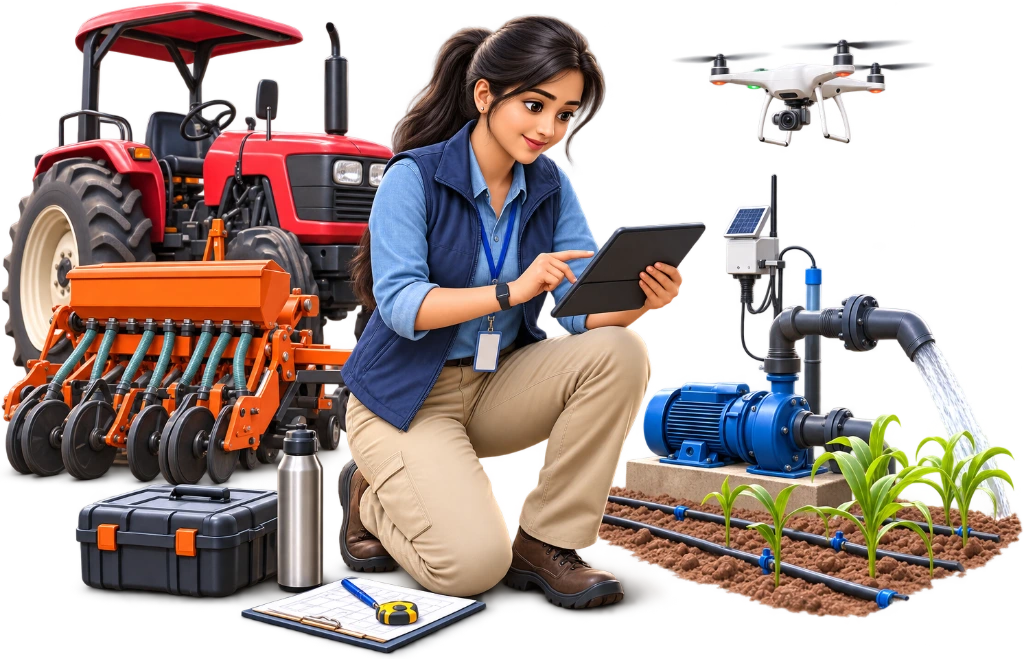
Applies engineering to farming - machinery, irrigation, post-harvest equipment and farm structures - for manufacturers, dealerships, government schemes or on farms directly. Fieldwork rather than desk work for most of the career.
- Route in
- Earliest entry: Diploma. Also entered at: Diploma, Undergraduate. Junior. 2 courses lead here
- Entry pay
- ₹14,000 – ₹26,000 / monthly Any experience
- Where you work
- Farm machinery manufacturers, Irrigation departments, Agri equipment dealerships, Krishi Vigyan Kendras
How people get in
Getting in
Earliest entry point. Diploma level.
Other levels people enter from. Diploma, Undergraduate.
How the role is usually reached. Junior.
Where people work
Outlook
Farm machinery manufacturers, Irrigation departments, Agri equipment dealerships, Krishi Vigyan Kendras.
Indicative starting salary
Understand the role
14,000 - 26,000 per month at entry level.
This is an indicative range, not a quote. Actual pay varies with employer, city, sector and the specific role.
What this work actually is
Understand the role
You work on the physical systems that keep a farm running, rather than advising farmers mainly on crops or soil. You might select a pump and pipe layout for irrigation, test a seed drill, improve a grain dryer, or design a shed for storing equipment. Your work must suit the field size, water source, soil condition, budget and local repair options.
Much of the job happens outside the office. You may inspect a farm, measure water flow, watch machinery during use, or visit a dealer workshop where a tractor attachment needs fixing. Agricultural engineers work with farmers, mechanics, equipment sales teams, irrigation department staff and scientists at Krishi Vigyan Kendras. Manufacturers and government schemes also need engineers who can explain equipment in plain terms.
The work rewards practical judgement as much as technical design. A design that looks correct on paper fails if spare parts are unavailable in a district or the farmer cannot maintain it. Expect travel, heat, mud, delayed site visits and repeated checks of the same machine. People who do well learn to diagnose faults patiently and adapt standard equipment to real farm conditions.
What you actually do
Day to day
You spend much of your time at farms, dealer yards or project sites, making machinery, irrigation and farm equipment work in local soil and crop conditions.
- Inspect pumps, drip lines, sprinklers or machinery at a farm or installation site
- Measure field slope, water flow and soil conditions before suggesting an irrigation layout
- Trace faults in equipment such as blocked filters, leaking pipes, worn belts or poor machine settings
- Prepare drawings, estimates or equipment specifications for a farm structure or system
- Explain safe operation and routine maintenance to farmers, operators or dealership staff
- Visit farms to check whether an irrigation or machinery recommendation is working
- Compare equipment capacity with the acreage, crop and labour available on a farm
- Coordinate deliveries, installation work and repair visits with dealers, technicians or contractors
- Record water-use readings, machine faults, costs and farmer feedback in reports
- Discuss design changes when a system does not suit the field conditions
- Check pipe alignment, pump placement and pressure before an irrigation system is handed over
- Test post-harvest equipment such as dryers, threshers or grading units with actual produce
- Adjust machine settings to reduce grain damage, fuel waste or repeated blockages
- Inspect farm sheds, storage areas or equipment foundations for practical construction problems
- Return to site when a breakdown stops irrigation, planting or harvesting work
- Survey farms and prepare technical details for irrigation or farm-equipment proposals
- Verify installed equipment against the approved design and site measurements
- Submit inspection notes, cost estimates and progress reports to the department or project team
- Attend demonstrations where farmers see how to operate a new machine or irrigation system
The part people are surprised by. A large part of the job is follow-up: travel, measurements, calls and paperwork after the design work is finished.
Who this suits
Fit
Agricultural engineering suits you if you would rather solve a real farm problem, such as uneven irrigation or a broken thresher, than spend most days at a desk.
- You enjoy finding why a machine fails. You will check a clogged filter, a worn belt or an incorrect setting before suggesting a replacement.
- You do not mind field visits in heat, dust and mud. Much of the work happens on farms, at machinery sites or around irrigation systems, not in an air-conditioned office.
- You like Physics and Mathematics when they lead to a practical result, such as sizing a pump, planning a water channel or designing a grain-storage structure.
- You can explain a technical point in simple words to a farmer, dealership technician or government scheme worker, then listen when they say what goes wrong in daily use.
- You have patience for measuring, testing and adjusting. A better implement often comes after repeated checks, not one clever drawing.
- You are comfortable with work that mixes engineering and farming. You need interest in both, because a design that looks good on paper may fail if it ignores soil, water, crop timing or local repair options.
- This is not for you if you want a job with only computer-based design work or dislike travelling to farms and handling practical problems in the field.
Skills that actually matter
Capability
You need to solve practical farm problems in heat, dust and uneven field conditions, then explain a workable fix to the people using it.
You diagnose why a pump gives poor flow, a thresher jams, or a machine fails on wet soil, then choose a fix that suits the farm and budget.
How to build it. During your diploma or B.Tech, take one local problem, such as uneven irrigation in a village plot, measure it, list likely causes and test two fixes. Keep photographs, readings and a short report in a phone folder.
You read drawings and turn a farm need into equipment, a pipe layout, a grain-storage arrangement or a safer machine part. A design must survive real loads and allow repairs.
How to build it. Learn basic CAD through your college lab or free beginner lessons, then redraw an existing implement such as a seed drill or trolley. Add dimensions, materials and a simple cost sheet to your portfolio.
A drawing alone will not show loose soil, poor drainage, irregular plots or a farmer's repair habits. You need to notice these details before suggesting equipment or irrigation changes.
How to build it. Visit nearby farms, Krishi Vigyan Kendras, equipment dealerships or agricultural exhibitions. For each visit, write down the crop, soil condition, machine used, fault seen and how the operator dealt with it.
You explain settings, maintenance and safety in plain language. You also need to listen when an operator says a machine is difficult to use, even if the drawing looks correct.
How to build it. Ask to demonstrate one college project to a small group in your district. Explain it first in English, then in the language most people use locally, and ask them to point out what they did not understand.
You work with pumps, pipes, sprinklers, drip systems, drainage and water flow. Wrong pipe size or poor layout wastes water and gives uneven irrigation.
How to build it. Use a small plot, garden or college demonstration area to measure discharge from a pipe over five minutes. Draw the layout, calculate water delivered, and compare it after changing a nozzle or pipe diameter.
Farm equipment needs inspection, lubrication, adjustment and safe operation. You should spot worn belts, loose guards, poor tyre pressure and unsafe power connections before they cause damage.
How to build it. Spend part of an internship or vacation at an agri-equipment workshop or dealership. Maintain a log of each service job: complaint, parts checked, repair done, tools used and safety steps.
You use measurements for field levels, flow rate, moisture, machine output and fuel use. Clear records help you show whether a change actually improved the work.
How to build it. For a college project, record ten runs of a small machine or irrigation setup in a spreadsheet. Track time, area covered, fuel or electricity used, output and faults, then make one simple chart.
Installation and field trials involve farmers, mechanics, suppliers and sometimes government scheme staff. Parts arriving late or work planned during harvest can stop the job.
How to build it. Plan a college field project with a one-page schedule, materials list and backup plan for rain or missing parts. Take charge of follow-up calls and update the group after each visit.
What separates the well paid from the average. Better-paid engineers turn field observations into designs and service plans that farmers and technicians will actually use, rather than producing neat drawings that fail outside the workshop.
The honest part
Read this one
Most agricultural engineering work happens outside a clean office. You will inspect pumps, machinery or storage structures in heat, dust and rain, then explain faults to farmers, mechanics or dealers in simple words. A design that works on paper may fail because water pressure drops, a spare part is unavailable, or the farm cannot afford it. Travel to villages and districts is common.
Your first two years often involve site visits, measurements, installation checks, service complaints and reports rather than designing new machines. You may start on a contract role or with a dealership, where targets and customer follow-up take time. Some people leave for general mechanical jobs, government exam preparation, farm equipment sales, or family farming because they want steadier hours, less travel, or work closer to home.
What people get wrong
Read this one
Agricultural engineering is practical field engineering, and most jobs involve farms, equipment sites or government schemes rather than a desk all day.
- “It is only about driving tractors.” You work on machinery selection and repair, irrigation systems, post-harvest equipment and farm structures. Technical design and problem solving matter as much as knowing how a machine runs.
- “You must do a B.Tech to enter.” A Diploma in Agricultural Engineering is also an entry route, especially for junior roles. Your later work experience and specialism still matter.
- “It is a city office job with an agriculture label.” Much of the work happens on farms, at dealerships, with manufacturers or during scheme work in districts. Expect travel, site visits, dust, heat and time spent checking whether equipment works in real conditions.
- “There are no jobs outside government.” Irrigation departments and Krishi Vigyan Kendras do employ people, but manufacturers and agri-equipment dealerships also need engineers. Government exams are one route, not the only route.
- “It has no future because farming is traditional.” Farms still need better irrigation, machinery and post-harvest systems. The work is often less glamorous than people expect, with breakdown checks, measurements and paperwork, but it can lead towards senior technical work or an agri-machinery business.
Working reality
Read this one
Job availability scores lowest because entry roles depend on local farm activity, equipment dealers, manufacturers and government projects in your state or district.
The route in, step by step
6 steps from where you are now.
Class 12 with Physics, Chemistry and Mathematics Required
PCM for the engineering route; some programmes accept biology as well.
Diploma or B.Tech in Agricultural Engineering Required
Three years for the diploma, four for the degree. Farm machinery, irrigation, soil and water conservation, and post-harvest processing.
Choose a specialism Required
Farm machinery and power, irrigation and water management, or food and post-harvest engineering. They lead to different employers entirely.
Work in industry or government Required
Tractor and implement manufacturers, irrigation companies, food processing plants, or state agriculture and minor irrigation departments.
Sit government examinations, or deepen technically Required
State PSC agricultural engineer posts and ICAR recruitment, or an M.Tech towards research and design.
Senior engineer, or agri-machinery business Optional
Design and product roles, government service, or a custom hiring and machinery business, which is an established rural enterprise.
Courses that lead here
2 mapped routes into this career.
The roles this becomes
6 lanes out of the same starting point.
What it pays
Indicative bands.
| Stage | Pay band | What changes |
|---|---|---|
| Any experience | ₹14,000 – ₹26,000 / monthly | Varies by employer |
These are ranges, not offers. Pay varies by city, employer size, sector and your own skill more than by job title. Treat the band as the shape of the market, not as a number you can hold anyone to.
Common questions
The ones people actually ask about this work.
What qualification do you need to become a Agricultural Engineer?
The earliest entry point is diploma level. People also enter from: Diploma, Undergraduate.
Where does a Agricultural Engineer usually work?
Farm machinery manufacturers, Irrigation departments, Agri equipment dealerships, Krishi Vigyan Kendras.
What does a Agricultural Engineer earn to start?
14,000 - 26,000 per month is a typical entry-level range. Pay varies with employer, city and sector.
Test this against your own priorities
Pay, hours and entry route matter differently to different people. Compare this against the alternative you are actually weighing, rather than against the average.