
Agronomist
Last updated · Confirm dates, fees and eligibility on the official website before you apply.
Advises on crop production - variety, soil, nutrition, protection and timing - for farmers, agri-input companies, cooperatives or plantations. The advice is judged by yield, so field credibility matters.
- Route in
- Earliest entry: Undergraduate. Also entered at: Undergraduate, Postgraduate. Direct entry. 2 courses lead here
- Entry pay
- ₹20,000 – ₹40,000 / monthly Any experience
- Where you work
- State agriculture departments, ICAR research institutes, Public and private sector banks (agri loan roles), Seed and fertiliser companies (Bayer
How people get in
Getting in
Earliest entry point. Undergraduate level.
Other levels people enter from. Undergraduate, Postgraduate.
Where people work
Outlook
State agriculture departments, ICAR research institutes, Public and private sector banks (agri loan roles), Seed and fertiliser companies (Bayer.
Indicative starting salary
Understand the role
20,000 - 40,000 per month at entry level.
This is an indicative range, not a quote. Actual pay varies with employer, city, sector and the specific role.
What this work actually is
Understand the role
An agronomist turns crop science into advice a farmer can use this season. Unlike a researcher who may focus on trials and papers, you help decide the variety, sowing time, fertiliser dose, irrigation, weed control and crop protection plan for a real field. Your work is judged by what happens at harvest: yield, crop quality, input cost and whether the recommendation suited that soil and weather.
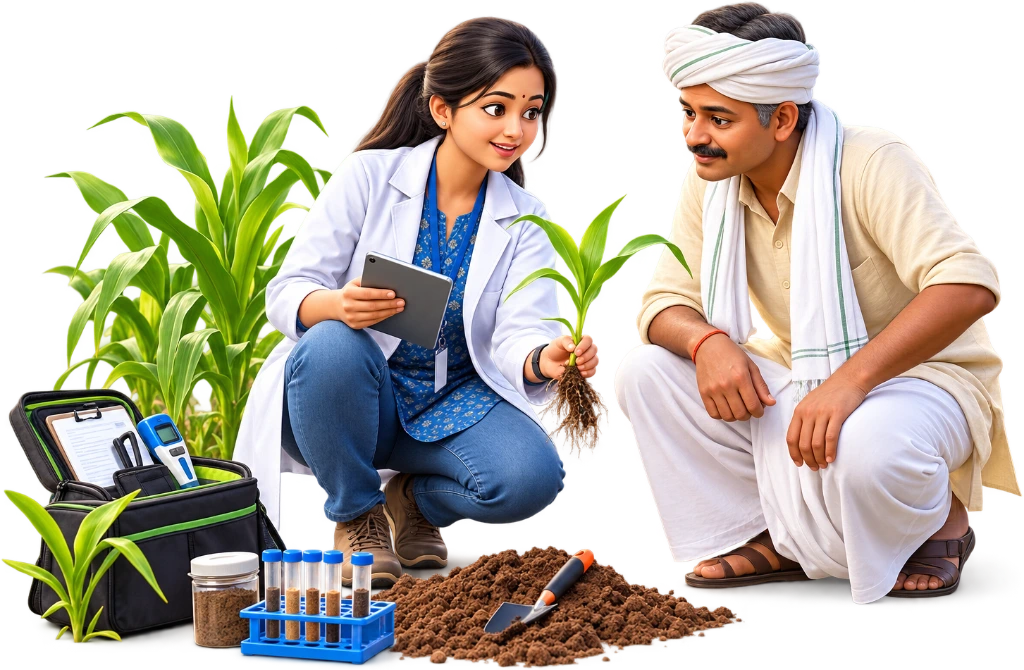
You may visit farms, check leaves for pest or nutrient signs, take soil samples and compare plots. Work also happens in state agriculture departments, ICAR research institutes, cooperatives, plantations, seed and fertiliser companies, and bank roles linked to agricultural loans. You work with farmers, field officers, scientists, dealers and sometimes sales teams. Some days involve village visits; others mean writing reports, recording trial results or explaining a crop plan to a group.
Field credibility matters more than sounding technical. A recommendation that works for paddy in one district may fail in another because of soil, rainfall, water access or local pests. People who do well usually build depth in a crop and region, such as cotton in a dry belt or vegetables near a tier-2 city market. You need patience for repeat visits, seasonal pressure and results that weather can still upset.
What you actually do
Day to day
You spend much of the job turning soil, crop and weather observations into advice a farmer can use for the next field operation.
- Walk crop fields and check plant growth, leaf colour, pest damage and weed pressure.
- Inspect soil condition, drainage and signs of nutrient deficiency.
- Recommend a crop variety, sowing window, fertiliser dose or crop-protection step for the field conditions.
- Record crop stage, field observations and advice given to farmers or clients.
- Speak with farmers to find out what was applied, when irrigation happened and what problem appeared first.
- Review rainfall, temperature and irrigation records against the crop stage.
- Visit demonstration plots or crop trials and compare treated and untreated sections.
- Collect soil, water or plant samples when a field problem needs testing.
- Plan farmer meetings, field demonstrations or training sessions on crop practices.
- Share field findings with sales, research or agriculture-department teams.
- Help plan land preparation, seed treatment and sowing or transplanting schedules.
- Check whether fertiliser and irrigation timing suits the crop's growth stage.
- Identify pest, disease or nutrient problems before they spread across the field.
- Assess crop maturity and advise on harvest timing to reduce losses.
- Compare yield and crop quality with the plan made at the start of the season.
- Prepare field reports with crop performance, input use, yield and farmer feedback.
- Review failed plots and separate weather damage from problems caused by timing, soil or crop management.
- Update crop plans for the next season using local rainfall, soil and pest patterns.
- Present trial results or advisory findings to clients, cooperatives, research teams or state agriculture staff.
The part people are surprised by. A large part of the work is careful follow-up, because advice given at the wrong crop stage is often useless even when it is scientifically correct.
Who this suits
Fit
Agronomy suits you if you like turning field observations, soil conditions and crop records into advice a farmer can test in the next season.
- You notice that one patch in a field is shorter, yellower or flowering later than the rest, and you want to find the reason instead of calling it ‘poor crop’.
- You are comfortable spending days outdoors in heat, dust and rain, visiting farms, checking plots and speaking with farmers. Much of the work happens away from an office desk.
- You can explain a fertiliser dose, seed choice or pest-control timing in plain language, then listen when a farmer says the advice will not fit their water supply, budget or labour.
- You do not mind keeping careful notes on sowing dates, rainfall, soil tests, pest incidence and yield. A good recommendation needs records, not a confident guess.
- You accept that results take time. You might advise on a crop today and learn whether it worked only at harvest, with weather affecting the outcome.
- You can balance crop science with business limits. An input company, cooperative, plantation or bank-linked agri role will expect advice that farmers can afford and use.
- This is probably not for you if you want predictable indoor work with little travel, or if you dislike being judged by crop performance rather than by a report alone.
Skills that actually matter
Capability
An agronomist earns trust by giving crop advice that works in a farmer’s field, not only on a college plot.
You need to connect crop stage, variety, soil condition, nutrient need, weeds, pests, disease and weather before recommending an action.
How to build it. During B.Sc Agriculture, keep one notebook for a local crop each season. Visit farms through your college, Krishi Vigyan Kendra activities or a cooperative, record sowing date, inputs and crop condition, then compare your observations with the farmer’s final yield.
You must spot uneven germination, nutrient deficiency, water stress, pest damage and weed pressure while walking a field. Heat, mud, travel and repeated farm visits are routine.
How to build it. Join college field trials, NSS farm visits or seasonal work with a local input dealer or farmer group. Learn to inspect plants in a fixed pattern and take clear photos with the date, village, crop stage and symptoms.
A correct recommendation fails if a farmer cannot afford it, does not understand the dose, or has already had poor advice from others. You need to listen before you prescribe.
How to build it. Practise explaining one recommendation in the local language to a family member or farmer. At each visit, ask what was applied, how much land is involved and what the farmer can spend, then write the advice in simple steps.
You need to read soil-test results and turn them into practical fertiliser, organic matter, irrigation and drainage advice for the crop and soil type.
How to build it. Learn soil sampling properly in college. Collect samples from different plots with permission, follow the sampling method used by a soil-testing lab, and make sample nutrient plans rather than copying one fertiliser dose for every field.
You need to tell a disease from insect injury, nutrient deficiency or herbicide damage. Wrong identification can waste a spray and damage the crop.
How to build it. Make a photo log of symptoms seen on local crops, with crop stage and field conditions. Compare it with university extension material and ask an agriculture faculty member or experienced field officer to check your diagnosis.
Field notes, rainfall, input doses, trial results and yield records help you see what worked. This is also the unglamorous part of advisory and research work.
How to build it. Use a notebook or free spreadsheet app to track a small demonstration plot or a relative’s farm. Record dates, seed rate, fertiliser, sprays, irrigation, cost and harvest, then calculate yield per acre or hectare.
Advice has to fit the farmer’s cash flow, local input availability and market risk. In an agri-input company or bank-linked role, you also need to understand product cost and repayment pressure.
How to build it. Visit a mandi and two local input shops during a crop season. Note crop prices, common seed and fertiliser packs, and the difference in cost between two treatment choices. Discuss why a farmer might choose the cheaper option.
What separates the well paid from the average. Better-paid agronomists build a record of advice that improves yield or cuts avoidable cost in a specific crop and region, then communicate it in a way farmers act on.
The honest part
Read this one
The hard part is that crops do not follow a timetable. In the first two years, you may spend long days visiting farms, checking soil, pest damage and irrigation, then writing reports or explaining the same advice to many growers. Rain, heat, market prices and a pest outbreak can overturn a good plan. Farmers judge you by what happens in the field, not by how well you spoke in class.
Early roles often involve demonstration plots, sales support for seed or fertiliser, data collection, or field trials under a senior agronomist. You need patience with travel, local languages and repeated follow-up. Some people leave for bank agri-loan work, government exam routes, farm management, input sales, research, or other jobs with steadier hours and less seasonal pressure.
What people get wrong
Read this one
Agronomy is practical crop work, and your advice earns trust only when it works in a farmer’s field.
- “An agronomist only works in a laboratory.” Much of the job happens on farms: checking soil, crop stage, pests, water and whether a recommendation suits that district.
- “You only need to know fertilisers.” You must connect seed variety, soil nutrition, sowing time, crop protection and local weather. A good dose on the wrong day can still waste a farmer’s money.
- “This is a dead-end job with only farm visits.” Agronomists also work in state agriculture departments, ICAR research institutes, cooperatives, plantations, agri-input companies and agri-loan roles in banks.
- “A B.Sc Agriculture automatically makes you an agronomist.” It gets you started, but field credibility comes from seeing crop results over seasons. An M.Sc in Agronomy or a crop and region specialism can deepen your work.
- “The work is glamorous because you advise farmers.” Some days mean travel on rough roads, heat, mud, repeated field records and explaining the same practice to different farmers. Yield results, not presentation, decide whether people trust your advice.
Working reality
Read this one
Entry roles are limited, government posts face heavy competition, and private employers usually want proof that you can advise farmers in local crop conditions.
The route in, step by step
6 steps from where you are now.
Class 12 with Physics, Chemistry and Biology Required
The science base.
B.Sc Agriculture Required
Four years. Agronomy is a specialisation within it, so use the electives and the project deliberately.
M.Sc in Agronomy Required
Two years, entered through ICAR AIEEA PG or a state agricultural university test. Agronomist as a job title generally means a postgraduate.
Work in the field or in research Required
Seed and agrochemical companies, agri-input firms, plantations, or research stations. Company agronomists spend most of their time with farmers, not in laboratories.
Build a crop and region specialism Required
Cropping systems, soil fertility, precision agriculture or protected cultivation. Agronomy advice is region-specific and that specificity is your value.
Senior agronomist, Ph.D., or advisory Optional
Technical lead in industry, a Ph.D. towards research and teaching, or independent advisory to large farms and FPOs.
Courses that lead here
2 mapped routes into this career.
The roles this becomes
6 lanes out of the same starting point.
What it pays
Indicative bands.
| Stage | Pay band | What changes |
|---|---|---|
| Any experience | ₹20,000 – ₹40,000 / monthly | Varies by employer |
These are ranges, not offers. Pay varies by city, employer size, sector and your own skill more than by job title. Treat the band as the shape of the market, not as a number you can hold anyone to.
Common questions
The ones people actually ask about this work.
What qualification do you need to become a Agronomist?
The earliest entry point is undergraduate level. People also enter from: Undergraduate, Postgraduate.
Where does a Agronomist usually work?
State agriculture departments, ICAR research institutes, Public and private sector banks (agri loan roles), Seed and fertiliser companies (Bayer.
What does a Agronomist earn to start?
20,000 - 40,000 per month is a typical entry-level range. Pay varies with employer, city and sector.
Test this against your own priorities
Pay, hours and entry route matter differently to different people. Compare this against the alternative you are actually weighing, rather than against the average.