
Air Force Agniveer (Y group)
Last updated · Confirm dates, fees and eligibility on the official website before you apply.
technical trades need 12th
- Route in
- Typically ITI trade certificate or Diploma in Engineering (Polytechnic). 3 courses lead here
- Entry pay
- ₹30,000 – ₹33,000 / monthly 0–1 yrs
- Experienced
- ₹40,000 / monthly 3–4 yrs
What the work involves
Day to day
Non-technical and support trade service in the Air Force - administration, logistics, medical assistance, security and ground support functions keeping air operations running.
Who this suits
Fit
Class 12 pass candidates wanting Air Force service. Working conditions and stations are generally better than the other services, the training is professional, and administrative and logistics experience transfers cleanly to civilian employment.
The honest reality
Read this one
Competition is high and the written and physical standards are demanding. Support trades offer less of the flying-adjacent experience many applicants imagine. The same short-service exit applies - most will leave in their early twenties without pension, so use the term to complete a degree through distance study and build a certified skill. Verify the current terms of the scheme when you apply rather than relying on secondhand information.
What this work actually is
Understand the role
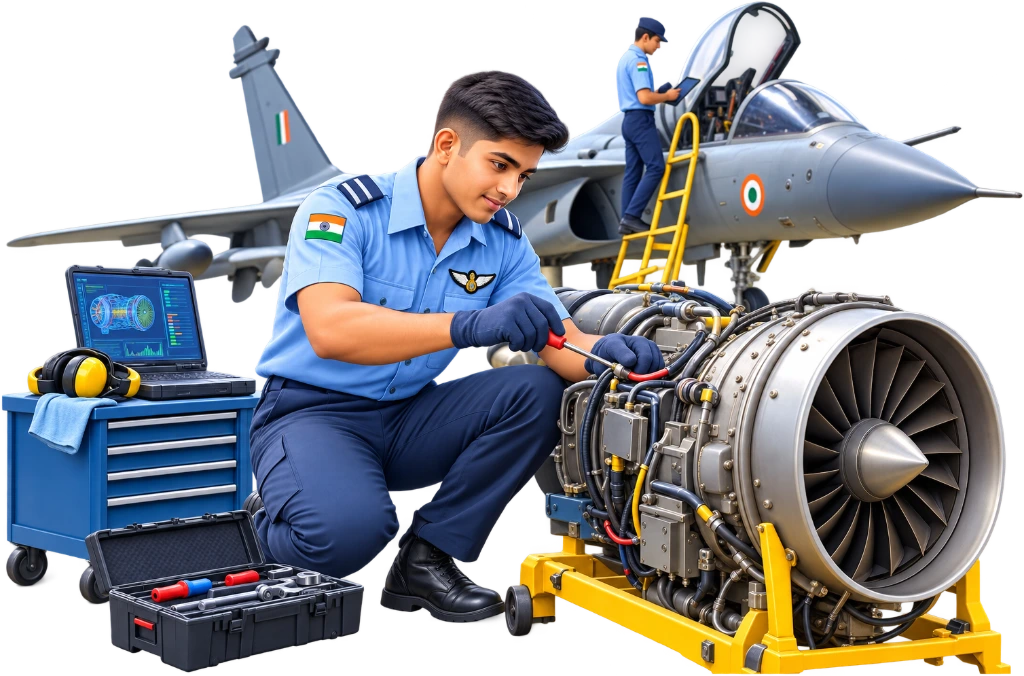
You work on the technical side of Air Force operations, rather than flying aircraft or planning missions. As an Agniveer in the Y group, you train for a trade after selection and carry out assigned technical duties with strict procedures. Your work must meet service standards because a missed check, wrong record, or poor handover can affect the next team’s work.
Most work happens at Air Force stations, workshops, technical sections, hangars, stores, or other service units. You work in a unit with airmen, officers, instructors and other Agniveers. The day follows timings, drill, fitness, training, inspections and duty rosters. You may spend long periods maintaining equipment records, learning procedures, cleaning and preparing work areas, or waiting for the next task.
Understand the four-year term before you apply. Training and trade allocation shape the work you do, and retention is not assured for everyone. Discipline, fitness, teamwork and the ability to learn technical procedures matter as much as your Class 12, ITI or diploma background. On exit, your trade experience may support civil aviation or technical work, but you should plan that next step early.
Skills that actually matter
Capability
You need disciplined physical preparation, comfort with technical systems and the habit of working exactly to procedure.
You must report on time, follow orders and safety rules, maintain kit, and complete routine tasks properly even when nobody is checking.
How to build it. Keep a fixed waking, exercise and study timetable for 12 weeks. Use a paper log, and ask a teacher, NCC instructor or family member to check it weekly.
Selection includes a physical fitness test, and training demands stamina, strength, mobility and recovery. Fitness work cannot be left until after the online examination.
How to build it. Start with walking or running, bodyweight squats, push-ups and core work four to five days a week. Increase slowly, record your timings, and train on an open ground or school field if you do not have a gym.
Technical and operational work depends on checklists, correct tool use, clean records and immediate reporting of faults. Guesswork around equipment is unsafe.
How to build it. During ITI, diploma practicals or school lab work, practise reading the full instruction sheet before starting. Make your own checklist for each task and get the instructor to point out missed steps.
You work in a unit, where handovers, clear communication and helping the group finish matter more than doing your own part alone.
How to build it. Take a defined role in NCC, sports, college practical groups or community events. Practise giving short updates: what is done, what is pending, and what problem needs help.
An ITI trade certificate or Polytechnic diploma helps you understand tools, components, drawings and faults. Trade allocation during training decides the exact work you learn.
How to build it. Use ITI or Polytechnic workshop sessions seriously. Learn to identify parts, read basic diagrams and write down why a fault occurred, rather than only copying the practical record.
A wrong number in a log, an unchecked connection or poorly maintained equipment can delay work and create a safety risk.
How to build it. In practical work, check measurements, labels and tool counts twice before submitting. Review one page of your notes each day for small errors such as units, dates and missing steps.
Training, tests, shared living and strict routines put pressure on you. You need to accept correction, recover after a poor performance and continue working.
How to build it. Use timed mock tests and regular fitness targets to practise working under pressure. After each setback, write one mistake, one fix and the date you will try again.
What separates the well paid from the average. The stronger Agniveers are trusted with equipment and people because they stay accurate, calm and dependable during routine work, not because they only perform well in the selection test.
How people actually get in
Getting in
Most entrants prepare through an ITI trade certificate or Polytechnic diploma, then clear the online examination, physical fitness test and medical.
Complete an ITI trade certificate in a relevant technical trade. Prepare for the online examination for 6 to 12 months, then clear the physical fitness test and medical. If selected, you complete training and receive a trade allocation under the four-year Agniveer term.
Usually takes Selection preparation and tests usually take 9 to 18 months, followed by a four-year term..
After Class 10, complete a three-year Diploma in Engineering at a Polytechnic. Apply through the Agniveer process, prepare for the online examination, and meet the physical and medical standards. Your diploma gives you a technical base, but selection still depends on every stage of recruitment.
Usually takes Three-year diploma, then usually 9 to 18 months for preparation and selection, followed by a four-year term..
Finish Class 12 and prepare for the online examination. You also need disciplined fitness work for the physical test and must clear the medical. Successful candidates enter training before trade allocation and serve on the four-year Agniveer term.
Usually takes Usually 6 to 12 months of exam preparation and 3 to 6 months for physical and medical stages, followed by a four-year term..
What people get wrong
Read this one
The biggest mistake is treating this as a permanent Air Force job from day one.
- “Agniveer Y group means you will serve in the Air Force until retirement.” No. The term is four years, after which some people may be retained and others exit into civil aviation or technical work.
- “It is only for students who are strong in sports.” Physical fitness and medical standards matter, but you also need to prepare for the online exam and learn a technical trade.
- “Only Class 12 science students have a route.” Class 12 is one route, but Class 10 plus a three-year diploma also appears in the entry pathway. An ITI trade certificate or Polytechnic diploma is usually useful for technical trades.
- “Training means you choose your exact job on day one.” Trade allocation happens during training, so you should be ready for disciplined work, teamwork and technical learning rather than one fixed posting.
- “Leaving after four years means you have failed.” It does not. The experience can support a move into civil aviation or technical roles, though you will still need to compete for jobs like other applicants.
Where this leads
Outlook
Your first four years are in the Indian Air Force under the Agnipath scheme; after that, you may seek retention or move into civil aviation and technical work.
| Who employs | What it is like |
|---|---|
| Indian Air Force | This is the entry employer for an Agniveer (Y Group). Work follows a strict chain of command, fixed routines and trade allocation after training. You need discipline, fitness, teamwork and care with technical procedures. The four-year term gives structure, but it is not the same as permanent service. |
| Civil aviation operations | Airports, airlines and aviation support organisations need people who can follow safety procedures, work shifts and keep accurate records. The pace rises during delays, weather disruption and peak travel periods. Employers will look for relevant technical skills, a clean work record and comfort with shift duty. |
| Aircraft maintenance and repair organisations | Maintenance work is methodical. Much of the day involves inspections, tools, parts records and following approved instructions, rather than working around aircraft all the time. Employers value technical training, attention to detail and evidence that you work safely with a team. |
| Aerospace and defence manufacturing | Factories and engineering units make, assemble, test or repair equipment and components. Contract roles are common at entry level, especially outside large cities. The work rewards people who can read procedures, meet quality checks and report faults instead of hiding them. |
| Public sector technical organisations | Some PSUs and government technical bodies recruit for trade and maintenance work through their own notices or government exams. Jobs can offer more stability than a contract role, but selection is competitive and the joining process may take time. They usually want the exact trade qualification stated in the notice. |
Working reality
Read this one
Job availability scores lowest because selection is competitive, with an online exam, physical test and medical clearance before a four-year term.
What it pays
Indicative
The government package rises during the four-year term; these are gross monthly amounts before deductions.
What decides where you land in the range. Your service year under the Agniveer terms sets the package, so city, trade allocation and salary negotiation do not usually change it.
The route in, step by step
6 steps from where you are now.
Class 12, or Class 10 plus a three-year diploma Required
Y group generally requires Class 12 in any stream with the prescribed marks, or a three-year engineering diploma. X group requires Class 12 with Physics and Mathematics.
Understand the four-year terms Required
Agnipath applies to the Air Force in the same way - four years, up to twenty-five per cent retained into the regular cadre, the remainder discharged with Seva Nidhi and no pension.
Prepare for the online examination Required
English, reasoning and general awareness for Y group, with physics and mathematics added for X group. The Air Force paper is more academic than the Army rally route.
Clear the physical fitness test and medical Required
A 1.6 kilometre run within the set time, push-ups and sit-ups, then a demanding medical. Air Force medical standards are the strictest of the three services, particularly on vision.
Complete training and trade allocation Required
Basic training, then a trade - automobile, ground support, logistics, medical assistant, security and others. The trade you receive shapes what you can do afterwards, and some transfer to civilian work far better than others.
Retention, or a civil aviation or technical exit Required
If retained, a full Air Force career. If not, technical trades transfer well into aviation maintenance, ground handling and logistics, and ex-Agniveer reservations apply.
Courses that lead here
3 mapped routes into this career.
The roles this becomes
2 lanes out of the same starting point.
What it pays
Indicative bands.
| Stage | Pay band | What changes |
|---|---|---|
| 0–1 yrs | ₹30,000 – ₹33,000 / monthly | First year of the Agniveer term. |
| 1–3 yrs | ₹33,000 – ₹36,500 / monthly | Second and third years, with the scheduled annual rise. |
| 3–4 yrs | ₹36,500 – ₹40,000 / monthly | Final year of the four-year term. |
These are ranges, not offers. Pay varies by city, employer size, sector and your own skill more than by job title. Treat the band as the shape of the market, not as a number you can hold anyone to.
Common questions
The ones people actually ask about this work.
What is the difference between X and Y group?
<p>X group covers technical trades and requires Class 12 with Physics, Mathematics and English, or a relevant engineering diploma. Y group covers non-technical trades and requires Class 12 in any stream with English. Some candidates are eligible for both and can apply accordingly.</p>
What does the selection process involve?
<p>An online written examination, then a physical fitness test, then adaptability tests and a medical examination. The Air Force medical is strict, particularly on vision, and it is the stage where a substantial number of otherwise strong candidates are rejected.</p>
What trades are available?
<p>A wide range across technical and support functions — from aircraft and electronics maintenance in the technical groups to administration, logistics, medical assistance, security and ground support in the non-technical ones. The specific trades offered vary by intake and are listed in the notification.</p>
Is the training useful afterwards?
<p>The technical trades in particular give skills that transfer — aircraft maintenance, electronics, avionics and ground equipment experience is recognised by civil aviation, MRO organisations and industry. Use the service period to also complete formal qualifications, because civilian employers want the certificate alongside the experience.</p>
Test this against your own priorities
Pay, hours and entry route matter differently to different people. Compare this against the alternative you are actually weighing, rather than against the average.