
Aircraft Maintenance Engineer (AME)
Last updated · Confirm dates, fees and eligibility on the official website before you apply.
DGCA licence, 3 yrs
- Route in
- Typically Diploma in Engineering (Polytechnic) or Bachelor of Technology (B.Tech). 3 courses lead here
- Entry pay
- ₹240,000 – ₹480,000 / annual 0–1 yrs
- Experienced
- ₹1,800,000 / annual 6–12 yrs
What the work involves
Day to day
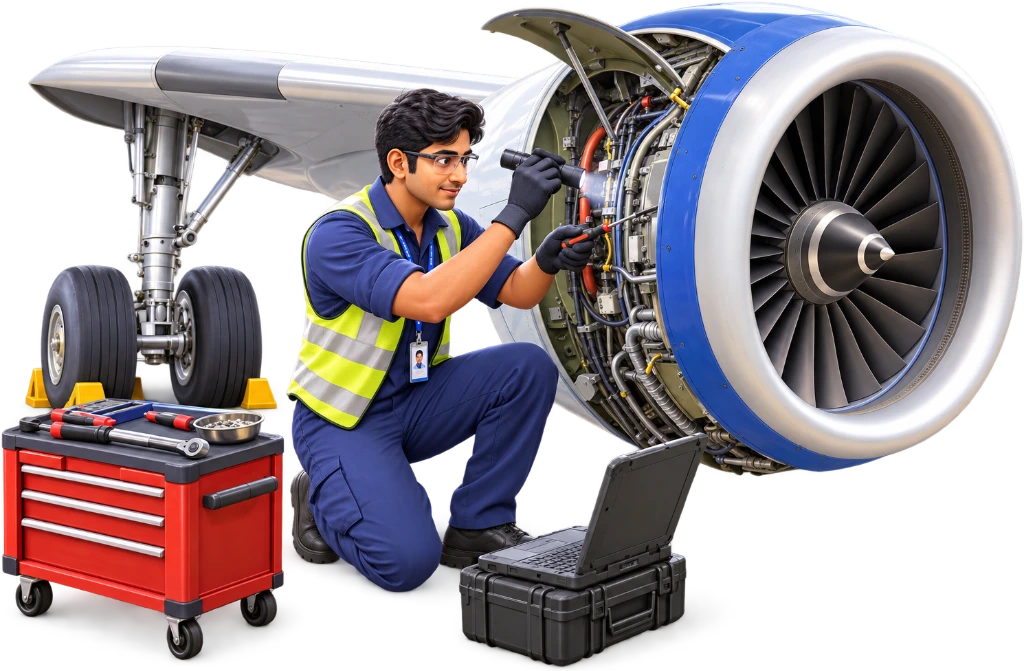
Certifying aircraft as fit to fly - inspection, fault diagnosis, rectification and release to service, working strictly to approved procedures with your licence behind every signature.
Who this suits
Fit
Technically capable, methodical people who want a licensed aviation career at a fraction of the cost of flight training. The licence is respected internationally, and fleet expansion in India means sustained demand for certifying engineers.
The honest reality
Read this one
The course takes years and licensing requires passing modular examinations plus logged practical experience, so the gap between finishing training and being able to certify anything is long - many students underestimate this badly. Institute approval status is critical and some unapproved schools have taken large fees from students whose training was worthless; verify it independently. Work is shift-based, often overnight and outdoors. You personally sign for airworthiness, and that responsibility is not shared with anyone.
What this work actually is
Understand the role
You do not design the aircraft or fly it. You inspect, troubleshoot and certify maintenance work so an aircraft meets safety and regulatory standards before service. That can mean tracing a hydraulic leak, checking an engine component against its limit, or confirming that a repair record and part number are correct. Small errors matter here, so documented work is as serious as the hands-on repair.
Most work happens in airport hangars, line-maintenance bays and workshops, often around flight schedules. You work beside technicians, other licensed engineers, pilots, stores staff and quality teams. A line-maintenance shift may involve checking an aircraft between flights; hangar work can involve longer inspections and major component changes. Noise, heat, night shifts and strict access rules are normal parts of the setting.
The licence and your approved experience set the ceiling more than a diploma alone. You need DGCA module examinations, documented practical work and later type ratings before you certify work on particular aircraft. People do well when they follow procedures even under time pressure, read manuals closely, and refuse to sign off a job they have not properly checked.
Skills that actually matter
Capability
You need disciplined technical work, clear records and the confidence to stop an aircraft from flying when the evidence is not right.
You must treat every inspection, tool count and sign-off as a safety decision. If a fault remains unclear, you raise it rather than guessing or working around it.
How to build it. During AME training, use checklists exactly as written in workshop tasks. After each task, write down what could cause harm if it were missed, then ask an instructor to check your reasoning.
A wrong part number, loose fastener, missed leak or incomplete log entry can ground an aircraft. You need to compare the aircraft, the manual and the maintenance record line by line.
How to build it. Practise reading maintenance-style instructions slowly: mark torque values, part numbers and inspection limits. In practical classes, use a personal tool and task checklist, then get a classmate to audit it.
Aircraft work follows approved procedures, DGCA requirements and controlled records. A repair is not complete until the paperwork states accurately what was found, done and checked.
How to build it. Learn to write short, factual job notes in training: fault, action, reference and result. Read DGCA module material alongside practical work, instead of treating the rules as a separate theory subject.
You need to understand how engines, hydraulic systems, landing gear, flight controls and structures behave. This helps you trace a symptom to a likely fault instead of replacing parts blindly.
How to build it. Build your Physics and Mathematics basics from Class 12, especially force, pressure, electricity and measurement. Use polytechnic or AME lab time to dismantle, inspect and reassemble components under supervision.
Aircraft faults often have several possible causes. You must follow the approved troubleshooting steps, test one possibility at a time and record the result.
How to build it. For each practical fault exercise, make a simple table of symptom, possible cause, test and result. Do not jump to the likely answer before checking the manual and evidence.
Maintenance happens across shifts and teams. You need to explain an unresolved defect, work completed and limits on the aircraft plainly, especially during a rushed handover.
How to build it. Ask to give the end-of-task handover in lab sessions. Practise saying the fault, work done, checks completed and anything still open in four short points.
Flights, shift changes and delayed parts create pressure. Good engineers keep to the procedure, manage fatigue and do not let a senior person or deadline push them into an unsafe sign-off.
How to build it. Use a fixed routine in training: read the task, gather tools, do the work, inspect, record, return tools. Take feedback calmly when an instructor finds an error, then repeat the task correctly.
Manuals, service instructions, labels and records use precise technical English. You need to understand terms accurately and write notes that another engineer will not misread.
How to build it. Keep a notebook of terms from DGCA modules and maintenance manuals, with a plain-English meaning and one example. Rewrite a long procedure into numbered steps without changing its meaning.
What separates the well paid from the average. The engineers who progress are trusted for accurate records, calm handovers and the judgement to refuse a doubtful sign-off, even when the aircraft is due to depart.
How people actually get in
Getting in
Most people enter through a DGCA-approved AME programme, then pass module exams and build documented aircraft maintenance experience before getting a licence.
Take Physics, Chemistry and Mathematics in Class 12. Check that the institute is DGCA-approved before paying fees, then complete AME training, clear DGCA module examinations, and log practical experience. The licence comes after this work, not simply after finishing the course. Type ratings and certification follow the licence.
Usually takes About 6 to 12 years from starting Class 12, including training, exams and practical experience.
Start with a Polytechnic diploma in engineering, then join a DGCA-approved AME training path. You still need the DGCA module examinations and documented practical experience. A diploma gives you technical basics, but it does not replace the AME licence process.
Usually takes About 6 to 12 years after Class 10, depending on training, exams and experience.
Some students complete a B.Tech before entering AME training or maintenance work. The degree may help with engineering knowledge, but aircraft certification work still needs the DGCA module exams, practical experience and AME licence. This route takes longer and is not a shortcut to signing off aircraft work.
Usually takes About 7 to 13 years after Class 12, including the degree and licence steps.
What people get wrong
Read this one
People often confuse AME work with flying, or assume a diploma alone makes you licensed.
- “AMEs spend most of their time travelling with airlines.” Most work happens on the ground, checking aircraft, tracing faults, reading maintenance records and signing work only when it meets safety rules.
- “Any aviation course will lead to an AME licence.” You need to verify DGCA approval before paying fees, then clear DGCA module examinations and build documented practical experience.
- “A Diploma or B.Tech makes you a licensed engineer straight away.” These qualifications can support your route, but the licence comes after the required training, examinations and experience.
- “The job is only about repairing engines and parts.” Much of the work is careful inspection, regulatory compliance, paperwork and checking that a small detail has not been missed.
- “After getting the AME licence, there is nothing more to learn.” Type ratings and certification for particular aircraft add to what you can work on, so your learning continues after licensing.
Where this leads
Outlook
Your first few years are usually spent building documented practical experience and passing DGCA modules before you can sign off aircraft work under an AME licence.
| Who employs | What it is like |
|---|---|
| Scheduled airlines | Work follows tight flight schedules, shift rosters and strict release procedures. You may handle line maintenance between flights, where accurate paperwork matters as much as finding a fault. Pay often includes shift-related components; roster changes and night work are common. |
| Maintenance, repair and overhaul organisations | These workshops carry out planned checks, component work and heavier maintenance. The pace comes in peaks around aircraft-check schedules. They want careful technicians who follow manuals, tool-control rules and documentation without shortcuts; early roles may be contract-based. |
| Cargo and charter operators | Aircraft may fly at night or on irregular routes, so maintenance teams work around less predictable schedules. A smaller team can give you broad exposure, but you must be comfortable with call-outs, turnaround pressure and detailed records. |
| Business aviation operators | You may support a smaller fleet and deal with aircraft that move between airports at short notice. The work needs discretion, tidy documentation and flexibility about location and timings. Jobs are fewer than in large airline operations. |
| Public-sector aviation organisations and PSUs | These roles tend to have formal recruitment, defined grades and clearer service rules than many contract roles. Entry may involve a government recruitment process. Work remains safety-led and process-heavy, with less room to skip a step to save time. |
| Aircraft and aviation component repair units | Some teams focus on engines, avionics, structures or workshop components rather than daily flight-line work. The work is repetitive at times: inspection, measurement, repair records and test reports. They look for strong mechanical aptitude and attention to detail. |
Working reality
Read this one
Job availability is low because you need DGCA modules, documented practical experience and an AME licence before you can certify aircraft work.
What it pays
Indicative
Early pay is usually trainee or technician pay until you build documented experience and gain the DGCA licence.
What decides where you land in the range. Your DGCA licence, aircraft type ratings, documented experience, employer, airport base, shift pattern and negotiation decide where you land in these ranges.
The route in, step by step
6 steps from where you are now.
Class 12 with Physics, Chemistry and Mathematics Required
PCM is required for AME training. A three-year engineering diploma is the alternative entry.
Verify the institute is DGCA-approved before paying anything Required
AME training must be at a DGCA-approved CAR-147 organisation. Unapproved institutes advertise heavily to exactly these students, and their certificates lead to no licence at all. Check the DGCA approval list directly rather than trusting a brochure.
Complete the AME training programme Required
Two to three years covering airframes, engines and avionics, in the B1 mechanical or B2 avionics category.
Clear the DGCA module examinations Required
A series of papers set by DGCA. Passing all modules is a multi-year process for most candidates, and papers are attempted repeatedly.
Complete documented practical experience Required
Supervised maintenance experience at an approved organisation, recorded in a logbook. Both the examinations and the experience are required before a licence issues - one without the other is worth nothing.
AME licence, then type ratings and certification Required
The licence permits you to certify aircraft as fit for flight - a legal responsibility, not merely a technical one. Type ratings on specific aircraft follow, and each adds to what you can sign for.
Courses that lead here
3 mapped routes into this career.
The roles this becomes
2 lanes out of the same starting point.
What it pays
Indicative bands, 2 ways to read them.
| Stage | Pay band | What changes |
|---|---|---|
| 0–1 yrs | ₹240,000 – ₹480,000 / annual | Trainee work under supervision; licence usually not held yet. |
| 1–3 yrs | ₹360,000 – ₹720,000 / annual | Routine maintenance work and documented practical experience. |
| 3–6 yrs | ₹600,000 – ₹1,200,000 / annual | DGCA licence, aircraft type exposure and certifying work raise pay. |
| 6–12 yrs | ₹900,000 – ₹1,800,000 / annual | Licensed work on aircraft types, shift responsibility and team supervision. |
| Stage | Pay band | What changes |
|---|---|---|
| Any experience | ₹360,000 – ₹1,200,000 / annual | Pay depends heavily on licence status and assigned aircraft type. |
These are ranges, not offers. Pay varies by city, employer size, sector and your own skill more than by job title. Treat the band as the shape of the market, not as a number you can hold anyone to.
Common questions
The ones people actually ask about this work.
How long before I can certify an aircraft?
Several years. The course is followed by modular examinations and logged practical experience, and students routinely underestimate that gap.
How do I verify an AME institute?
Check its approval status with the regulator directly. Unapproved institutes have taken large fees from students whose training proved worthless.
Is the licence usable abroad?
Broadly yes, subject to conversion requirements in the destination country, which makes it one of the more portable technical qualifications available.
What responsibility comes with certifying?
You personally sign for the aircraft's airworthiness. That accountability is not shared, and it shapes how carefully the job is done.
Test this against your own priorities
Pay, hours and entry route matter differently to different people. Compare this against the alternative you are actually weighing, rather than against the average.