
Anaesthesia & Critical Care
Last updated · Confirm dates, fees and eligibility on the official website before you apply.
always short-staffed
- Route in
- Typically Doctor of Medicine (MD). 1 course lead here
- Entry pay
- ₹80,000 – ₹160,000 / monthly 0–1 yrs
- Experienced
- ₹500,000 / monthly 6–12 yrs
What the work involves
Day to day
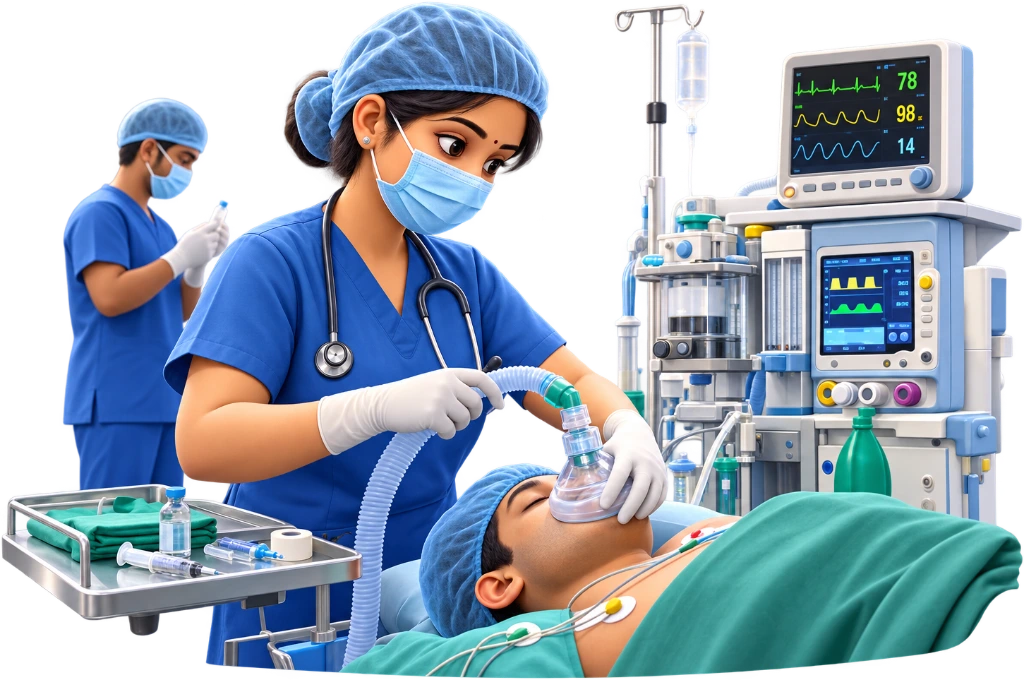
Keeping patients safe and unconscious through surgery, and managing the sickest patients in intensive care. You control airway, breathing and circulation moment to moment, and you are the person who notices deterioration first.
Who this suits
Fit
People who are calm under pressure, meticulous with checklists, and content to be essential rather than visible. Demand is consistently strong because no surgical department functions without anaesthetists.
The honest reality
Read this one
Long periods of vigilance punctuated by moments where a mistake is catastrophic. Patients rarely know your name and thanks usually goes to the surgeon. Night and weekend cover is heavy, and intensive care work carries a genuine emotional toll.
What this work actually is
Understand the role
An anaesthetist does not usually diagnose the illness or perform the operation. You prepare the patient for surgery, give anaesthesia, keep breathing, blood pressure and pain under control, then respond fast if something changes. In critical care, you manage very sick patients in an ICU, including ventilator settings, medicines, fluids and emergency procedures.
Much of the work happens in an operation theatre, ICU, recovery room and emergency department. You work beside surgeons, nurses, technicians, physicians and junior doctors. A planned surgery still needs careful checks of fasting, allergies, airway risk and medicines. During trauma cases, deliveries or cardiac arrests, the room can become crowded and decisions have to be made within minutes.
The hard part is that your work is often invisible when it goes well. You may stand at the patient’s head for hours while someone else performs the visible operation. People who do well stay calm, notice small changes on monitors, and keep checking details even during long shifts, night duties and emergencies.
Skills that actually matter
Capability
In anaesthesia and critical care, your patients may be unconscious, frightened or deteriorating fast, so calm clinical judgement and precise monitoring matter every day.
You must connect the diagnosis, planned surgery, medicines, examination findings and monitor readings before choosing an anaesthetic plan or changing treatment in ICU.
How to build it. During MBBS, write a short problem list for each ward patient: what is failing, what evidence supports it, and what you would check next. In postgraduate training, discuss your plan before theatre lists and compare it with what actually happened.
A falling oxygen level, severe bleeding, difficult airway or cardiac arrest needs immediate, ordered action. Panic wastes seconds and confuses the team.
How to build it. Take every simulation, code blue drill and emergency posting seriously. Practise speaking the first three actions aloud, then ask a senior for feedback after real emergencies or drills.
Small errors in drug concentration, dose, equipment checks, oxygen supply or patient identity can cause serious harm. You need a fixed checking routine even during a long night shift.
How to build it. Use checklists during internship and residency rather than trusting memory. Before each case, practise saying the patient, procedure, allergies, airway plan and drug calculations to a senior or colleague.
You must explain risk and consent issues to families, hand over clearly, and speak firmly with surgeons, nurses and technicians when a patient is unsafe to proceed.
How to build it. Volunteer to give structured handovers in wards and ICU. Use a simple order: patient problem, current status, treatment given, concern and next step. Ask seniors to point out unclear or missing details.
You need steady hands and safe technique for airway management, vascular access, regional blocks and other procedures, while knowing when to stop and call for help.
How to build it. Start with anatomy, equipment names and observation in theatre. Keep a supervised procedure log during internship and MD training, noting what went wrong, what you changed and what you need to repeat.
A few clear words before surgery can settle a patient. In ICU, families need honest explanations without false reassurance, especially when the outlook is poor.
How to build it. Before a procedure, practise introducing yourself and explaining the next steps in plain language. Watch how experienced doctors speak to families, then ask to lead part of a supervised update.
The work includes early theatre lists, night ICU calls, repeated chart reviews, documentation and checking machines and drugs. Carelessness often appears when you are tired.
How to build it. During internship, use a pocket list or secure digital task list for pending tests, drug changes and handovers. Learn to prepare the next shift's priorities before the current shift becomes busy.
What separates the well paid from the average. The doctors who progress fastest are usually the ones who communicate clearly under pressure, spot deterioration early and make every handover dependable.
How people actually get in
Getting in
Most doctors enter anaesthesia and critical care after MBBS by clearing NEET PG and completing an MD in Anaesthesiology.
Complete MBBS, including the internship and registration, then clear NEET PG for an MD Anaesthesiology seat. During MD, you learn to assess patients before surgery, give anaesthesia, manage airways and respond when blood pressure or oxygen levels fall suddenly.
Usually takes About 8.5 years from starting MBBS.
After MD Anaesthesiology, many doctors spend time as a senior resident. You handle more complex operating theatre and ICU work under a hospital department, build emergency judgement and prepare for consultant posts.
Usually takes Usually 3 years.
Some doctors train further in a focused area such as critical care. This route suits you if you want regular ICU work alongside or instead of mainly operating theatre anaesthesia.
Usually takes A further 1 to 3 years.
What people get wrong
Read this one
Anaesthesia and critical care involves long training, close monitoring and quick decisions when a patient's condition changes.
- "Anaesthetists only put patients to sleep for surgery." They assess patients before an operation, manage pain and breathing during it, and watch blood pressure, oxygen and other signs throughout.
- "It is a quiet backroom job with little patient contact." You often meet patients briefly before surgery, but in ICU and emergency work you may speak with distressed families and make urgent treatment decisions.
- "You become a consultant soon after MBBS." The usual route includes 5.5 years of MBBS and internship, NEET PG, a three-year MD, and often senior residency before consultant practice.
- "Critical care is only for people who enjoy dramatic emergencies." Emergencies matter, but much of the work is repeated monitoring, drug dose changes, ventilator settings, notes and careful handovers.
- "Anaesthesia has no scope because patients do not see the doctor." Hospitals continue to need anaesthetists and intensivists, and the work can lead to private consultant practice or contract roles in hospitals.
Where this leads
Outlook
Most anaesthetists and intensivists build their career in hospitals, where shift work, emergencies and careful teamwork shape the day more than a fixed office schedule.
| Who employs | What it is like |
|---|---|
| Private multi-speciality hospitals | These hospitals employ anaesthetists for operating theatres and intensivists for ICUs. Work is fast when trauma, emergency surgery or beds fill up. Pay usually rises with experience, procedures handled and your ability to cover nights or difficult cases; contracts and notice periods are common. |
| Government medical colleges and teaching hospitals | You combine patient care with teaching junior doctors and postgraduate trainees. Caseloads are often heavy, and equipment or bed availability may limit choices. Entry is usually through government recruitment, and posts offer more structure than many private hospital roles. |
| District hospitals and state health services | District hospitals need doctors who can keep emergency theatres, labour rooms and critical-care beds running. You may work with a smaller team than in a large city hospital and take broader on-call duties. Government posts bring set pay structures, though transfers within a state can happen. |
| Standalone intensive-care and emergency centres | The work centres on ventilators, sepsis, trauma and patients whose condition changes hour by hour. Shifts can be long and nights are routine. These centres want calm clinical reasoning, accurate notes and quick escalation when a patient needs surgery or a higher-level facility. |
| Nursing homes and surgical day-care centres | Smaller surgical units use anaesthetists for planned procedures such as general surgery, orthopaedics or obstetrics. The pace may be more predictable than a large ICU, but work depends on operating lists and surgeon schedules. Many roles are session-based or contract roles. |
| Medical colleges and academic departments | After gaining experience, you may teach, supervise residents, run theatre lists and contribute to clinical research. Promotion follows institutional rules and available posts. The work still includes calls and patient care, especially in teaching hospitals. |
Working reality
Read this one
Work-life balance scores lowest because emergency cases, ICU rounds and operation lists can extend shifts and disrupt nights, weekends and holidays.
What it pays
Indicative
Most anaesthesia and critical-care doctors start on a fixed hospital salary, then earn more through consultant posts, night-duty load and procedure-linked work.
What decides where you land in the range. Your pay changes most with government versus private employment, city, years after MD, ICU or theatre workload, night calls, surgical case volume and the terms you negotiate.
The route in, step by step
6 steps from where you are now.
MBBS, internship and registration Required
Five and a half years, then permanent registration.
Clear NEET PG Required
Anaesthesia has become steadily more competitive as critical care demand has grown.
MD Anaesthesiology Required
Three years - general and regional anaesthesia, airway management, pain, and intensive care. Anaesthetists carry the highest moment-to-moment responsibility in a hospital and the lowest public visibility.
Senior residency Required
Three years, usually including intensive care rotations.
Sub-specialise Required
Critical care through DM or a fellowship, cardiac anaesthesia, neuroanaesthesia, or pain medicine. Critical care demand rose sharply after the pandemic and has not fallen back.
Consultant practice Required
Hospital consultant, intensivist, or freelance anaesthesia across several hospitals - a common and well-paid model in Indian private practice.
Courses that lead here
1 mapped route into this career.
The roles this becomes
2 lanes out of the same starting point.
What it pays
Indicative bands, 2 ways to read them.
| Stage | Pay band | What changes |
|---|---|---|
| 0–1 yrs | ₹80,000 – ₹160,000 / monthly | First post-MD job or senior residency; government posts often follow a pay level, while private hospitals offer fixed pay. |
| 1–3 yrs | ₹100,000 – ₹200,000 / monthly | Senior residency or early consultant work, with regular theatre and emergency duty. |
| 3–6 yrs | ₹150,000 – ₹300,000 / monthly | Independent consultant cover for operation theatres, ICU shifts or both. |
| 6–12 yrs | ₹220,000 – ₹500,000 / monthly | Established consultant work; higher totals often include extra calls, multiple hospitals or procedure-linked fees. |
| Stage | Pay band | What changes |
|---|---|---|
| Any experience | ₹120,000 – ₹400,000 / monthly | Depends heavily on surgical case volume, on-call work and links with surgeons or hospitals. |
These are ranges, not offers. Pay varies by city, employer size, sector and your own skill more than by job title. Treat the band as the shape of the market, not as a number you can hold anyone to.
Common questions
The ones people actually ask about this work.
How do I become an anaesthetist in India?
<p>MBBS, then NEET PG and an MD or DNB in Anaesthesiology, followed optionally by super-specialisation in critical care or pain medicine. It is one of the more sought-after PG branches, so the NEET PG rank required is competitive.</p>
What is the work actually like?
<p>Keeping a patient alive and stable while a surgeon operates, then managing recovery. Add intensive care, pain management, and emergency airway work. It is high-stakes, procedure-heavy and involves long and unpredictable hours, because surgery and emergencies do not keep office time.</p>
Why is anaesthesiology in demand?
<p>No hospital can run an operating theatre or an intensive care unit without anaesthetists, and India has fewer than it needs. That produces steady demand across private and government hospitals and reasonable bargaining position, which is part of why the PG seats are competitive.</p>
What is the downside people underestimate?
<p>The invisibility and the pressure together. Patients rarely remember the anaesthetist, but the responsibility during a case is absolute and errors are unforgiving. Critical care in particular carries a heavy emotional load, because the patients who reach an ICU are the ones who may not leave it.</p>
Test this against your own priorities
Pay, hours and entry route matter differently to different people. Compare this against the alternative you are actually weighing, rather than against the average.