
Anaesthesia / OT Technology
Last updated · Confirm dates, fees and eligibility on the official website before you apply.
hospital core staff
- Route in
- Typically B.Sc Allied Health Sciences. 1 course lead here
- Entry pay
- ₹15,000 – ₹45,000 / monthly Any experience
- Experienced
- ₹65,000 / monthly 6–12 yrs
What the work involves
Day to day
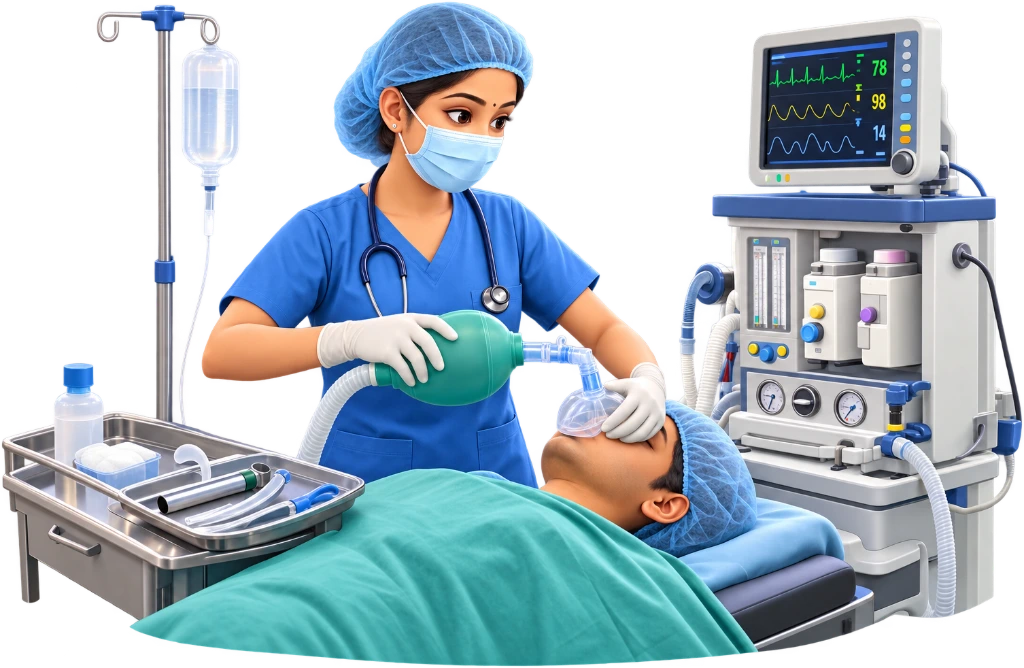
Preparing anaesthesia equipment and drugs, assisting the anaesthetist through surgery, and monitoring the patient alongside them. You are responsible for the theatre being ready and everything in it working.
Who this suits
Fit
Organised, unflappable people who want to be inside the operating theatre without a medical degree. Every surgical department needs the role, which makes employment reliable.
The honest reality
Read this one
You carry real responsibility but limited authority, and credit for a good outcome goes elsewhere. Emergency lists mean unpredictable hours and night call. Advancement essentially requires further study, since the technician grade itself has a low ceiling.
What this work actually is
Understand the role
You prepare the operation theatre and anaesthesia equipment so the surgical team can work safely. Unlike a surgeon or anaesthetist, you do not decide the treatment or perform the operation. You check monitors, suction, oxygen supply, instruments and sterile items before a case. During surgery, you assist with equipment, watch for problems and help the team respond quickly in an emergency.
The work happens mainly inside hospital operation theatres, recovery areas and procedure rooms. You work close to anaesthetists, surgeons, nurses and other OT technicians, often while the patient is unconscious and the room must stay sterile. A shift may include planned operations in the morning, cleaning and resetting the theatre between cases, then an emergency case late at night. Private hospitals commonly employ OT Technicians and Anaesthesia Technologists as core theatre staff.
Small errors matter here. A missing tube, wrongly prepared machine or break in sterile technique can delay surgery or put a patient at risk. People who do well stay calm when others are rushing, follow the same checks every time and communicate clearly. After two to three years in theatre, you can specialise by theatre type or work towards an OT in-charge role.
Skills that actually matter
Capability
You need steady hands, strict sterile habits and clear communication because a small missed check in an operation theatre can put a patient at risk.
You prepare and handle equipment without contaminating the sterile field, and you notice immediately if a glove, trolley or instrument has been compromised.
How to build it. During your B.Sc or diploma postings, ask to practise surgical hand scrub, gowning, gloving and trolley set-up under supervision. Keep a written checklist for each procedure and learn why each item stays inside or outside the sterile area.
You check patient details, equipment settings, drug labels, oxygen supply, suction and counts before the surgeon starts. Routine checks are a large part of the work.
How to build it. Use the hospital's pre-operative checklist on every posting. After each case, write down one missed or nearly missed detail and the check that would catch it next time.
When oxygen pressure drops, suction fails or a patient’s condition changes, you must bring the right equipment, follow instructions and stay calm without guessing.
How to build it. Take every mock drill seriously in college or hospital training. Learn the location and daily checks of the crash cart, defibrillator, backup oxygen and suction, then practise reporting a problem in one clear sentence.
An operation theatre runs through short, exact exchanges between the anaesthesia team, surgeon, nurses and technicians. You repeat back instructions, confirm when a task is complete and speak up about an unsafe gap.
How to build it. In postings, volunteer to give the pre-case equipment status aloud. Practise saying the item, action and result: for example, "Suction checked, working". Ask your supervisor to correct unclear communication.
You set up, test and monitor anaesthesia machines, breathing circuits, monitors, suction and oxygen systems as directed by the clinical team.
How to build it. Learn one machine at a time during theatre duty. Draw its gas path and make your own daily check sequence. First observe, then perform the check under supervision until you can explain each alarm and connection.
You clean and prepare equipment between cases, separate waste correctly and follow the theatre's infection-control rules even when the list is running late.
How to build it. Spend time with the central sterile supply and OT cleaning staff during training if your hospital permits it. Learn the local colour coding, cleaning sequence and documentation rather than treating turnaround work as someone else's job.
You keep consumables, instruments and equipment ready for several cases, while handling delays, changed case lists and missing items without creating confusion.
How to build it. Before a theatre list, make a case-wise tray and consumables list from the schedule. At the end of each shift, compare planned and used items, then improve your list for the next similar case.
You may stand for long procedures, move equipment and remain alert through repetitive checks. Theatre work can include early starts, late cases and emergency duty.
How to build it. Use clinical postings to build safe work habits: supportive footwear, correct posture while moving cylinders or machines, regular water breaks when permitted, and a handover note before your shift ends.
What separates the well paid from the average. The technicians who move ahead are the ones who make the whole theatre reliably ready before anyone asks, communicate problems early and remain dependable during long or emergency cases.
How people actually get in
Getting in
Most people enter after Class 12 with Physics, Chemistry and Biology, then train for operating theatre and anaesthesia work.
After Class 12 with Physics, Chemistry and Biology, complete the degree, register with your state allied health council, and join an OT team. Your early work includes preparing theatre equipment, keeping sterile supplies ready, and supporting anaesthesia procedures.
Usually takes 2-4 years after Class 12.
A B.Sc Allied Health Sciences course is the main undergraduate route listed for this career. After training and state allied health council registration, you usually begin in theatre work and build experience before focusing on a theatre type.
Usually takes 2-4 years after Class 12.
A diploma offers another way into OT work after Class 12 with Physics, Chemistry and Biology. Register with your state allied health council, then gain practical theatre experience before moving towards roles such as OT in-charge or perfusion.
Usually takes 2-4 years after Class 12.
What people get wrong
Read this one
Anaesthesia and OT work is hospital core work, but it is often misunderstood from both sides.
- “It is only passing instruments in an operation theatre.” You prepare equipment, maintain sterile technique, support the anaesthesia team and respond quickly when a case changes.
- “You will spend every shift watching surgeries.” Much of the work happens before and after the operation: checking machines, arranging supplies, cleaning protocols and documenting what was used.
- “A diploma and a B.Sc lead to exactly the same work.” Both routes exist, but a B.Sc in Anaesthesia and Operation Theatre Technology or Allied Health Sciences is the usual route in the recorded pathway.
- “There is no growth after becoming an OT technician.” After theatre experience, you can specialise by theatre type, become an OT in-charge or move towards perfusion.
- “This job suits only people who stay calm in emergencies.” Calm helps, but the everyday standard matters too: careful checks, sterile practice, teamwork and noticing a small error before it reaches the patient.
Where this leads
Outlook
Most jobs are in hospital operating theatres, where your next move depends on the procedures you learn and the trust you earn from the theatre team.
| Who employs | What it is like |
|---|---|
| Private multi-speciality hospitals | These hospitals employ OT Technicians and Anaesthesia Technologists across several theatres. The pace is busy, shifts are common, and pay often rises with experience in complex procedures and dependable emergency work. |
| Government hospitals and medical colleges | You work with high patient numbers, teaching teams and a wide range of cases. Posts may come through state recruitment or contract roles; security and pay structure depend on the post, while the workload can be heavy. |
| District hospitals | A district hospital gives broad theatre exposure, often with a smaller team and fewer specialised theatres. You need to set up carefully, keep sterile supplies ready and stay calm when cases change quickly. |
| Speciality hospitals | Cardiac, orthopaedic, eye, maternity or cancer hospitals want people who understand their theatre routines and instruments. The work becomes focused, which helps you build depth but gives less exposure to other procedures. |
| Day-care surgery centres | These centres handle planned procedures where patients usually go home the same day. Turnover is quick, so accurate room preparation, instrument checks and clear handovers matter every day. |
Working reality
Read this one
Work-life balance scores lowest because OT lists, emergency cases and shift duty can extend your day or bring you in at short notice.
What it pays
Indicative
Private-hospital pay usually starts modestly and rises most when you handle complex theatres or take an OT in-charge role.
What decides where you land in the range. Your pay depends most on hospital type and city, years in theatre, specialist surgery exposure, shift allowances and how well you negotiate when changing jobs.
The route in, step by step
6 steps from where you are now.
Class 12 with Physics, Chemistry and Biology Required
PCB for the allied health route.
B.Sc in Anaesthesia and Operation Theatre Technology, or a diploma Required
Three years plus internship for the degree, two for the diploma. Anaesthesia equipment, monitoring, sterile technique and theatre setup.
Register with your state allied health council Required
Where constituted under the 2021 Act.
Work in theatre Required
Preparing and checking the anaesthesia machine, assisting the anaesthetist, monitoring, and turning the theatre around between cases. You are relied on absolutely during induction and emergence.
Specialise by theatre type Required
Cardiac, neuro, transplant or robotic surgery. Each has its own equipment, its own drugs and its own premium.
OT in-charge, or move to perfusion Optional
Supervising the technician team, or retraining into cardiac perfusion - which requires separate qualification and pays considerably more.
Courses that lead here
1 mapped route into this career.
The roles this becomes
2 lanes out of the same starting point.
What it pays
Indicative bands, 2 ways to read them.
| Stage | Pay band | What changes |
|---|---|---|
| 0–1 yrs | ₹15,000 – ₹25,000 / monthly | First hospital role after a B.Sc or diploma; night and emergency shifts may add allowances. |
| 1–3 yrs | ₹20,000 – ₹35,000 / monthly | Independent routine OT preparation and anaesthesia-machine checks. |
| 3–6 yrs | ₹28,000 – ₹45,000 / monthly | Experience in busy surgical lists, infection control and emergency cases. |
| 6–12 yrs | ₹38,000 – ₹65,000 / monthly | Senior technologist or OT in-charge work, often across specialist theatres. |
| Stage | Pay band | What changes |
|---|---|---|
| Any experience | ₹15,000 – ₹45,000 / monthly | Pay rises with theatre volume, shift work and responsibility for instruments and sterile setup. |
These are ranges, not offers. Pay varies by city, employer size, sector and your own skill more than by job title. Treat the band as the shape of the market, not as a number you can hold anyone to.
Common questions
The ones people actually ask about this work.
What is the difference between this and being an anaesthetist?
<p>A large one, and it is worth being clear about before enrolling. An anaesthetist is a doctor — MBBS plus MD. An anaesthesia technologist is an allied health professional with a B.Sc or diploma who prepares and operates anaesthesia equipment, assists the anaesthetist and monitors during procedures. Both are needed; they are not the same qualification or the same authority.</p>
What course do I need?
<p>A B.Sc in Anaesthesia and Operation Theatre Technology, or a diploma, after Class 12 with science. Confirm the programme is recognised by the relevant state paramedical council before paying — this is the single most common way students in allied health lose years.</p>
Where do anaesthesia technologists work?
<p>Hospital operating theatres, intensive care units, day surgery centres and emergency departments. Larger private hospitals and teaching hospitals are the main employers, and the skills are recognised abroad, particularly in the Gulf.</p>
What are the hours like?
<p>Shifts, plus on-call for emergency surgery. Theatres run to a list during the day and emergencies arrive at any hour, so night and weekend work is part of the job rather than occasional.</p>
Test this against your own priorities
Pay, hours and entry route matter differently to different people. Compare this against the alternative you are actually weighing, rather than against the average.