
Animator
Last updated · Confirm dates, fees and eligibility on the official website before you apply.
Creates motion and performance for characters, objects or information across film, games, advertising and digital media.
- Route in
- Animation, design, fine arts or related education can help, but employers primarily assess an original showreel, craft fundamentals, teamwork and production reliability. 3 courses lead here
- Entrance
- National Institute of Design Design Aptitude Test
- Entry pay
- ₹280,000 – ₹1,500,000 / annual 0–10 yrs
- Where you work
- Animation and VFX studios, games, film, advertising, education and independent production. Production deadlines may require extended hours.
Overview
What this career is, in plain terms.
Animator overview
Understand the role
Eligibility and preparation
Fit
Work environment
Capability
Reality check
Read this one
What you actually do
Day to day
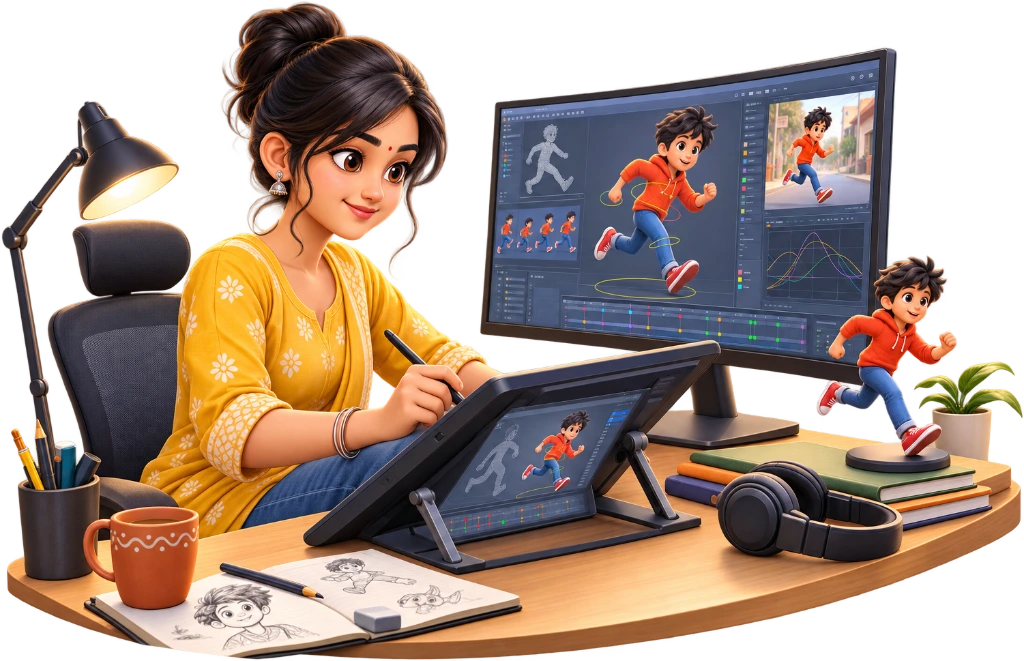
You turn a brief, storyboard or game design into movement that reads clearly on screen, then revise it until it fits the production.
- Study the assigned shot, reference video and director's notes before posing the character.
- Block key poses and timing so an action such as a jump, turn or lift reads clearly.
- Refine body weight, facial expression and hand movement in 2D or 3D software.
- Check that a character's shoulder, clothing or prop does not distort or pass through another object.
- Save clean versions of scene files and submit the shot to the studio review system.
- Attend shot reviews with the lead animator, director or game team.
- Apply feedback on timing, acting, camera framing and continuity between shots.
- Match a character's movement to the approved model, rig and style guide.
- Coordinate with rigging, lighting, compositing or game teams when a file has a technical problem.
- Estimate how long remaining revisions will take and flag delays before the deadline.
- Prioritise shots marked for client review, final render or game integration.
- Fix review notes quickly without breaking approved animation in nearby frames.
- Check frame ranges, file names, versions and output settings before delivery.
- Re-submit failed files or exports and confirm that the correct version reached the next team.
- Keep working through repeated feedback rounds while maintaining the same character performance across shots.
- Record or collect video reference for actions such as running, carrying weight or speaking.
- Test a difficult action in a short rough animation before committing to a full sequence.
- Help prepare a showreel clip or internal presentation from approved work.
- Share a workflow tip or give practical feedback on a teammate's shot when asked.
The part people are surprised by. A large part of the job is version control, review notes and fixing small continuity errors, not creating a new animation from scratch.
How people actually get in
Getting in
Your showreel gets you noticed, so build it alongside a course that gives you time, feedback and finished work.
Study 2D and 3D animation, drawing, storyboards, editing and production software. Use each project to improve a short showreel. Recruiters will look for movement that has weight and timing, clean shots, and evidence that you can take feedback without missing deadlines.
Usually takes Usually 3 years, then a portfolio and job search period.
A B.Des gives you design basics before you focus on animation, motion graphics or digital storytelling. Choose briefs where you animate characters, products or information. Keep the final showreel focused; ten strong shots are more useful than a long college film with uneven work.
Usually takes Usually 4 years.
This route suits you if drawing, observation and visual storytelling are your stronger starting points. Add animation practice during or after the degree, because studios need to see movement, not only still artwork. Many entrants begin with short films, student projects, freelance clips or assistant work.
Usually takes Usually 4 years, plus time to build animation samples.
The honest part
Read this one
The hard part is not making one good shot. It is making the fiftieth shot after feedback, file fixes and a deadline that has moved closer. In your first two years, you may spend long hours polishing walk cycles, lip sync, props or small scenes while senior artists handle bigger sequences. A strong showreel gets attention, but teams also watch whether you take notes without ego, name files properly and deliver work that fits the brief.
Deadline weeks can mean extended hours, especially in studios working on film, games or advertising work. Remote work saves travel, but it does not remove review calls or late changes. Some people leave because they prefer steadier hours, less screen time or work where results come faster. Others move into design, editing, teaching, game art, motion graphics or freelance projects after finding which part of production suits them.
What people get wrong
Read this one
Animation rewards strong work on screen, but much of the job is repeated fixing, feedback and deadline pressure.
- “You need an animation degree to get hired.” A B.Sc in Animation and Multimedia, B.Des or BFA can help, but studios chiefly judge your original showreel, basic craft, teamwork and whether you deliver on time.
- “Animators only draw cartoons.” You may animate a game character, a product advert, a training video or motion graphics for digital media. Some roles involve 2D work, while others use 3D software and rigs.
- “It is all creative fun.” You will spend long stretches adjusting timing, cleaning movement, acting on client notes and repairing shots that do not work. Production deadlines can mean extended hours, and recorded stress is high.
- “Animation means film studios in big cities.” Work also comes from games, advertising, education, VFX and independent production. Remote work and freelancing exist, though you still need reliable communication and delivery.
- “There is no stable path after the first job.” You can build towards different specialisms as your showreel improves, and government 2D/3D Animator roles are recorded at ₹2.8 lakh to ₹15 lakh a year for 0 to 10 years of experience. Entry and progress still depend on the quality of your work and production reliability.
Where this leads
Outlook
Your showreel, clean files and ability to take feedback will shape your next role more than the course name on your certificate.
| Who employs | What it is like |
|---|---|
| Animation and VFX studios | You work in a shot-based pipeline with leads, reviews and fixed delivery dates. Entry work often means revisions, lip-sync, walk cycles or polishing shots. Pay rises with a dependable reel and faster, cleaner output; deadline weeks can run long. |
| Game studios | You animate characters, creatures, props or interface motion that must work inside a game engine. Teams want timing, looping actions and close work with artists and programmers. Releases bring sharp deadlines, while contract roles are common on individual projects. |
| Film, television and independent production | Work follows a production schedule and may last only for the film, series or episode. You need to match an established visual style and accept repeated director notes. Freelancing gives more control between projects, but gaps in income are possible. |
| Advertising and digital content agencies | Short films, product videos and social-media pieces move quickly, often with several client changes in a day. A broad motion-graphics portfolio helps. The pace is fast, and a strong finish matters more than spending weeks perfecting one shot. |
| Education and e-learning producers | You turn lessons, diagrams and demonstrations into clear visual sequences. The work usually has steadier subject matter than entertainment, but accuracy and plain communication matter. Teams often want someone who can animate information, not only characters. |
| Government media units and public-sector bodies | Government 2D/3D Animator roles may support public communication, training or educational media. Recruitment commonly follows a formal selection process. The recorded indicative annual range for 0 to 10 years is ₹2.8 lakh to ₹15 lakh; grade, experience and posting affect where you fall within it. |
Working reality
Read this one
Pay predictability is lowest because studio projects, contract roles and freelancing can leave gaps between assignments, especially early in your career.
The route in, step by step
5 steps from where you are now.
Validate the career fit Required
Understand the real tasks, work conditions, risks and progression of Animator.
Complete an eligible pathway Required
Animation, design, fine arts or related education can help, but employers primarily assess an original showreel, craft fundamentals, teamwork and production reliability.
Build supervised practical ability Required
Use recognised clinical training, internships, projects, laboratories, fieldwork or portfolio practice appropriate to this career.
Complete required selection or registration Required
Follow the current official recruitment, examination, licensing, registration or portfolio process applicable to the exact role.
Develop specialisation responsibly Optional
Choose further study or certification only after verifying recognition, eligibility, cost and relevance.
Courses that lead here
3 mapped routes into this career.
Exams on the way
What is required, and what is optional.
Exam rules and eligibility are revised regularly. Check the current official notification for your admission year before you act on anything here.
The roles this becomes
1 lane out of the same starting point.
What it pays
Indicative bands.
| Stage | Pay band | What changes |
|---|---|---|
| 2D/3D Animator | ₹280,000 – ₹1,500,000 / annual | Broad indicative annual range only; actual pay varies substantially by qualification, experience, location, employer, practice model and role scope. |
These are ranges, not offers. Pay varies by city, employer size, sector and your own skill more than by job title. Treat the band as the shape of the market, not as a number you can hold anyone to.
Who can enter
1 route into this work.
| Qualification | Stream | Minimum | Subjects |
|---|---|---|---|
| Graduation | Any | — |
Common questions
The ones people actually ask about this work.
What does a Animator do?
Creates motion and performance for characters, objects or information across film, games, advertising and digital media.
How can I become a Animator?
Animation, design, fine arts or related education can help, but employers primarily assess an original showreel, craft fundamentals, teamwork and production reliability.
Where does a Animator work?
Animation and VFX studios, games, film, advertising, education and independent production. Production deadlines may require extended hours.
Is Animator a good career in India?
It can be suitable when your aptitude, eligibility, interests and preferred work conditions align with the role. Verify recognised pathways and current opportunities before deciding.
Test this against your own priorities
Pay, hours and entry route matter differently to different people. Compare this against the alternative you are actually weighing, rather than against the average.