
Archaeologist (ASI)
Last updated · Confirm dates, fees and eligibility on the official website before you apply.
MA Archaeology, IGNCA
- Route in
- Typically Master of Arts or Bachelor of Arts (BA). 2 courses lead here
- Entry pay
- ₹35,400 – ₹112,400 / monthly Any experience
What the work involves
Day to day
Excavating, documenting and interpreting material remains, and protecting monuments and sites. Work divides between field seasons and the far longer periods of cataloguing, analysis and reporting that follow.
Who this suits
Fit
Patient, physically capable people with real intellectual curiosity about the past. India has an extraordinary density of sites and a shortage of trained archaeologists to work on them properly.
The honest reality
Read this one
Government posts are few and recruitment is infrequent, so entry can take years and many trained archaeologists never find a post in the discipline. Fieldwork means remote locations, heat and physically demanding conditions. Funding for excavation and conservation is chronically short, and heritage in India is politically contested in ways that can affect what gets studied and how findings are received.
What this work actually is
Understand the role
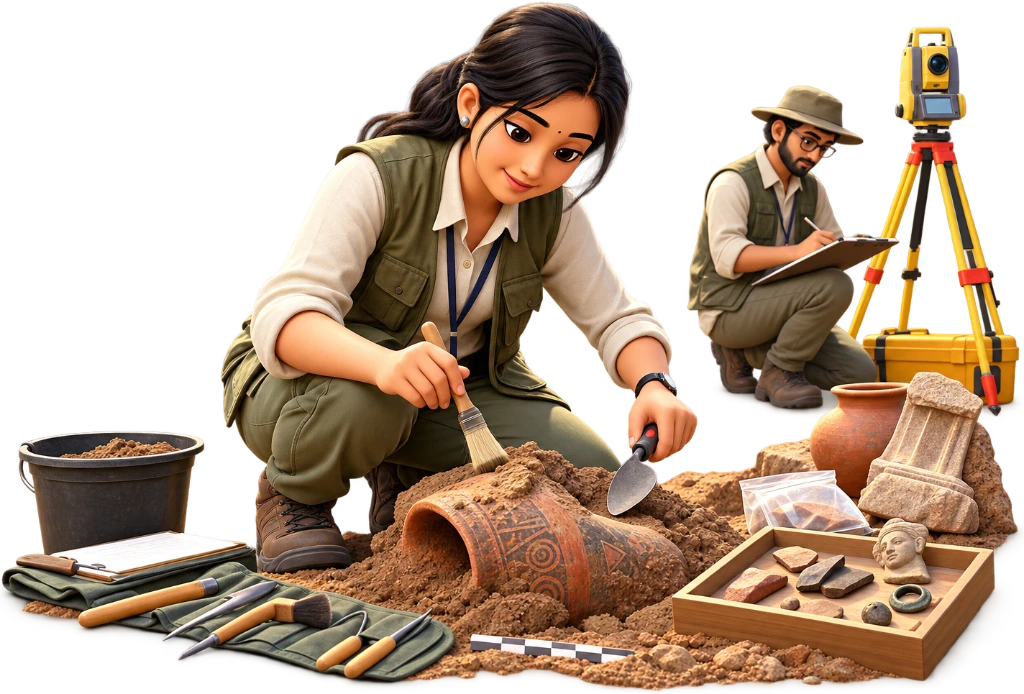
An archaeologist with the ASI does not only study old objects in books. You document where each find came from, its soil layer, measurements and condition, so the evidence keeps its meaning after excavation. You may help survey a site, record pottery or coins, examine old site files, and support conservation work on structures and artefacts.
Work happens at protected monuments, excavation sites, museums, archives and government offices. During a dig, you work with excavation assistants, conservators, survey staff, labour teams and local officials. Back in the office or laboratory, much of the work involves catalogues, photographs, maps, reports and comparing finds with earlier records. ASI posts are government roles; state archaeology departments and universities offer related work.
Before choosing this route, understand that careful record-keeping matters as much as the dig itself. A wrongly labelled pot or missing context sheet can damage years of research. People who do well combine fieldwork stamina with patient archival research, and usually build experience through excavations after a BA or MA in Archaeology, History or Ancient Indian History.
Skills that actually matter
Capability
Archaeology needs patient fieldwork, careful records and the discipline to draw conclusions only from evidence.
You need to excavate slowly in layers, label every find, record its exact position and protect the site from damage. Most days involve dust, heat, measuring, digging and paperwork rather than dramatic discoveries.
How to build it. Join supervised college field camps and museum or university projects where possible. Start by learning trench grids, context sheets, photography logs and safe handling from your department faculty.
A pot sherd without its trench, layer, date and sketch has little research value. You must keep legible field notes, registers, drawings, photographs and digital records that another researcher can check years later.
How to build it. Keep a field notebook during every visit to a local monument, museum or college survey. Practise making measured sketches of objects and writing one-page observation records from museum displays.
You read excavation reports, site records, inscriptions and academic papers, then write reports that separate evidence from guesswork. A good argument cites where each claim came from.
How to build it. During your BA or MA, choose assignments on one site, artefact type or period. Use library catalogues, published reports and footnotes, then ask a teacher to mark your citations and argument.
Old maps, survey reports, gazetteers, photographs and administrative records often reveal what changed at a site before excavation begins. Finding the right record takes patience and careful note-taking.
How to build it. Use your college library to compare a district gazetteer, old maps and current maps for one nearby site. Make a source list with the archive or book name, page number and date for each fact.
You need to recognise when an object or structure is fragile and avoid causing further harm. This includes safe packing, basic condition notes and knowing when a conservator must handle the item.
How to build it. Learn through supervised practical classes, museum visits and excavation training. Study how finds are packed and labelled, but do not attempt chemical cleaning or repairs on old objects yourself.
Excavations depend on clear work between supervisors, excavation assistants, labour teams, photographers and local officials. You need to report a change in soil, a find or a safety problem quickly and plainly.
How to build it. Take responsibility for one small task in a college field camp, such as the daily find register or photo log. Practise giving short updates that state the trench, context, observation and next step.
You may spend hours screening soil, cleaning small finds, checking measurements or entering records. Field seasons can mean early starts, outdoor work and basic living arrangements away from home.
How to build it. Volunteer for full-day site surveys or college camps rather than only attending lectures. Build a routine of walking, carrying a day pack safely and working carefully outdoors in the local season.
You must notice changes in soil, wall lines, slopes and object positions, then measure them correctly. Small errors in a plan can change how a whole feature is interpreted.
How to build it. Practise reading scale drawings and measuring a simple space such as a classroom or courtyard. Draw a plan to scale, add a north arrow and compare it with measurements checked by a teacher.
What separates the well paid from the average. The archaeologists who progress stand out through reliable records, sound judgement about evidence and the patience to finish reports after the field season ends.
How people actually get in
Getting in
Most people start with a BA, add an MA in Archaeology or Ancient Indian History, and build real excavation experience before applying to ASI or state departments.
After Class 12 in any stream, take a BA in History, Archaeology or Ancient Indian History. Follow it with an MA in Archaeology or Ancient Indian History, then spend 1 to 2 years on excavation work. This is the clearest preparation for Assistant Archaeologist and similar government posts.
Usually takes About 6 to 7 years after Class 12.
Complete a BA and MA first, then take the two-year postgraduate diploma at the Institute of Archaeology. You still need field experience. The diploma route suits students who want more practice in excavation, conservation technique and archaeological records before applying.
Usually takes About 8 to 9 years after Class 12, including 1 to 2 years of excavation experience.
A BA in History, Archaeology or Ancient Indian History can lead to excavation assistant work. You will spend more time on site records, finds, archives and fieldwork while building experience. Many people later add an MA to move towards archaeology posts with greater research responsibility.
Usually takes About 3 years after Class 12 to complete the BA, then 1 to 2 years gaining experience.
What people get wrong
Read this one
Archaeology involves patient research, records and conservation work as much as digging at a site.
- “Archaeologists spend most of their time excavating.” Excavation matters, but much of the work involves archival research, documenting finds, studying reports and handling conservation work.
- “You need to take Science in Class 12.” You can start from any stream, then study a BA in History, Archaeology or Ancient Indian History. An MA in Archaeology or Ancient Indian History is the usual next step.
- “It is only an outdoor job.” Fieldwork may involve heat, dust, travel and long site days, but you will also work with museum records, site notes and research material.
- “A degree alone gets you into ASI work.” Excavation experience matters, and the Institute of Archaeology postgraduate diploma is part of the recorded route for many candidates.
- “There is no work beyond famous monuments.” ASI, state archaeology departments and academia offer routes, including roles such as Assistant Archaeologist and Excavation Assistant.
Where this leads
Outlook
Most archaeologists build a career through government departments, museums, research institutions and teaching, with field seasons and document work shaping your early years.
| Who employs | What it is like |
|---|---|
| Archaeological Survey of India | This is the main central government route for site protection, excavation, records and conservation. Work is structured and security is stronger than short project work. You need careful research, fieldwork discipline and patience with files, permissions and site reports. |
| State archaeology departments | State departments work on protected monuments, district sites, museums and local surveys. The pace depends on the state and its projects. You may spend time travelling to sites, checking records and working with local administration. |
| Government museums and site museums | Museum work centres on objects, catalogues, storage, display records and visitor interpretation. Field excavation is less frequent. Employers look for strong archival research and careful handling of collections. |
| Universities and publicly funded research institutions | Here you may teach, research, join surveys or work on excavation projects. Project roles can be contract-based, especially early on, while permanent academic posts are limited. A strong MA, field experience and written research matter. |
| Heritage conservation and documentation projects | These projects record buildings, map sites, photograph objects and prepare conservation notes. Work often runs to project deadlines and may involve short contracts or freelancing. Employers value conservation technique, accurate drawings and clear reports. |
Working reality
Read this one
Job availability scores lowest because ASI and state archaeology departments have limited posts, so many applicants compete for a small number of government and academic roles.
What it pays
Indicative
ASI and state archaeology jobs usually follow government pay matrices, so your grade and years of service matter more than city.
What decides where you land in the range. Your state or central government cadre, pay level, years in service, allowances and promotion decide where you fall in the range.
The route in, step by step
6 steps from where you are now.
Class 12, any stream Required
History at Class 12 helps but is not required.
BA in History, Archaeology or Ancient Indian History Required
Three years. A B.Sc in geology or anthropology also feeds archaeology, particularly the scientific side.
MA in Archaeology or Ancient Indian History Required
Two years. Deccan College Pune, Banaras Hindu University and the central universities run the established programmes.
Take the Institute of Archaeology postgraduate diploma Required
The Archaeological Survey of India runs a two-year PG Diploma at its Institute of Archaeology, with a small intake and a stipend. It is the single most direct route into ASI and very few students know it exists.
Get excavation experience Required
Field seasons on real excavations. Archaeology is learned in a trench, and the field school record is what selection panels actually examine.
ASI, state departments, or academia Optional
Assistant Archaeologist and Deputy Superintending Archaeologist posts through ASI and UPSC, state archaeology departments, or a Ph.D. towards university research.
Courses that lead here
2 mapped routes into this career.
The roles this becomes
2 lanes out of the same starting point.
What it pays
Indicative bands, 2 ways to read them.
| Stage | Pay band | What changes |
|---|---|---|
| 0–1 yrs | ₹35,400 – ₹45,000 / monthly | Entry Assistant Archaeologist basic pay, before allowances. |
| 1–3 yrs | ₹39,000 – ₹56,000 / monthly | Regular service in an Assistant Archaeologist post. |
| 3–6 yrs | ₹44,900 – ₹70,000 / monthly | Promotion to Assistant Superintending Archaeologist often needs five years in grade. |
| 6–12 yrs | ₹57,000 – ₹112,400 / monthly | Higher pay-matrix stages and supervisory archaeology work. |
| Stage | Pay band | What changes |
|---|---|---|
| Any experience | ₹35,400 – ₹112,400 / monthly | Central government Level 6 basic-pay range. |
These are ranges, not offers. Pay varies by city, employer size, sector and your own skill more than by job title. Treat the band as the shape of the market, not as a number you can hold anyone to.
Common questions
The ones people actually ask about this work.
How do I become an archaeologist in India?
<p>A BA and then an MA in Archaeology, Ancient History or a related subject, usually followed by a PhD for research and senior positions. The Institute of Archaeology run by the ASI offers a postgraduate diploma that is highly regarded and is a direct route into the field. Recruitment to the Archaeological Survey of India is through its own and UPSC notifications.</p>
What does the work involve?
<p>Excavation and survey in the field, then a great deal of documentation, cataloguing, analysis and report writing. Conservation of monuments, museum work and heritage management are the larger part of employment — far more archaeologists maintain and interpret sites than dig new ones.</p>
Are there enough jobs?
<p>It is a small field and recruitment is irregular, so be realistic. Beyond the ASI and state archaeology departments there are museums, universities, heritage conservation organisations, and the archaeological impact assessment work required for large infrastructure projects, which is a growing and less-known employer.</p>
What makes someone good at it?
<p>Patience and precision. Excavation is slow, meticulous and mostly unglamorous, and the value is in recording accurately rather than in finding something spectacular. Field seasons also mean living rough for weeks, which suits some people and not others.</p>
Test this against your own priorities
Pay, hours and entry route matter differently to different people. Compare this against the alternative you are actually weighing, rather than against the average.