
Armed Forces Officer
Last updated · Confirm dates, fees and eligibility on the official website before you apply.
Leads personnel and performs operational, technical or administrative duties in an authorised branch of the Indian Armed Forces.
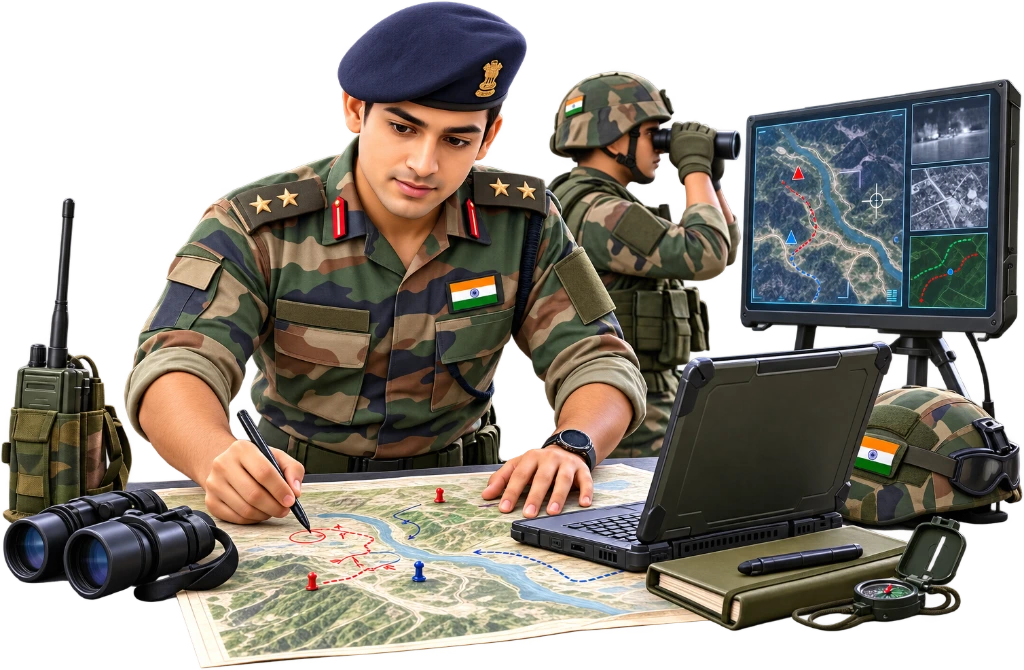
- Route in
- Entry requires the education, age, nationality, medical and physical standards specified for the relevant NDA, CDS, AFCAT or other notified route, plus successful selection and training. 4 courses lead here
- Entrance
- National Defence Academy and Naval Academy Examination or 2 other routes
- Entry pay
- ₹700,000 – ₹2,200,000 / annual 0–10 yrs
- Where you work
- Military units, ships, air stations, training institutions, headquarters and operational postings. Irregular and extended duty is inherent to many postings.
Overview
What this career is, in plain terms.
Armed Forces Officer overview
Understand the role
Eligibility and preparation
Fit
Work environment
Capability
Reality check
Read this one
What you actually do
Day to day
Your work changes with your unit and posting, but it always centres on leading people, maintaining readiness and carrying out authorised duties.
- Brief your personnel on the day's duty, safety points and priorities.
- Inspect turnout, equipment, vehicles or work areas and report defects.
- Lead training such as physical conditioning, drills, weapon handling or technical practice.
- Issue clear orders, check that tasks are completed and deal with problems in the team.
- Record attendance, stores, incidents and operational information in the required format.
- Plan training sessions and assign instructors, equipment and training areas.
- Review the readiness of personnel, vehicles, weapons, communications equipment or other unit resources.
- Meet senior officers to report progress, staffing needs and concerns from your team.
- Guide junior personnel on conduct, performance and welfare issues.
- Practise emergency or operational procedures with the unit.
- Study operational orders and brief your team on their task, timings and safety measures.
- Coordinate movement, communications, supplies and personnel at the assigned location.
- Make decisions within your authority when plans change or equipment fails.
- Monitor the condition, discipline and welfare of personnel during long duties.
- Send situation reports and maintain records for the next shift or higher headquarters.
- Hand over equipment, records, ongoing tasks and local procedures to the incoming officer.
- Attend branch training, professional courses or exercises as ordered.
- Prepare your unit for inspections by checking records, stores, equipment and personnel standards.
- Learn the duties and operating procedures of a new unit or posting.
- Settle your team into new accommodation, duty rosters and local working arrangements.
The part people are surprised by. Many officers spend substantial time on planning, records, inspections, equipment checks and looking after their team, alongside field or operational duties.
How people actually get in
Getting in
You enter as an officer through a notified Armed Forces selection route, then complete its training before receiving a commission.
Apply for the notified NDA entry after Class 12 if you meet its education, age, nationality, medical and physical standards. Clear the selection process and complete academy training. This route suits students ready for military training early, rather than those planning a regular college life first.
Usually takes After Class 12, followed by the notified selection process and academy training.
Finish an eligible graduation degree, such as a BA or B.Tech, then apply through the notified CDS route. You still need to meet the stated age, nationality, medical and physical standards, clear selection, and complete training. This is a practical route if you decide on the Services during college.
Usually takes A bachelor’s degree, then the notified selection process and academy training.
Watch official notifications for AFCAT and other branch-specific entries. Eligibility changes by entry and branch, so check the required education, age, nationality, medical and physical standards for that notification. Selection and training remain compulsory; a degree alone does not lead to a commission.
Usually takes Varies by entry; usually after the required education, then selection and training.
Complete an eligible technical degree, often B.Tech, and apply when a notified technical entry matches your qualification. Expect the same hard filters on medical fitness, physical standards and selection. Technical work still includes leading people, postings, field duties and irregular hours.
Usually takes Usually four years for B.Tech, then the notified selection process and training.
The honest part
Read this one
The hard part is not the uniform or the first posting. It is accepting that duty can change your plans with little notice. You may work long, irregular hours, move between states, spend time in field conditions, and carry responsibility for people when you are still young. Physical standards and medical fitness need steady attention. So does discipline when you are tired, homesick or under pressure.
Your first two years are heavily shaped by training, learning procedures and earning trust in a unit. Much of the work is routine: preparation, reports, equipment checks, briefings and following orders exactly. You do not choose every location or schedule. Some officers later leave for government roles, PSUs, corporate security, operations, training, logistics or other administrative work, often after deciding that frequent transfers and family separation no longer suit them.
What people get wrong
Read this one
An Armed Forces officer’s job asks for leadership under pressure, but much of the work is disciplined preparation, administration and training.
- “It is all combat and adventure.” Operational postings are possible, but you may also serve in a unit, ship, air station, training institution or headquarters. Planning, reports, equipment checks and training take a large share of time.
- “Officers only give orders.” You lead people, work closely with your team and remain accountable for their readiness, welfare and performance. You also train, learn procedures and carry out duties assigned by your branch.
- “A uniform means fixed, regular office hours.” Many postings involve irregular and extended duty, including exercises, duties at odd hours and urgent tasks. Remote work is not an option.
- “You need to be physically strong, but academics do not matter.” Entry routes such as NDA, CDS and AFCAT have stated education, age, nationality, medical and physical standards. Selection and training test more than fitness.
- “It is a dead-end job after a few years.” Officers can develop technical, operational, training or administrative specialisations over time, though postings, transfers and field deployment remain part of service life.
Where this leads
Outlook
Your employer is a government service, and your branch and posting will shape daily work far more than the word “officer” does.
| Who employs | What it is like |
|---|---|
| Indian Army | Expect unit, field, border-area, headquarters and training postings, often with frequent moves. Early-career officer pay sits within the recorded indicative ₹7 lakh to ₹22 lakh a year band for 0 to 10 years, while allowances vary by posting and service conditions. Government service offers structure, but field duty, physical standards and extended hours are part of the job. |
| Indian Navy | Work may centre on ships, naval air stations, dockyards, shore establishments or headquarters. Sea deployments can keep you away from home for long periods, followed by shore postings. Pay follows government service structures and posting-linked allowances; the Navy expects calm decisions, technical discipline and reliable teamwork in confined working conditions. |
| Indian Air Force | Air stations, operational units, maintenance settings, training establishments and headquarters are common postings. The pace changes sharply during exercises, operational readiness and deployments. Pay follows the government structure, with allowances linked to posting and duties; officers need physical fitness, clear communication and close attention to procedure. |
| Integrated defence headquarters and joint organisations | Some postings involve planning, operations coordination, logistics, intelligence support or administration alongside personnel from more than one service. The work is less field-based in many roles, but deadlines and security rules remain strict. Pay and service security follow your parent service, while these posts value sound written work, planning and coordination. |
| Military training institutions | Experienced officers may serve at academies, schools and training centres, teaching recruits or officers and running exercises. The daily routine is more structured than a field deployment, though training days can be long and physically demanding. These postings value instructional skill, discipline and the ability to correct people fairly. |
Working reality
Read this one
Job availability scores lowest because you must meet strict notified eligibility, medical and physical standards, then clear a competitive selection process and training.
The route in, step by step
5 steps from where you are now.
Validate the career fit Required
Understand the real tasks, work conditions, risks and progression of Armed Forces Officer.
Complete an eligible pathway Required
Entry requires the education, age, nationality, medical and physical standards specified for the relevant NDA, CDS, AFCAT or other notified route, plus successful selection and training.
Build supervised practical ability Required
Use recognised clinical training, internships, projects, laboratories, fieldwork or portfolio practice appropriate to this career.
Complete required selection or registration Required
Follow the current official recruitment, examination, licensing, registration or portfolio process applicable to the exact role.
Develop specialisation responsibly Optional
Choose further study or certification only after verifying recognition, eligibility, cost and relevance.
Courses that lead here
4 mapped routes into this career.
Exams on the way
What is required, and what is optional.
Exam rules and eligibility are revised regularly. Check the current official notification for your admission year before you act on anything here.
The roles this becomes
1 lane out of the same starting point.
What it pays
Indicative bands.
| Stage | Pay band | What changes |
|---|---|---|
| Commissioned Officer | ₹700,000 – ₹2,200,000 / annual | Broad indicative annual range only; actual pay varies substantially by qualification, experience, location, employer, practice model and role scope. |
These are ranges, not offers. Pay varies by city, employer size, sector and your own skill more than by job title. Treat the band as the shape of the market, not as a number you can hold anyone to.
Who can enter
1 route into this work.
| Qualification | Stream | Minimum | Subjects |
|---|---|---|---|
| Graduation | Any | — |
Common questions
The ones people actually ask about this work.
What does a Armed Forces Officer do?
Leads personnel and performs operational, technical or administrative duties in an authorised branch of the Indian Armed Forces.
How can I become a Armed Forces Officer?
Entry requires the education, age, nationality, medical and physical standards specified for the relevant NDA, CDS, AFCAT or other notified route, plus successful selection and training.
Where does a Armed Forces Officer work?
Military units, ships, air stations, training institutions, headquarters and operational postings. Irregular and extended duty is inherent to many postings.
Is Armed Forces Officer a good career in India?
It can be suitable when your aptitude, eligibility, interests and preferred work conditions align with the role. Verify recognised pathways and current opportunities before deciding.
Test this against your own priorities
Pay, hours and entry route matter differently to different people. Compare this against the alternative you are actually weighing, rather than against the average.