
Art director
Last updated · Confirm dates, fees and eligibility on the official website before you apply.
senior agency role
- Route in
- Typically Bachelor of Design (B.Des) or Bachelor of Visual Arts (BVA). 5 courses lead here
- Entry pay
- ₹18,000 – ₹35,000 / monthly Any experience
- Where you work
- Advertising agencies, Animation and gaming studios, Art galleries and museums, Animation and VFX studios (DNEG
What the work involves
Day to day
Owning the visual direction of a campaign, publication or production - concept, art, typography and imagery - and directing the designers, photographers and illustrators who execute it. Senior agency and production roles.
Who this suits
Fit
Designers with strong ideas who want to shape the whole rather than produce parts of it. It is one of the higher-paying creative roles in India and carries genuine authorship over what audiences see.
The honest reality
Read this one
This is not an entry-level position; expect several years as a designer first. Advertising hours are long and client revisions can dismantle good work for reasons that are not about the work. Agency employment is cyclical and layoffs follow account losses. The generative AI shift is changing production economics fast, and nobody in the industry is certain yet where it settles.
What this work actually is
Understand the role
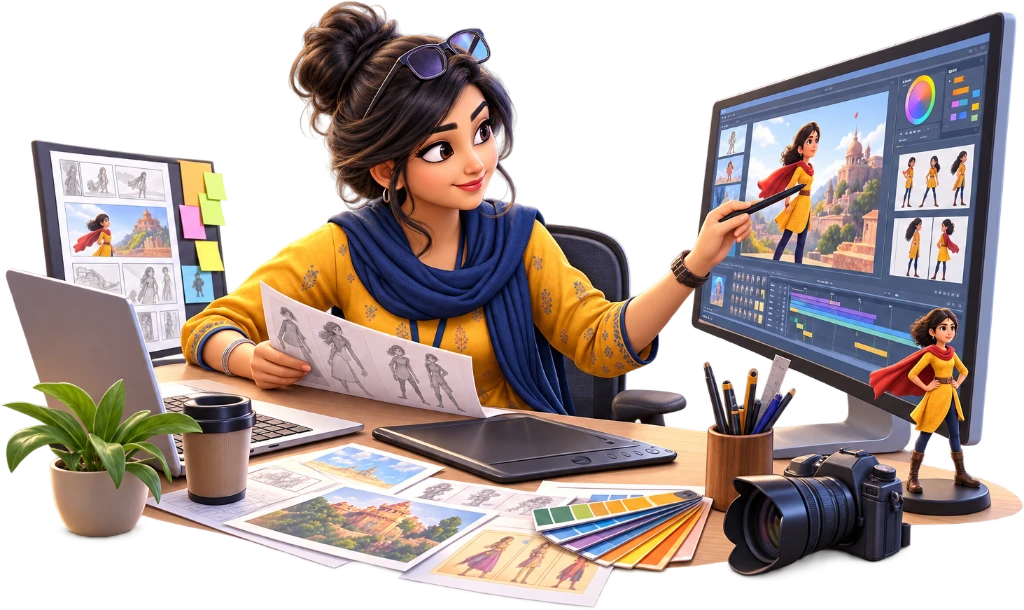
You set the visual direction for a campaign, film frame, game sequence or exhibition, rather than making every poster or asset yourself. You turn a brief into a look that others can follow: colours, type, images, sets, characters and mood. You check that the work tells one clear story and fix work that looks good alone but does not fit the idea.
Most art directors work in advertising agencies, animation and VFX studios, gaming teams, galleries or museums. You sit with copywriters, graphic designers, illustrators, photographers, animators, editors and account teams. A large part of the day is reviewing drafts, explaining changes, presenting to clients and working backwards from a deadline.
Your portfolio and judgement matter more than the degree name once you start working. Most people spend years as designers before leading a visual team. You need to give clear feedback without taking over every task, and accept that client changes, budget limits and repeated revisions are routine.
Skills that actually matter
Capability
An art director turns a campaign or project brief into a clear visual idea, then guides designers, photographers, illustrators or animators until the work is ready to show.
You need a trained eye for type, colour, spacing, layout and image choice. A good idea still fails if a poster is hard to read or a social-media campaign looks inconsistent.
How to build it. Use free design software or a college lab to remake one print ad, poster and Instagram carousel each week. Put your version beside the original, write down three choices you changed, and keep the best work in a PDF book.
Clients and agency teams often start with a product, audience and deadline, not a finished concept. You must turn that into a visual direction people can understand and make.
How to build it. Take advertisements from newspapers, YouTube or local shops and write a one-page brief for each. Create two different campaign directions, with a mood board, headline and three sample executions.
You will explain why a colour, image or layout suits the audience. You also need to take feedback without becoming defensive, especially when a client rejects work you spent days on.
How to build it. Present your college projects to classmates for three minutes without reading from slides. Ask them what they understood, then revise the explanation and the work using their feedback.
Art direction is not doing every design yourself. You assign work, spot weak details, and tell a designer how to improve a layout without giving vague comments such as 'make it better'.
How to build it. Lead a small college event poster or short film project with two or three classmates. Set a shared reference board, divide tasks, check drafts on fixed dates and give feedback linked to the brief.
A campaign needs a sequence and a point of view, not only attractive frames. This matters in advertising, animation, gaming and museum displays, where each visual should push one message forward.
How to build it. Choose a simple product used at home and plan a six-frame story for it. Make each frame add new information, rather than repeating the same product shot.
You need to know what changes when work goes to print, a billboard, a phone screen, a video edit or an animation pipeline. This prevents costly last-minute fixes.
How to build it. Ask a local print shop for file specifications and prepare one poster correctly for print. For digital work, make the same idea in vertical, square and horizontal formats, then compare what breaks.
Most briefs come with limits: a fixed logo, a small budget, legal wording, an approval chain or a two-day deadline. Strong art directors find a fresh route without ignoring these limits.
How to build it. Set yourself a constraint for personal projects, such as using only two colours, one typeface or photographs taken within your district. Finish within a fixed weekend deadline and add the constraint to your portfolio note.
Your book must show thinking, not only polished final images. Hiring teams look for strong choices, range and evidence that you understand the kind of agency, animation or gaming work you want.
How to build it. Keep 8 to 12 of your best projects in a simple PDF or free portfolio site. For each, show the brief, early references, one rejected direction and the final work; remove weaker pieces after every new project.
What separates the well paid from the average. The better-paid art directors make a team’s work clearer and faster, protect the core idea during client changes, and build a portfolio that shows real campaign thinking rather than only attractive images.
How people actually get in
Getting in
Most art directors in India first spend several years as designers, building a strong portfolio before they lead a campaign’s visual work.
After Class 12 in any stream, complete a four-year B.Des. Start as a graphic, visual, digital or motion designer. Your portfolio matters at each move: show campaign layouts, brand work and the choices behind them. After about three to five years, you may take responsibility for a campaign’s visual direction and guide other designers.
Usually takes 4-year degree, then 3-5 years as a designer.
A BVA or BFA builds drawing, composition, colour and image-making skills. You will still need to learn agency work, such as making layouts for a brief, revising work after client feedback and preparing files for production. Many people begin in design roles and build a book aimed at advertising, branding or editorial work.
Usually takes 4-year degree, then 3-5 years of design work.
A B.Sc in Animation and Multimedia can lead to work in animation, gaming or VFX. Begin by making assets, frames, storyboards or motion graphics. As your work develops, show that you can hold one visual style across a sequence and give clear feedback to artists. That is the step from making individual pieces to directing the look.
Usually takes 3-year degree, then 3-5 years in a studio.
An MFA gives you more time to develop a personal visual practice. It does not replace agency or studio experience. Use the course to make a focused portfolio, then take design or visual development work and learn the production pace, budget limits and revision cycle before aiming for art direction.
Usually takes 4-year undergraduate degree, 2-year MFA, then 3-5 years of work.
What people get wrong
Read this one
Art direction is a senior creative job built through years of design work, not a first job after college.
- “Art directors only make things look pretty.” You turn a campaign idea into a visual system, then make choices about images, type, colour, layout and what the audience should notice first.
- “A drawing prodigy has an automatic advantage.” Visual skill helps, but you also need storytelling, design judgement and the ability to explain why one route fits the brief better than another.
- “You become an art director as soon as you finish a B.Des or BFA.” Most people work as designers for three to five years first, build a strong book, and learn how agencies or studios handle briefs, deadlines and client changes.
- “It is all mood boards and big ideas.” A lot of the work is checking layouts, giving clear feedback, revising work after comments, and keeping designers, copywriters and production teams moving towards the same deadline.
- “Agency work is the only route.” Advertising is one route, but animation, gaming, VFX, galleries and museums also need people who can lead the visual direction of a project.
Where this leads
Outlook
Most art directors start as designers, then earn bigger briefs by showing that they can turn an idea into work a whole team can produce.
| Who employs | What it is like |
|---|---|
| Advertising agencies | This is the usual route for campaign art direction. The pace is deadline-led, with client changes and several pitches running at once. You need a strong portfolio, clear visual judgement and the ability to guide designers, photographers and copywriters. Pay is usually a fixed monthly salary; the page’s indicative 2026 band is ₹18,000 to ₹35,000 a month, while later pay depends on experience, portfolio and the agency. |
| Animation and gaming studios | Here, you may direct character style, environments, props, colour and visual references. Teams want you to understand how artwork moves from concept to asset, not only make attractive boards. Project schedules can become intense near a release, and contract roles are common. |
| Animation and VFX studios | The work centres on keeping a film, series or advertisement visually consistent across shots. You will spend time giving references, reviewing work and fixing details that do not match the approved look. Studios value production discipline as much as drawing or design skill. |
| Art galleries and museums | You may shape exhibition graphics, signage, catalogues and the visitor’s visual experience. The pace is often tied to exhibition dates rather than daily client pitches. They look for careful research, respect for the artwork and strong print or spatial design. |
| Independent and freelance creative work | Some experienced art directors take project work for campaigns, films, games or cultural events. Income is less regular than a salaried role, and you must find clients, agree fees, manage invoices and keep a portfolio updated. A reliable network matters as much as your visual work. |
Working reality
Read this one
Job availability scores lowest because art direction usually comes after several years as a designer and a strong portfolio, so entry-level art director posts are limited.
The route in, step by step
6 steps from where you are now.
Class 12, any stream Required
Any stream. Visual sense is the requirement.
A design or fine arts degree Required
B.Des through NID DAT or UCEED, BFA, or a visual communication degree. Four years. Art direction sits on design fundamentals.
Work as a designer first Required
Three to five years executing. Art direction means directing other designers, and nobody is directed by someone who cannot do the work.
Build a book, and understand the industry you want Required
Advertising art direction is concept-led and paired with a copywriter. Film art direction is production design - sets, props and physical space. They are entirely different careers sharing a title.
Take art direction responsibility Required
Owning the visual language of a campaign or a production, briefing designers, photographers and illustrators, and defending the idea to a client.
Creative director, or independent Optional
Creative direction across accounts, production design on features, or independent consulting with a recognisable body of work behind you.
Courses that lead here
5 mapped routes into this career.
The roles this becomes
2 lanes out of the same starting point.
What it pays
Indicative bands.
| Stage | Pay band | What changes |
|---|---|---|
| Any experience | ₹18,000 – ₹35,000 / monthly | Varies by employer |
These are ranges, not offers. Pay varies by city, employer size, sector and your own skill more than by job title. Treat the band as the shape of the market, not as a number you can hold anyone to.
Common questions
The ones people actually ask about this work.
What qualification do you need to become a Art director?
The earliest entry point is undergraduate level. People also enter from: Undergraduate, Postgraduate.
Where does a Art director usually work?
Advertising agencies, Animation and gaming studios, Art galleries and museums, Animation and VFX studios (DNEG.
What does a Art director earn to start?
18,000 - 35,000 per month is a typical entry-level range. Pay varies with employer, city and sector.
Test this against your own priorities
Pay, hours and entry route matter differently to different people. Compare this against the alternative you are actually weighing, rather than against the average.