
Art Teacher
Last updated · Confirm dates, fees and eligibility on the official website before you apply.
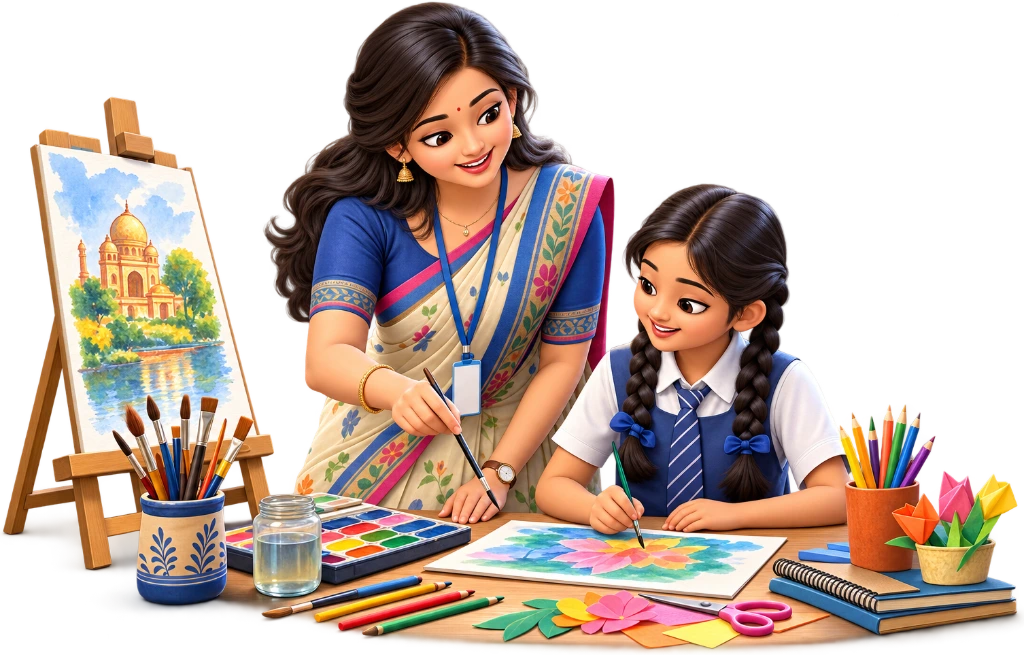
Teaches drawing, painting and craft in a school, and usually runs the exhibitions, competitions and everything visual the school produces. A fine arts qualification plus teaching credentials is the common route.
- Route in
- Earliest entry: Diploma. Also entered at: Diploma, Undergraduate. Direct entry. 2 courses lead here
- Entry pay
- ₹12,000 – ₹25,000 / monthly Any experience
- Where you work
- Advertising agencies, Publishing houses, Animation and gaming studios, Art galleries
How people get in
Getting in
Earliest entry point. Diploma level.
Other levels people enter from. Diploma, Undergraduate.
Where people work
Outlook
Advertising agencies, Publishing houses, Animation and gaming studios, Art galleries.
Indicative starting salary
Understand the role
12,000 - 25,000 per month at entry level.
This is an indicative range, not a quote. Actual pay varies with employer, city, sector and the specific role.
What this work actually is
Understand the role
You will spend less time making your own art than many students expect. You teach drawing, painting, craft and visual ideas, then assess work, plan lessons and help each child improve. You also often produce the school’s visual work: exhibition displays, competition entries, stage backdrops, noticeboards, certificates and festival decorations.
Most art teachers work in school art rooms, classrooms and assembly halls, with paint, paper, clay, storage cupboards and a timetable that rarely leaves much preparation time. You work with class teachers, activity coordinators and school leaders. During annual days or exhibitions, you may stay back to mount work, label displays and manage students carrying fragile pieces.
Your own drawing skill matters, but teaching skill and classroom control decide whether you do well. A strong artist who cannot organise a noisy class, work within a small materials budget or explain a technique simply will struggle. Schools also judge you by visible results, such as student portfolios, displays and competition work, alongside regular teaching.
What you actually do
Day to day
You teach art skills, but you also keep classrooms, corridors and school events looking organised and visually alive.
- Plan a drawing, painting or craft lesson around the class timetable and age group.
- Demonstrate a technique, such as shading a sphere, mixing a skin tone or folding paper for a model.
- Set out paper, colours, brushes, clay or recycled material before the class arrives.
- Move around the room to correct grip, proportion, colour use and unsafe handling of scissors or paint.
- Clean and sort student work, tools and leftover materials after the period.
- Review sketchbooks and give specific feedback on composition, effort and finish.
- Display selected student work on classroom boards or corridor panels.
- Make a list of paints, chart paper, glue, brushes and other supplies that need replacing.
- Adapt activities for students who need simpler steps, extra time or closer supervision.
- Coordinate with class teachers for assemblies, theme days and displays.
- Choose a theme and brief students for an exhibition, poster contest or inter-school art competition.
- Set deadlines for rough sketches, final work, labels and mounting.
- Mount artwork, write name labels and arrange displays so visitors can view them safely.
- Prepare backdrops, props, banners or notice-board material for annual day and school functions.
- Select and pack student entries according to the competition rules.
- Assess portfolios, practical work and class participation against the school rubric.
- Enter marks and short comments in school records or report cards.
- Keep strong examples of student work for future displays and lesson ideas.
- Plan the next term's material needs and submit a supply request.
The part people are surprised by. A large part of the job is mounting displays, finding materials, cleaning up and meeting event deadlines, not painting or drawing yourself.
Who this suits
Fit
Art teaching suits you if you enjoy making art, but also have the patience to teach thirty students with very different confidence and skill levels.
- You like showing a beginner how to shade a sphere, mix a skin tone, or cut a clean stencil, then watching them try it themselves.
- You do not mind that much of the work is practical supervision: distributing materials, checking paint spills, keeping scissors safe, and getting the room clean before the next period.
- You can stay calm when a student says, “I cannot draw,” and give them a small next step instead of praising vaguely.
- You enjoy planning work around school events, such as exhibition boards, annual-day backdrops, competition entries, certificates and stage props, often with a fixed deadline.
- You notice the work behind a picture. You can explain why a poster is hard to read, why proportions look odd, or why a colour choice changes the mood.
- You are comfortable managing a class while students use messy materials. If noise, repeated instructions and unfinished work drain you quickly, this job is likely to frustrate you.
- You are willing to keep practising your own drawing, painting or craft after college. Students notice when their teacher can demonstrate a technique, not only describe it.
Skills that actually matter
Capability
You need to teach art clearly, keep a class working safely, and finish the displays, competition entries and visual work that schools rely on.
You break drawing, painting and craft into small steps, show the technique, then help each student improve without doing the work for them.
How to build it. Teach one 30-minute art activity each week to children in your family, neighbourhood or a local tuition group. Plan the materials, demonstrate one skill, and keep samples of the lesson plan and student work.
Art periods need materials ready before students arrive. You must bring the right paper, colours and tools, set deadlines, and still complete exhibition boards and competition work on time.
How to build it. Run a low-cost monthly art project using a written materials list, a budget and a deadline. Use old cartons, newspapers and leftover fabric where possible, then record what ran short and how you would plan it next time.
A room with paint, scissors, glue and 35 students gets noisy fast. You need firm routines for sharing materials, cleaning up and stopping unsafe behaviour without turning every period into a scolding session.
How to build it. Volunteer to help manage an art activity at a school event, library or community centre. Practise giving instructions in three steps, assigning material monitors, and leaving the room clean within ten minutes.
You need enough control over line, colour, composition and common craft methods to demonstrate them and spot why a student's work is not working.
How to build it. Build a portfolio of 12 finished pieces across pencil, poster colour, watercolour, collage and three-dimensional craft. Copy no one’s work blindly: label the technique, materials, time taken and what you changed after feedback.
You regularly turn a school theme, national day or limited material box into work students of different ages can actually make.
How to build it. Choose one theme, such as water conservation or a district festival, and design three activities for classes 3, 6 and 9. Set a strict materials limit for each activity so you learn to create within a school budget.
Students often think they are 'bad at art' after one failed drawing. You need to give a clear correction, praise real effort, and speak to parents or colleagues about progress when needed.
How to build it. After each practice lesson, give every learner one specific comment: name what worked and one next step. Avoid vague praise such as 'nice work'; say, for example, 'your shapes are clear, now make the light side lighter'.
Schools often expect you to mount artwork, make backdrops, prepare competition entries and coordinate exhibition days alongside normal classes.
How to build it. Create a small exhibition in your school, college corridor or community hall. Make labels, arrange work by theme, prepare a hanging plan, and photograph the final display for your portfolio.
Basic photo editing, presentation design and digital illustration help when you prepare posters, certificates, exhibition notices or reference images.
How to build it. Use free software or a phone app to make five classroom-ready posters and a simple digital portfolio of your own artwork. Learn clean cropping, readable text and correct image credits.
What separates the well paid from the average. The better-paid teachers usually build trust with students and school staff, then reliably deliver polished exhibitions and competition work without last-minute chaos.
The honest part
Read this one
The hard part is that art periods are often treated as the school’s spare time until an annual day, competition or exhibition is due. Then you may need to prepare work from many classes, arrange displays, find materials, manage paint and glue, and meet a fixed date. Teaching drawing also means handling mixed ability. One child finishes quickly; another is afraid to make the first line.
Your first two years usually involve lesson plans, checking work, controlling a noisy room and doing plenty of practical preparation after class. You may spend more time mounting charts and cleaning brushes than making your own art. Some teachers leave because they want more time for studio practice, freelancing, galleries, animation or design work. Others move when repeated contract roles or limited pay growth no longer suit them.
What people get wrong
Read this one
Art teaching involves much more than making attractive drawings with students.
- "Art teacher" means you spend the day painting. You will teach basics repeatedly, plan lessons, manage a noisy class, assess work and help students who think they cannot draw.
- You need to be a brilliant professional artist first. Good art skills matter, but explaining shading to a Class 6 student and keeping materials organised matter just as much.
- The job ends when the art period ends. Schools often expect you to prepare displays, exhibitions, competition entries, stage backdrops and posters for events.
- Art has no serious career path in education. With experience, you can lead the department, and further study such as an MFA can support a move towards college teaching.
- Any art course is enough for a school post. A BFA followed by BEd or an art education qualification is the common route, and some posts require a teacher eligibility test.
Working reality
Read this one
Job availability scores lowest because schools hire limited art teachers, while many applicants compete for each post.
The route in, step by step
6 steps from where you are now.
Class 12, any stream Required
Art teaching is one of the more secure routes for someone who wants to keep making work.
Bachelor of Fine Arts Required
Four years in painting, sculpture, applied art or another specialisation.
Bachelor of Education, or an art education qualification Required
A B.Ed is required for most school teaching posts, and many state boards require an art-specific teaching qualification. Check your state's recruitment rules before choosing.
Clear the teacher eligibility test where required Required
State TET or CTET for government school posts. Private schools set their own requirements.
Teach Required
School art departments, or art institutes and studios. The steady income is what makes a personal practice sustainable, which is why many artists choose this deliberately.
Head of department, or MFA and college teaching Optional
An MFA opens college-level teaching, which pays better and leaves more studio time.
Courses that lead here
2 mapped routes into this career.
The roles this becomes
6 lanes out of the same starting point.
What it pays
Indicative bands.
| Stage | Pay band | What changes |
|---|---|---|
| Any experience | ₹12,000 – ₹25,000 / monthly | Varies by employer |
These are ranges, not offers. Pay varies by city, employer size, sector and your own skill more than by job title. Treat the band as the shape of the market, not as a number you can hold anyone to.
Common questions
The ones people actually ask about this work.
What qualification do you need to become a Art Teacher?
The earliest entry point is diploma level. People also enter from: Diploma, Undergraduate.
Where does a Art Teacher usually work?
Advertising agencies, Publishing houses, Animation and gaming studios, Art galleries.
What does a Art Teacher earn to start?
12,000 - 25,000 per month is a typical entry-level range. Pay varies with employer, city and sector.
Test this against your own priorities
Pay, hours and entry route matter differently to different people. Compare this against the alternative you are actually weighing, rather than against the average.