
Artist
Last updated · Confirm dates, fees and eligibility on the official website before you apply.
Makes original visual work - painting, sculpture, printmaking, digital - and earns from commissions, galleries, teaching or applied work. Almost nobody earns from a single source, and the portfolio is the qualification.
- Route in
- Earliest entry: Diploma. Also entered at: Diploma, Undergraduate, Postgraduate. Direct entry. 3 courses lead here
- Entry pay
- ₹12,000 – ₹25,000 / monthly Any experience
- Where you work
- Animation and gaming studios, Advertising agencies, Publishing houses, Art galleries and museums
How people get in
Getting in
Earliest entry point. Diploma level.
Other levels people enter from. Diploma, Undergraduate, Postgraduate.
Where people work
Outlook
Animation and gaming studios, Advertising agencies, Publishing houses, Art galleries and museums.
Indicative starting salary
Understand the role
12,000 - 25,000 per month at entry level.
This is an indicative range, not a quote. Actual pay varies with employer, city, sector and the specific role.
What this work actually is
Understand the role
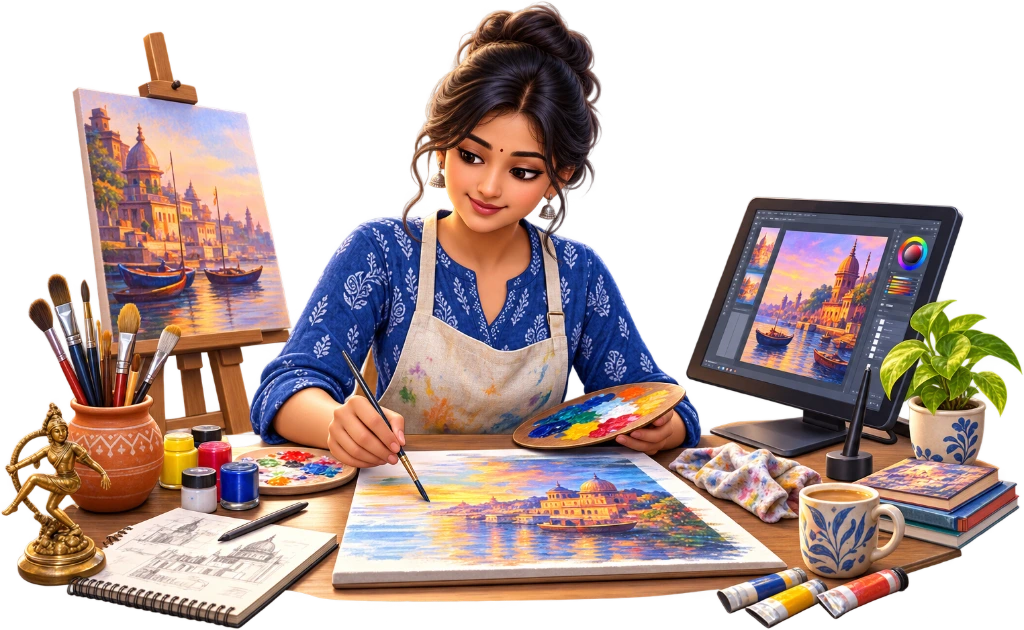
You make original visual work that carries your own idea and style, rather than only following a client brief as a designer or illustrator often does. This might mean painting a series, making a sculpture, creating prints, or producing digital artwork. You also photograph work, prepare it for display, price commissions, speak to buyers, and keep a portfolio that shows what you can do.
Work happens in a personal studio, a shared art space, an art gallery, museum, publishing house, advertising agency, or animation and gaming studio. On an exhibition project, you may work with gallery staff, framers and curators. In applied work, you take briefs from editors, art directors, animators or clients, then revise work to fit a deadline and budget.
Your portfolio matters more than a single degree when someone decides to buy, exhibit or commission your work. Income often comes from several sources at once, such as commissions, teaching, gallery sales and contract work. Discipline matters as much as creativity: you need to keep making work during slow periods, apply for shows, follow up on payments, and build trust over years.
What you actually do
Day to day
You spend much of your time making work, but you also photograph it, find buyers or clients, and keep income coming from more than one source.
- Develop paintings, sculptures, prints or digital pieces from sketches, references and experiments.
- Prepare surfaces, mix colours, edit digital files, or build forms with the materials chosen for a piece.
- Photograph finished work in good light and save clear images, dimensions and material details for your portfolio.
- Clean tools, label work in progress, and store paper, canvases or fragile pieces safely.
- Revise a piece after seeing where its composition, colour or finish is not working.
- Update your portfolio with recent work and short notes about the idea, size, medium and date.
- Reply to commission enquiries and discuss the brief, deadline, revisions, price and delivery method.
- Send selected work or portfolio links to galleries, publishers, advertising agencies, studios or exhibition calls.
- Plan a teaching session, workshop or applied-art assignment when this forms part of your income.
- Buy materials and check what you can finish with the time and budget available.
- Agree the subject, format, number of revisions, delivery date and payment terms before starting a commission.
- Make test sketches or digital drafts and get approval before committing to a large or costly piece.
- Frame, mount, pack or crate work so it reaches a gallery, museum, client or exhibition venue without damage.
- Write captions, an artist statement and a price list for work being shown or offered for sale.
- Install work at the venue, check lighting and labels, then collect or arrange return transport after the show.
- Send invoices for commissions, teaching, applied work or sales, and follow up on overdue payments.
- Record sales, material bills, studio rent, framing, printing, transport and other work expenses.
- Set aside time for paid work that supports your art practice when sales or commissions are irregular.
- Review which kinds of work brought enquiries, sales or repeat clients, then decide what to develop next.
The part people are surprised by. A large part of the job is photographing, pricing, packing, promoting and chasing payment for your work.
Who this suits
Fit
This work suits you if making and showing original visual work matters to you enough to keep practising when nobody has asked for it yet.
- You fill sketchbooks, make prints, paint, sculpt or create digital images on your own, then want to improve the work rather than only collect likes for it.
- You can spend hours correcting a composition, changing colours, or remaking one small section because the final image still feels wrong to you.
- You are willing to build a portfolio over years and show it repeatedly, including to galleries, clients, teachers and people who may reject it.
- You do not need one fixed job title or one monthly income source. Many artists combine commissions, teaching, applied work, freelancing and occasional gallery sales.
- You can plan your own practice without a teacher setting daily homework. A large part of the work is solitary: making work, photographing it, writing proposals, packing it and keeping track of enquiries.
- You can accept that income may start unevenly, especially while you build a body of work and contacts. If you need a predictable salary from the first year, this is probably not the right first choice.
- You enjoy learning both hand and digital methods, depending on your work, such as drawing, printmaking, sculpture, digital illustration or art for publishing, advertising, animation and gaming.
Skills that actually matter
Capability
Your portfolio gets you noticed, but steady practice and clear dealing with clients help you keep earning.
You need to notice proportion, light, colour and surface, then turn them into work with your chosen medium, such as paint, clay, print or digital tools.
How to build it. Keep one low-cost sketchbook and draw the same objects, people and streets repeatedly. Use daylight, compare your work with the subject, and make finished studies instead of only quick posts.
A portfolio must show your strongest work, a clear style or range, and proof that you can finish a brief. Ten strong pieces beat forty unfinished experiments.
How to build it. Photograph work near a window with a plain background. Keep a free online folder with titles, medium, size and year. Ask an art teacher, senior student or local artist to help you remove weak pieces.
You need original visual ideas and the habit of finding several ways to treat a subject, rather than copying the first reference image you find.
How to build it. Set small briefs for yourself, such as five posters on one local issue or three versions of a portrait. Collect references from life, museums, books and your district, then write what you changed and why.
Most art income comes after the unglamorous work: regular practice, fixing rejected drafts, packing work, updating images and meeting a promised date.
How to build it. Make a weekly timetable around college or other work. Set one finish date each week, even for a small study, and track hours and materials in a notebook.
For commissions, teaching and applied work, you need to understand what a client wants, explain your choices plainly and handle feedback without losing the brief.
How to build it. Take small real briefs from a school club, community group or family business. Before starting, write the subject, size, deadline, budget and number of changes in a simple message.
You need to count materials, time, framing, delivery and platform fees before quoting. Poor records make irregular freelance income harder to manage.
How to build it. Use a notebook or free spreadsheet for every piece. Record material cost, hours, quoted amount, payment received and photographs of the final work. Practise writing estimates for your own sample projects.
Clean images, simple layouts and basic digital editing help when applying to galleries, publishing work or taking projects from advertising, animation and gaming teams.
How to build it. Learn one free or low-cost image-editing and layout tool through its official tutorials. Create a one-page portfolio PDF and revise it after each finished project.
What separates the well paid from the average. Artists who earn more usually finish a recognisable body of work, price it properly and deliver reliably, rather than relying on talent alone.
The honest part
Read this one
The hard part is not making one good piece. It is making work regularly when nobody has ordered it, paid for it or praised it. In your first two years, you may spend more time building a portfolio, photographing work, sending proposals, packing pieces and posting online than painting or sculpting. Many artists take a ₹12,000 to ₹25,000 monthly role in 2026 alongside their practice, often in teaching, design, publishing or a studio.
Income can arrive late, unevenly and from several places: a commission one month, a workshop the next, then freelance applied work. Rejection from galleries, clients and open calls is routine, and feedback can be blunt. People usually leave when they need steadier pay, dislike selling their own work, or find that deadlines in advertising, animation or teaching suit them better than the long, solitary work of building an independent practice.
What people get wrong
Read this one
Making art for a living usually means building a portfolio and several income streams at the same time.
- “Artists only paint pictures for galleries.” Many artists also make digital work, prints, illustrations or sculpture, and take commissions, teaching or applied-work assignments.
- “You need a BFA before you can start.” A BFA or diploma helps you learn and meet peers, but direct entry exists; the work in your portfolio matters most.
- “If your work is good, people will find it.” You still need to show work, speak to clients or galleries, keep records and follow up on payments.
- “Artists earn only when they sell an original painting.” Most combine commissions, gallery sales, teaching, workshops, freelancing or studio work because one source rarely pays regularly.
- “Art is only a hobby with no paid work.” Animation and gaming studios, advertising agencies, publishing houses, galleries and museums hire people with strong visual work, though early income is often uneven.
Working reality
Read this one
Pay predictability scores lowest because most artists combine commissions, sales, teaching and applied work, so income often changes from month to month.
The route in, step by step
6 steps from where you are now.
Class 12, any stream Required
No formal requirement exists to be an artist. What follows is the route that makes it a living.
Bachelor of Fine Arts Required
Four years. The degree matters less for the certificate than for the studio time, the criticism and the peer group - all three are hard to replicate alone.
Build a body of work Required
Not scattered pieces - a coherent body with a consistent enquiry. Galleries and curators respond to a body of work, never to a portfolio of unrelated images.
Show your work Required
Group shows, art fairs, open calls and residencies. Residencies in particular give time, contacts and credibility, and many are funded.
Find income alongside the practice Required
Teaching, commissions, illustration or design work. Almost every working Indian artist has a second income stream, and planning for that honestly is better than discovering it.
Gallery representation, or an MFA Optional
Representation gives a market and takes a commission. An MFA opens teaching and international residencies.
Courses that lead here
3 mapped routes into this career.
The roles this becomes
7 lanes out of the same starting point.
What it pays
Indicative bands.
| Stage | Pay band | What changes |
|---|---|---|
| Any experience | ₹12,000 – ₹25,000 / monthly | Varies by employer |
These are ranges, not offers. Pay varies by city, employer size, sector and your own skill more than by job title. Treat the band as the shape of the market, not as a number you can hold anyone to.
Common questions
The ones people actually ask about this work.
What qualification do you need to become a Artist?
The earliest entry point is diploma level. People also enter from: Diploma, Undergraduate, Postgraduate.
Where does a Artist usually work?
Animation and gaming studios, Advertising agencies, Publishing houses, Art galleries and museums.
What does a Artist earn to start?
12,000 - 25,000 per month is a typical entry-level range. Pay varies with employer, city and sector.
Test this against your own priorities
Pay, hours and entry route matter differently to different people. Compare this against the alternative you are actually weighing, rather than against the average.