
Automobile Engineer
Last updated · Confirm dates, fees and eligibility on the official website before you apply.
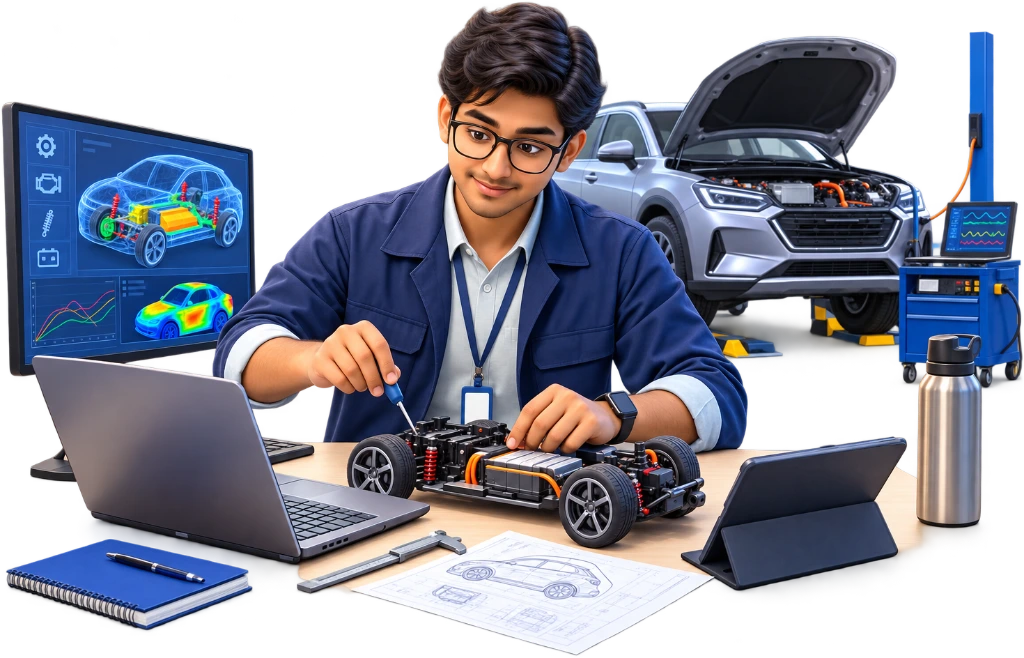
Develops, tests, manufactures and improves vehicles and their mechanical, electrical and electronic systems.
- Route in
- Automobile, mechanical or related engineering education is common. CAD, manufacturing, vehicle systems, electronics and practical projects strengthen entry readiness. 2 courses lead here
- Entrance
- Joint Entrance Examination Main
- Entry pay
- ₹350,000 – ₹1,600,000 / annual 0–10 yrs
- Where you work
- Automotive manufacturers, component suppliers, testing, mobility technology, dealerships and research centres. Regular or plant-shift hours depending on function.
Overview
What this career is, in plain terms.
Automobile Engineer overview
Understand the role
Eligibility and preparation
Fit
Work environment
Capability
Reality check
Read this one
What you actually do
Day to day
You spend much of the job turning vehicle requirements into drawings, test results and production changes, then checking that parts work reliably outside the CAD screen.
- Create or revise CAD drawings for a vehicle part, such as a bracket, suspension arm or battery enclosure.
- Check dimensions, materials and tolerances against the design specification.
- Review test data for heat, vibration, braking, emissions or electrical faults.
- Discuss a part failure or fitment problem with manufacturing, quality and supplier teams.
- Record design changes, test observations and approval notes in engineering documents.
- Inspect prototype vehicles or components during workshop, track or road tests.
- Compare failed parts with drawings and previous test results to identify the likely cause.
- Join design reviews to check whether a new part can be manufactured and assembled.
- Follow up with suppliers on sample parts, measurements and corrective actions.
- Plan the next set of tests and confirm that instruments, parts and safety checks are ready.
- Visit a plant or supplier site to examine an assembly issue on the line.
- Check a trial-built vehicle for panel gaps, noise, fluid leaks, warning lights or loose connections.
- Support changes to tooling, assembly steps or inspection points after a repeated defect.
- Prepare evidence for sign-off before a component moves from prototype to production.
- Travel to a test site or supplier facility when the vehicle or part needs hands-on inspection.
- Reproduce the fault under the same speed, load, temperature or road conditions where possible.
- Measure the affected component and compare it with the approved specification.
- Work with technicians to remove, inspect and refit the failed part.
- Suggest a design, material or process change and arrange a repeat test.
- Write a failure report that states the fault, likely cause, action taken and result.
The part people are surprised by. A large share of the work is documentation, measurements, meetings and repeat tests; designing a new vehicle part is only one part of getting it approved.
How people actually get in
Getting in
Most automobile engineers enter after a BE or B.Tech in automobile, mechanical or a related branch, then prove their skills through projects and practical work.
Complete an undergraduate engineering course, then build a portfolio of CAD models, vehicle-system work and practical projects. Internships, workshop exposure and final-year projects help when you apply to manufacturers, component suppliers, testing teams or mobility technology firms.
Usually takes Usually 4 years, followed by entry-level job applications.
Many engineers enter vehicle work from mechanical engineering. Choose projects in engine systems, thermal engineering, manufacturing, design or testing. Learn CAD and show that you can take a component from drawing to prototype, test report or production plan.
Usually takes Usually 4 years, followed by entry-level job applications.
Electrical, electronics and related engineering graduates often move into vehicle electronics, controls, testing or mobility technology roles. Projects involving sensors, embedded systems, batteries or vehicle diagnostics make this route stronger.
Usually takes Usually 4 years, followed by entry-level job applications.
After an eligible engineering degree, you can apply for government automotive design and related engineering posts when vacancies open. Selection depends on the recruiting body and post. Government roles may involve design review, testing, manufacturing support or inspection work.
Usually takes Usually 4 years for graduation, then recruitment timelines vary.
The honest part
Read this one
The hard part is that vehicles fail in small, stubborn ways. You may spend days tracing a noise, a vibration, a sensor fault or a drawing mismatch, then document the fix for review. In the first two years, much of your work is testing parts, updating CAD drawings, reading test data, following plant procedures and learning how suppliers, production and quality teams work. Remote work is not usual, and plant shifts or travel to a testing site can affect your routine.
You need patience with repeat checks and the confidence to ask basic questions without pretending you know the answer. A design role has less greasy hands than a workshop role, but it still depends on real manufacturing limits. Some people leave because they dislike shift-linked plant work, slow approval cycles or the gap between designing a part and seeing it reach production. Others move into manufacturing, quality, supplier work, testing, mobility technology or a government engineering role.
What people get wrong
Read this one
Automobile engineering is practical engineering work around vehicles, factories, parts and tests, not only sketching a new car.
- "I need an Automobile Engineering degree or I cannot enter." Automobile engineering is a common route, but mechanical or related engineering education also leads to vehicle roles when you build relevant CAD, manufacturing, electronics and vehicle-systems skills.
- "The job is only about designing cars." Design is one path, but engineers also test brakes and electronics, improve assembly processes, work with component suppliers, and investigate faults in vehicles already on the road.
- "It is a desk job with occasional factory visits." Many roles need regular time at plants, test sites or supplier locations, and plant functions may run on shifts. Remote work is generally not part of this career.
- "Electric vehicles have made mechanical skills useless." Electric vehicles still need structures, cooling, suspension, braking, manufacturing and testing, while adding electrical and electronic systems work.
- "There is no stable work outside private vehicle companies." You can work with manufacturers, component suppliers, dealerships, mobility technology firms, research centres and government design roles. Government Automotive Design Engineer roles are recorded at ₹3.5 lakh to ₹16 lakh a year across 0 to 10 years, though selection is competitive and roles are limited.
Where this leads
Outlook
Your next move depends on whether you want to design parts, solve plant problems, test vehicles, or move towards manufacturing and mobility systems.
| Who employs | What it is like |
|---|---|
| Vehicle manufacturers | You work with design, manufacturing, quality or vehicle integration teams. Plant-linked roles follow production schedules and may include shifts; design teams want CAD work, drawings and proof that you understand vehicle systems. |
| Auto-component suppliers | These firms make parts such as brakes, wiring, seats, engines or electronic units for several vehicle makers. The pace is tied to delivery deadlines, quality checks and supplier audits, with frequent attention to cost and repeatable production. |
| Government automotive and engineering organisations | Government roles usually offer clearer pay structures and stronger job security, but entry is competitive and project approvals can move slowly. For an Automotive Design Engineer, the recorded indicative pay is ₹3.5 lakh to ₹16 lakh a year across 0 to 10 years. |
| Vehicle testing and research centres | You test vehicles or components for performance, durability and faults. Expect test reports, instrument readings, repeat trials and some travel to tracks, plants or supplier sites; employers look for careful measurement and documented work. |
| Dealership and service networks | Work centres on diagnosing faults, supporting technicians and dealing with warranty cases or customer complaints. The work is practical and time-bound, especially when a vehicle must return to a customer quickly. |
| Mobility technology and engineering service firms | Teams work on connected systems, electronics, simulation or engineering projects for other organisations. Contract roles are common, and they want solid CAD, vehicle-systems or electronics skills alongside clear documentation. |
Working reality
Read this one
Job availability scores lowest because entry usually depends on practical engineering skills and openings with manufacturers, suppliers, testing teams or dealerships.
The route in, step by step
5 steps from where you are now.
Understand the real work Required
Explore the daily responsibilities, work environment and constraints of Automobile Engineer before choosing a course.
Complete an eligible recognised pathway Required
Automobile, mechanical or related engineering education is common. CAD, manufacturing, vehicle systems, electronics and practical projects strengthen entry readiness.
Build verified practical ability Required
Use laboratories, projects, supervised training, internships or portfolio work appropriate to the profession.
Enter a suitable role Required
Apply through the relevant recruitment, campus, portfolio, examination, registration or professional process.
Develop specialisation Optional
Choose advanced study or certification after confirming recognition, eligibility, cost and relevance to the intended role.
Courses that lead here
2 mapped routes into this career.
Exams on the way
What is required, and what is optional.
Exam rules and eligibility are revised regularly. Check the current official notification for your admission year before you act on anything here.
The roles this becomes
1 lane out of the same starting point.
What it pays
Indicative bands.
| Stage | Pay band | What changes |
|---|---|---|
| Automotive Design Engineer | ₹350,000 – ₹1,600,000 / annual | Broad indicative annual range only; actual pay varies substantially by skill, experience, location, employer and role scope. |
These are ranges, not offers. Pay varies by city, employer size, sector and your own skill more than by job title. Treat the band as the shape of the market, not as a number you can hold anyone to.
Who can enter
1 route into this work.
| Qualification | Stream | Minimum | Subjects |
|---|---|---|---|
| Graduation | Any | — |
Common questions
The ones people actually ask about this work.
What does a Automobile Engineer do?
Develops, tests, manufactures and improves vehicles and their mechanical, electrical and electronic systems.
How can I become a Automobile Engineer?
Automobile, mechanical or related engineering education is common. CAD, manufacturing, vehicle systems, electronics and practical projects strengthen entry readiness.
Where does a Automobile Engineer work?
Automotive manufacturers, component suppliers, testing, mobility technology, dealerships and research centres. Regular or plant-shift hours depending on function.
Is Automobile Engineer a good career in India?
It can be suitable when your aptitude, interests, eligibility and preferred work conditions align with the role. Compare recognised pathways, real tasks, costs and current opportunities before deciding.
Test this against your own priorities
Pay, hours and entry route matter differently to different people. Compare this against the alternative you are actually weighing, rather than against the average.