
Automobile Mechanic
Last updated · Confirm dates, fees and eligibility on the official website before you apply.
Diagnoses and repairs vehicles. EV service upskilling is increasingly the differentiator as the fleet transitions.
- Route in
- Earliest entry: ITI. Direct entry. 2 courses lead here
- Entry pay
- ₹12,000 – ₹22,000 / monthly Any experience
- Where you work
- OEM authorised service centres (Maruti, Tata, Hyundai), Multi-brand workshops
What this role is
Understand the role
Diagnoses and repairs vehicles. EV service upskilling is increasingly the differentiator as the fleet transitions.
How people get in
Getting in
Earliest entry point. ITI level.
Licence or registration. Registration with the State Allied and Healthcare Council under NCAHP, where the state council has been constituted.
Where people work
Outlook
OEM authorised service centres (Maruti, Tata, Hyundai), Multi-brand workshops.
Indicative starting salary
Understand the role
12,000 - 22,000 per month at entry level.
This is an indicative range, not a quote. Actual pay varies with employer, city, sector and the specific role.
What you actually do
Day to day
Most of your time goes into finding the real fault, then repairing the vehicle safely and explaining the work clearly to the customer.
- Listen to the customer’s complaint and note when the noise, warning light or loss of power occurs
- Inspect the engine bay, brakes, tyres, suspension and fluid levels for visible faults
- Use diagnostic equipment to read fault codes and test electrical circuits
- Repair or replace worn parts such as brake pads, filters, belts, batteries or sensors
- Test-drive or run the vehicle after repair to check that the fault has gone
- Change engine oil and replace oil, air or fuel filters according to the service schedule
- Check tyre pressure, tread wear and wheel alignment symptoms
- Inspect brake discs, pads, hoses and brake-fluid level for wear or leaks
- Top up or replace approved fluids and record the work done
- Reset the service reminder and complete the job card
- Trace an intermittent starting, charging or wiring fault with a multimeter and scan tool
- Compare live sensor readings with the vehicle’s specified values
- Remove panels or components carefully to reach a leak, damaged connector or failed part
- Check technical instructions before working on unfamiliar systems
- Escalate a complex diagnosis to a senior technician or workshop foreman when needed
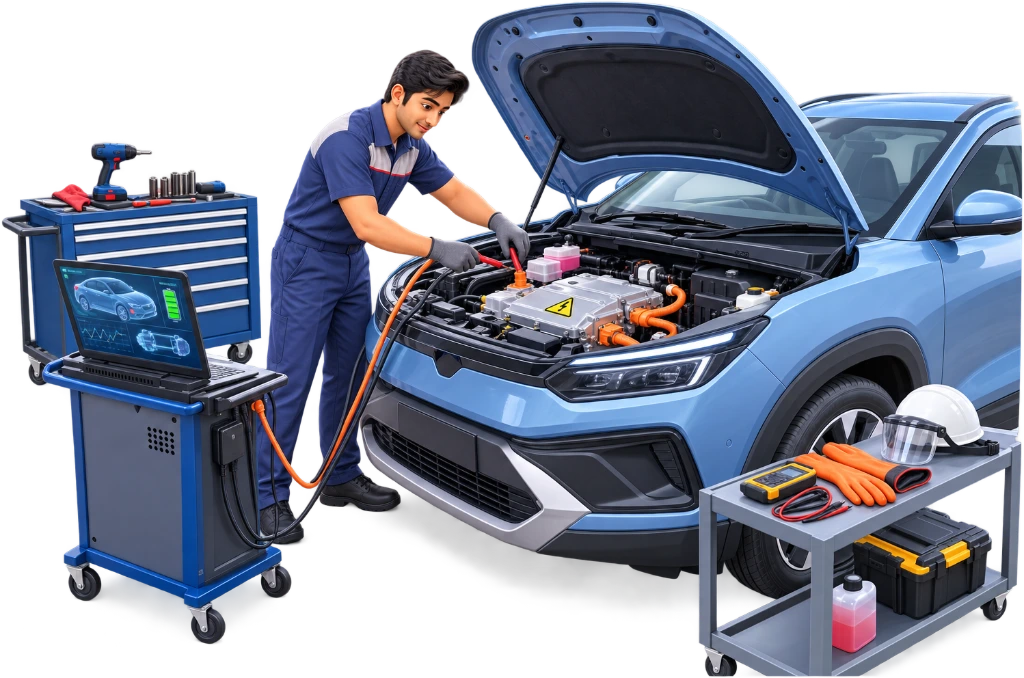
- Inspect charging ports, cables and warning messages before beginning a repair
- Read battery, motor and controller fault codes with the approved diagnostic tool
- Check cooling lines and connections around EV components for damage or leaks
- Follow workshop safety steps before touching high-voltage parts
- Record EV-related faults and parts replaced on the job card
The part people are surprised by. A large part of the job is paperwork, job cards, parts checks and explaining a repair in simple words, not turning spanners.
Who this suits
Fit
This work suits you if you prefer finding a fault with your hands and tools, then seeing the vehicle leave in working order.
- You enjoy taking things apart carefully, keeping track of bolts, clips and wires, and putting them back without creating a new problem.
- You do not mind getting grease on your hands or spending much of the day standing, bending under a bonnet, or working beneath a lifted vehicle.
- You notice a change in an engine sound, brake feel or vibration, and you have the patience to test possible causes instead of guessing.
- You can explain a repair in simple words to a vehicle owner, including what needs attention now and what can wait.
- You are willing to keep learning diagnostic tools and EV service work. A technician who only wants to work on older petrol or diesel vehicles will find fewer options as fleets change.
- You should look elsewhere if you dislike repetitive jobs such as oil changes, tyre checks, cleaning parts and filling service records. Much of workshop work is routine, especially at the start.
Skills that actually matter
Capability
You need reliable hands, a method for finding faults, and the patience to explain a repair clearly to a customer.
Find the actual cause of a complaint before changing parts. This includes reading symptoms, checking error codes, testing circuits and ruling out simple faults such as a loose connector or weak battery.
How to build it. During your ITI and apprenticeship, keep a notebook of real faults: customer complaint, tests done, root cause and repair. Ask to observe diagnosis jobs, not only routine servicing, then repeat the checks under a senior technician's supervision.
Use hand tools, lifting equipment and measuring tools safely. You need to remove and refit brakes, suspension, engine parts and panels without damaging threads, clips, seals or wiring.
How to build it. Take every stripping and refitting task in the ITI workshop seriously. Start with servicing jobs, then practise following torque settings and parts diagrams during an apprenticeship. Photograph connector positions before dismantling, where the workshop allows it.
Modern vehicles depend on sensors, wiring, control units and scan tools. EV work adds high-voltage safety, battery systems, motors and charging faults.
How to build it. Learn multimeter basics first: voltage, resistance, continuity and voltage drop. Use an ITI lab or workshop vehicle to trace one circuit at a time. After basic experience, take manufacturer or recognised EV service training offered through your workplace.
Follow safe lifting, tool, fuel and battery procedures every time. A missed axle stand, wrong torque setting or careless high-voltage check can injure someone or cause a vehicle failure.
How to build it. Make a pre-job habit: isolate the vehicle, use the right protective equipment, check lifting points and confirm torque specifications. Ask a senior to inspect your setup until these steps become automatic.
Listen properly to a noise or vibration complaint, write useful job notes, and explain what needs repair without confusing the customer. You also need to hand over clear information to the service adviser and next technician.
How to build it. At the workshop, listen when senior technicians speak to customers. Practise turning a complaint such as 'car pulls left' into short notes: when it happens, speed, road type and warning lights. Explain one completed repair each week in plain Hindi, English or the local language.
Use repair manuals, wiring diagrams, parts lists and job cards to follow the correct sequence. Guesswork wastes time and can create a second fault.
How to build it. Download or borrow training manuals used in your ITI course and practise finding torque values, fault-code steps and wiring colours. Before starting a job, read the full procedure, then tick off each completed step on the job card.
Finish routine jobs within the workshop's allotted time while checking for leaks, warning lights, loose fasteners and a clean handover. Fast work that returns with the same fault harms your reputation.
How to build it. Time your own servicing tasks during apprenticeship. At the end of each job, use a simple final check list: fluids, bolts, connectors, road test if permitted, and tools removed from the vehicle.
What separates the well paid from the average. The better-paid technicians find difficult faults accurately, avoid repeat repairs, and stay current with electronic and EV systems rather than only doing routine servicing.
The honest part
Read this one
The first two years are usually dirty, repetitive and closely watched. You will spend long hours on routine servicing, oil leaks, brake jobs and parts fitting before anyone trusts you with a difficult diagnosis. Customers want the vehicle back quickly, but a wrong diagnosis costs the workshop money and can bring the same vehicle back angry. You also need to explain faults in simple words, even when the customer thinks a small sound should have a small bill.
Workshop work means standing for much of the day, working in heat, grease and noise, and meeting service deadlines during busy periods. Newer vehicles add scan tools, sensors and software, so learning EV systems and electrical fault finding matters alongside mechanical work. Some people leave for less physical jobs, sales roles or other trades when workshop hours and pay growth feel slow. Others move towards senior technician work, foreman roles, body repair, or a small garage after building trust and repeat customers.
What people get wrong
Read this one
People often judge this work by old ideas about greasy garages, without seeing how vehicle repair is changing.
- “A mechanic only changes oil and fixes punctures.” You spend much of the day finding the real fault, checking brakes, steering, engine parts and electrical systems before fitting a part.
- “You need a degree to start.” An ITI in Mechanic Motor Vehicle or Auto Body Repair is a common direct route after Class 10, followed by workshop learning.
- “This job will disappear because of electric vehicles.” EVs still need inspection, fault diagnosis and repair, but you need to learn EV service work as vehicle fleets change.
- “Workshop work is only physical labour.” Hand skills matter, but so does listening to a customer describe a problem and explaining what repair is needed in simple words.
- “You will remain a junior technician forever.” After workshop experience and a specialisation, some mechanics move into senior technician or foreman work, and some run their own garage.
Working reality
Read this one
Pay predictability scores lowest because workshop income often depends on the employer, your diagnostic skill and the steady flow of repair work.
The route in, step by step
6 steps from where you are now.
Class 10 Required
Entry for the ITI motor vehicle trades.
ITI Mechanic Motor Vehicle, or Auto Body Repair Required
Two years. Mechanic Motor Vehicle covers engine and driveline; Auto Body Repair covers panel and paint. They are different careers, so choose deliberately.
Apprenticeship at a dealership or workshop Required
One year, ending in a National Apprenticeship Certificate. Manufacturer dealership apprenticeships also give you brand-specific training that independents cannot.
Work in a service workshop Required
Periodic service, diagnostics, brake and suspension work, and engine repair. Scan tools and reading fault codes are now as central as the spanner work.
Specialise Required
Automatic transmissions, diesel injection, auto electrical, or electric vehicles. EV service training is short and the demand is rising faster than the supply of trained people.
Senior technician, workshop foreman, or your own garage Optional
Foreman inside a dealership, or an independent workshop, where the constraint is equipment cost and customer trust rather than skill.
Courses that lead here
2 mapped routes into this career.
The roles this becomes
7 lanes out of the same starting point.
What it pays
Indicative bands.
| Stage | Pay band | What changes |
|---|---|---|
| Any experience | ₹12,000 – ₹22,000 / monthly | Varies by employer |
These are ranges, not offers. Pay varies by city, employer size, sector and your own skill more than by job title. Treat the band as the shape of the market, not as a number you can hold anyone to.
Common questions
The ones people actually ask about this work.
What qualification do you need to become a Automobile Mechanic?
The earliest entry point is iti level.
Where does a Automobile Mechanic usually work?
OEM authorised service centres (Maruti, Tata, Hyundai), Multi-brand workshops.
What does a Automobile Mechanic earn to start?
12,000 - 22,000 per month is a typical entry-level range. Pay varies with employer, city and sector.
Does a Automobile Mechanic need a licence or registration?
Registration with the State Allied and Healthcare Council under NCAHP, where the state council has been constituted.
Test this against your own priorities
Pay, hours and entry route matter differently to different people. Compare this against the alternative you are actually weighing, rather than against the average.