
Electronics Engineer
Last updated · Confirm dates, fees and eligibility on the official website before you apply.
Designs and tests electronic circuits, embedded systems, communication equipment and control products.
- Route in
- Electronics, electronics and communication, electrical or related engineering education is common, supported by laboratories, circuit design, programming and projects. 2 courses lead here
- Entrance
- Joint Entrance Examination Main
- Entry pay
- ₹350,000 – ₹1,800,000 / annual 0–10 yrs
- Where you work
- Electronics manufacturing, semiconductor, telecommunications, embedded products, research and automation. Usually regular hours; laboratories and production deadlines may extend schedules.
Overview
What this career is, in plain terms.
Electronics Engineer overview
Understand the role
Eligibility and preparation
Fit
Work environment
Capability
Reality check
Read this one
What you actually do
Day to day
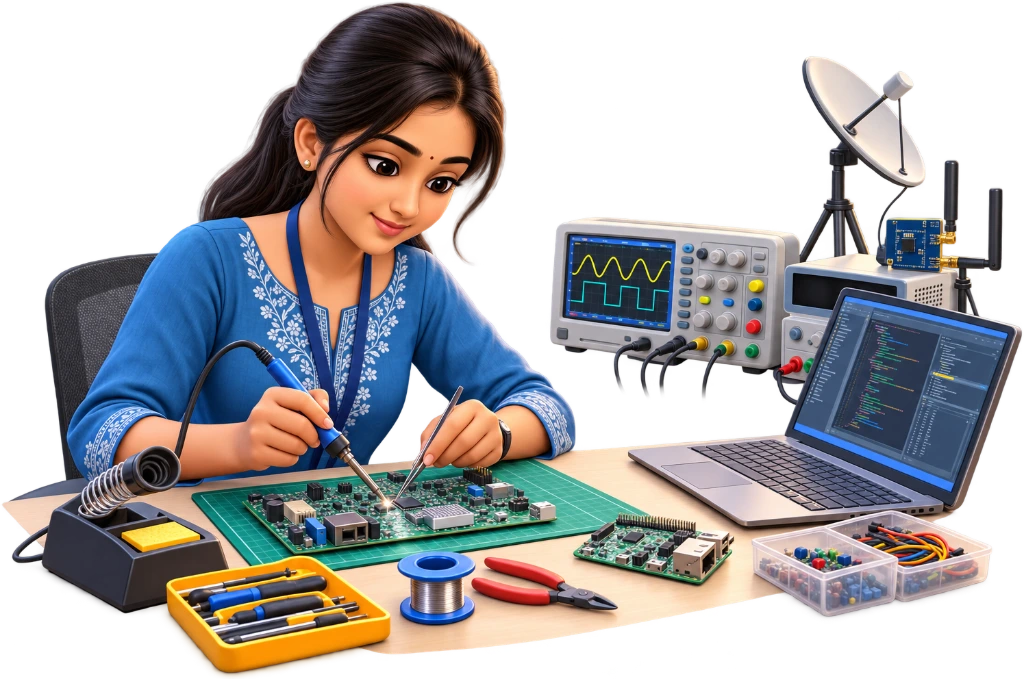
You spend much of the job turning a requirement into a circuit or embedded product that works reliably outside the lab.
- Read circuit diagrams, component data sheets and product requirements before changing a design.
- Draw schematics and select parts such as sensors, regulators, microcontrollers and connectors.
- Write, build and test embedded code for a board or control unit.
- Use lab instruments to measure voltage, current, signal timing and noise.
- Trace a fault on a prototype, then record the cause and the fix.
- Review test results against limits for power use, communication range, speed or temperature.
- Meet mechanical, software and production teams to resolve fit, wiring or interface problems.
- Update circuit drawings, board files, test notes and version records after approved changes.
- Check that replacement components meet the electrical and physical requirements.
- Explain a fault or design change clearly to a project lead or customer team.
- Assemble or inspect prototype boards and check for wrong parts, solder faults or reversed connections.
- Run repeated tests on communication equipment, embedded products or control units under different conditions.
- Support production staff while they test a new board or investigate failures from the line.
- Make a test procedure that another engineer or technician can follow without guessing.
- Prioritise faults that stop the product from working, then track smaller issues for later fixes.
- Visit a manufacturing site to investigate a recurring board or assembly problem.
- Test equipment at an installation site where power supply, wiring or interference differs from lab conditions.
- Review older designs to find parts that are no longer available or need replacement.
- Prepare technical evidence for an internal design review or research project.
The part people are surprised by. A large part of the work is reading data sheets, repeating tests and writing clear records, not building new circuits from scratch.
How people actually get in
Getting in
Most electronics engineers enter after a BE or B.Tech in electronics, electronics and communication, electrical, or a related branch, then show practical work through labs and projects.
After Class 12, study circuit design, programming, laboratories and engineering design. Use projects to show that you can design, test and debug a circuit or embedded system, not only pass written exams. Apply for entry-level roles in manufacturing, telecom, embedded products, automation or research.
Usually takes Usually 4 years after Class 12.
Electrical and related engineering graduates also move into electronics work when their coursework and projects include circuits, control products, programming or embedded systems. Choose practical project work early, because employers will look for evidence of this ability.
Usually takes Usually 4 years after Class 12.
Graduate first through an eligible engineering pathway, then apply when government bodies or PSUs recruit for relevant technical posts. The selection method depends on the vacancy. Government embedded systems work may involve engineering design, testing and technical documentation.
Usually takes Usually 4 years of graduation, then recruitment timing varies.
The honest part
Read this one
The hard part is that circuits rarely fail in a neat, obvious way. You may spend hours tracing a noise problem, checking a power supply, reading a datasheet, or finding why code works on one board and not another. Lab and production deadlines can stretch the day. Remote work is uncommon because you need the hardware in front of you.
In your first two years, expect testing, documentation, small design changes and repeated debugging before you lead a product section. Your college project helps, but employers still look for practical skill with circuits, programming and lab instruments. Some people leave because they dislike detailed fault-finding or slow approval cycles, especially in government or large manufacturing setups. Others move into software, testing, project coordination, sales engineering, or prepare for government exams and PSU roles.
What people get wrong
Read this one
Electronics engineering is practical design work, with long stretches of testing, debugging and improving small details.
- “Electronics engineers only repair phones, TVs and appliances.” Repair work exists, but engineers also design and test circuits, embedded systems, communication equipment and automation controls.
- “You need to be a coding expert, so circuit knowledge does not matter.” Programming helps in embedded work, but you still need to understand components, circuits, laboratory testing and engineering design.
- “It is a desk job that you can do fully from home.” Most roles need access to labs, production lines or physical equipment, so remote work is generally not part of this career.
- “The work is always glamorous invention.” A lot of time goes into finding why a board fails, checking measurements, writing test notes and fixing one fault at a time before a deadline.
- “There is no future beyond private manufacturing jobs.” You can work in telecommunications, semiconductor, research and automation settings, and government embedded systems roles are also recorded in this field.
Where this leads
Outlook
Your next move depends less on the degree name and more on the work you can show: circuits, code, test results and a project that works outside the lab.
| Who employs | What it is like |
|---|---|
| Government electronics and engineering bodies | Work often centres on embedded systems, communication equipment, testing or control products. Pay and promotion follow set grades more often than in private firms. For government Embedded Systems Engineer roles, the recorded indicative range is ₹3.5 lakh to ₹18 lakh a year across 0 to 10 years. Selection may involve a government exam, interview or both. |
| Electronics manufacturing units | You may work near production lines, checking boards, test fixtures, faults and quality records. Deadlines rise before dispatch, and some roles have shifts or contract terms. Employers want people who can read schematics and find a fault without replacing parts at random. |
| Semiconductor and chip design organisations | Work is specialised and detail-heavy, with long debug cycles and strict review of designs and test data. Teams look for strong circuit basics, programming and evidence that you can work carefully with tools and specifications. |
| Telecommunications equipment and network organisations | You may test communication equipment, support field trials or work on hardware used in networks. Travel is low to moderate, but installation or testing deadlines can extend the day. Employers value clear documentation and systematic fault finding. |
| Embedded product and automation firms | Small teams often give you broad work: selecting components, writing firmware, bringing up a board and testing a prototype. The pace can be quick, especially near a customer demonstration. A working project portfolio matters strongly here. |
| Research laboratories and technical institutes | Projects may involve measurement, prototypes, reports and repeated experiments that do not work on the first attempt. Roles can be project-based or contract roles. Employers want patient testing, sound engineering design and accurate records. |
Working reality
Read this one
Job availability scores 3 because entry roles depend heavily on your laboratory work, circuit design, programming projects, and the hiring needs of manufacturing, telecom or embedded-product teams.
The route in, step by step
5 steps from where you are now.
Understand the real work Required
Explore the daily responsibilities, work environment and constraints of Electronics Engineer before choosing a course.
Complete an eligible recognised pathway Required
Electronics, electronics and communication, electrical or related engineering education is common, supported by laboratories, circuit design, programming and projects.
Build verified practical ability Required
Use laboratories, projects, supervised training, internships or portfolio work appropriate to the profession.
Enter a suitable role Required
Apply through the relevant recruitment, campus, portfolio, examination, registration or professional process.
Develop specialisation Optional
Choose advanced study or certification after confirming recognition, eligibility, cost and relevance to the intended role.
Courses that lead here
2 mapped routes into this career.
Exams on the way
What is required, and what is optional.
Exam rules and eligibility are revised regularly. Check the current official notification for your admission year before you act on anything here.
The roles this becomes
1 lane out of the same starting point.
What it pays
Indicative bands.
| Stage | Pay band | What changes |
|---|---|---|
| Embedded Systems Engineer | ₹350,000 – ₹1,800,000 / annual | Broad indicative annual range only; actual pay varies substantially by skill, experience, location, employer and role scope. |
These are ranges, not offers. Pay varies by city, employer size, sector and your own skill more than by job title. Treat the band as the shape of the market, not as a number you can hold anyone to.
Who can enter
1 route into this work.
| Qualification | Stream | Minimum | Subjects |
|---|---|---|---|
| Graduation | Any | — |
Common questions
The ones people actually ask about this work.
What does a Electronics Engineer do?
Designs and tests electronic circuits, embedded systems, communication equipment and control products.
How can I become a Electronics Engineer?
Electronics, electronics and communication, electrical or related engineering education is common, supported by laboratories, circuit design, programming and projects.
Where does a Electronics Engineer work?
Electronics manufacturing, semiconductor, telecommunications, embedded products, research and automation. Usually regular hours; laboratories and production deadlines may extend schedules.
Is Electronics Engineer a good career in India?
It can be suitable when your aptitude, interests, eligibility and preferred work conditions align with the role. Compare recognised pathways, real tasks, costs and current opportunities before deciding.
Test this against your own priorities
Pay, hours and entry route matter differently to different people. Compare this against the alternative you are actually weighing, rather than against the average.