
Electroplater
Last updated · Confirm dates, fees and eligibility on the official website before you apply.
Applying metal coatings to components by electroplating - for corrosion resistance, wear resistance or appearance. Chemistry-adjacent trade work with strict process and safety control.
- Route in
- ITI Electroplater, followed by an apprenticeship 1 course lead here
- Where you work
- Electroplating and metal finishing units, automotive and hardware supply chains Shift work in plating shops
What this is
Understand the role
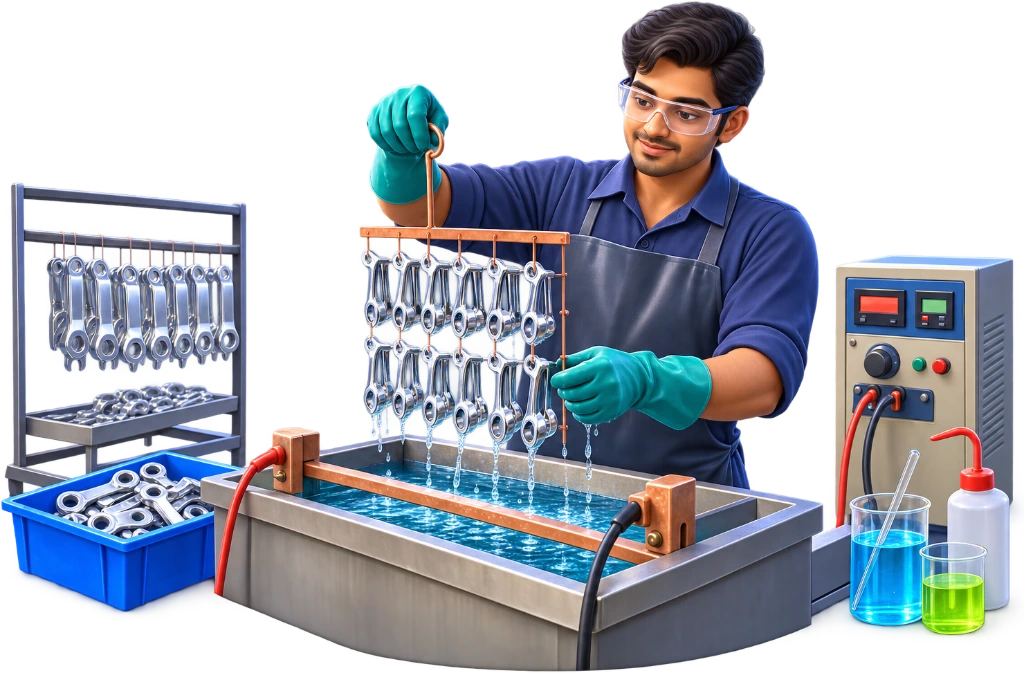
Depositing a metal coating onto a component using an electrical current and a chemical bath — chrome, nickel, zinc, gold — for corrosion protection, wear resistance or appearance. It sits in the supply chain of automotive parts, hardware, jewellery and electronics.
What the work is
Day to day
Cleaning and preparing parts, mixing and maintaining bath chemistry, controlling current and time, then rinsing, drying and inspecting. Coating thickness and adhesion are measurable and specified, so this is process work with quality control attached, not just dipping parts.
What you need
Capability
ITI Electroplater and an apprenticeship. A working grasp of the chemistry pays off quickly, because most plating defects are bath problems rather than handling ones, and the person who can diagnose a bath is worth more than the person who can only run it.
What people get wrong
Read this one
Treating the chemicals casually. Plating baths involve acids, alkalis and in some processes cyanide compounds, and effluent is regulated. Work only in units with proper ventilation, protective equipment and effluent treatment. A shop that is careless with its effluent is careless with your lungs and can also be shut down, taking your job with it.
Who this suits
Fit
This work suits you if you can follow a set process carefully through a full shift, even when the work is wet, chemical-heavy and repetitive.
- You like finding the cause of a defect. A patchy coating, dull finish or rough spot makes you want to check the bath, timing, cleaning and current settings.
- You do not treat gloves, goggles, ventilation and chemical handling as rules to ignore when no supervisor is nearby. Plating work involves strict safety control every day.
- You are comfortable standing for long periods and handling components in a shop. This is physical work, often done in shifts, not desk work or remote work.
- You can repeat the same checks without becoming careless. Much of the job involves preparing parts, watching bath conditions, recording readings and checking finished pieces.
- You are interested in practical chemistry, even if you do not want a degree-level science career. You need to understand how solution strength, contamination and process settings affect a metal coating.
- You may not enjoy this work if you want frequent travel, flexible hours or a clean office setting. Most jobs are in plating and metal-finishing units serving automotive and hardware supply chains.
How people actually get in
Getting in
Most electroplaters enter after Class 10 through a two-year ITI Electroplater course and a one-year apprenticeship in a plating shop.
After Class 10, complete ITI Electroplater. Then work as an apprentice in a plating shop, where you learn bath preparation, coating steps, testing, safe chemical handling and routine cleaning. After this, you usually start by running baths and checking coating quality under supervision.
Usually takes About 3 years before your first regular shop role.
Some people begin as shop-floor helpers or assistants in metal finishing units and learn loading, rinsing, drying and inspection work first. Progress depends on hands-on skill, safety discipline and whether the shop trains you on bath control. This route takes longer to build the chemistry and process knowledge that the ITI teaches.
Usually takes Usually 2 to 4 years to handle bath work with confidence.
After you have run baths for 2 to 3 years, learn effluent treatment and compliance work. This helps if you want to move towards quality checks, shift supervision or running a small unit later. It is a progression route, not a first-entry route.
Usually takes About 6 to 12 months of focused learning after initial shop experience.
The honest part
Read this one
The hard part is discipline. You work around chemical baths, fumes, wet floors and repeated handling of metal parts, often on shifts. A small error in bath concentration, timing or cleaning can leave a patchy coating and reject a full batch. Safety steps and records are part of the job, not paperwork someone else handles.
In your first two years, you will spend a lot of time preparing components, loading racks, checking bath conditions, measuring coating quality and cleaning up. The work is physical, and there is no remote option. People who leave often move to machine operation, quality inspection, maintenance, production supervision or effluent-treatment work. Some stay in metal finishing and work towards supervising a shop or running a small unit.
Where this leads
Outlook
Most electroplaters start in a plating shop, then move towards quality, effluent treatment, supervision or, sometimes, a different manufacturing trade.
| Who employs | What it is like |
|---|---|
| Electroplating and metal finishing units | This is the usual starting point. Work is shift-based and hands-on: preparing parts, checking bath conditions, controlling coating quality and following safety rules. Smaller units often teach you several tasks quickly, but job security and pay can vary with orders. |
| Automotive component supply chains | These units plate fasteners, fittings and other parts that must meet set specifications. The pace is steady and quality checks are strict. They look for people who follow process sheets, spot defects and keep records without skipping steps. |
| Hardware and fittings manufacturers | You may plate door hardware, plumbing fittings, tools or decorative items. Appearance matters alongside corrosion resistance, so surface defects bring rework. Production can rise before dispatch deadlines and festival-season sales. |
| Industrial machinery and engineering component makers | These employers need coatings that resist wear or corrosion on machine parts. Work tends to focus more on thickness, adhesion and inspection than on decorative finish. They value careful bath control and consistent results across batches. |
| Contract metal finishing shops | A contract shop receives parts from many factories, so the work changes from one batch to the next. You learn to read job instructions and handle different finishes, but deadlines can be tight and overtime may rise when orders pile up. |
| PSU and government manufacturing units | Openings are less frequent and usually follow a formal recruitment process. The work is process-led, with clearer safety procedures and records. Selection may involve a trade test or government exam, depending on the post. |
Working reality
Read this one
Work-life balance scores lowest because plating shops commonly run shifts, and production or quality problems can extend your day.
The route in, step by step
6 steps from where you are now.
Class 10 Required
Entry for the ITI trade. Chemistry marks help, because this is applied electrochemistry.
ITI Electroplater Required
Two years - bath preparation, surface preparation, nickel, chrome, zinc and anodising, and the testing that goes with them.
Apprenticeship in a plating shop Required
One year. Automotive component plating is the largest employer and has the tightest standards.
Run baths and control quality Required
Bath chemistry and analysis, current density, thickness testing and adhesion. Rejections are expensive and usually trace to bath control, which is your responsibility.
Learn effluent treatment and compliance Required
Plating generates hazardous effluent. Effluent treatment plant operation and State Pollution Control Board consent conditions are a real part of the job, and the part that closes shops down when ignored.
Shop supervisor, or your own unit Optional
Supervising a plating line, or setting up a unit - which needs pollution control consent, effluent treatment and a serious look at the compliance burden before you commit.
Courses that lead here
1 mapped route into this career.
The roles this becomes
6 lanes out of the same starting point.
Common questions
The ones people actually ask about this work.
What does an electroplater do?
<p>Applies a metal coating to components using an electrical current and a chemical bath — chrome, nickel, zinc or gold — for corrosion protection, wear resistance or appearance. The work is cleaning and preparing parts, controlling bath chemistry and current, then rinsing, drying and inspecting to a specified coating thickness.</p>
Is electroplating work hazardous?
<p>Yes, and it should be treated seriously. Plating involves strong acids and alkalis, and some processes use cyanide compounds. Effluent is regulated and must be treated. Work only in units with proper ventilation, protective equipment and effluent treatment — a shop cutting corners on effluent is also cutting corners on your safety, and can be shut down, taking your job with it.</p>
What makes an electroplater valuable to an employer?
<p>Diagnosing the bath. Most plating defects — dullness, pitting, poor adhesion — are chemistry problems rather than handling ones. The person who can work out why a bath is producing bad parts is worth considerably more than the person who can only run it.</p>
Which industries employ electroplaters?
<p>Automotive component suppliers, hardware and sanitaryware manufacturers, jewellery, electronics and general engineering. Most work is in specialist plating job shops serving those supply chains.</p>
Test this against your own priorities
Pay, hours and entry route matter differently to different people. Compare this against the alternative you are actually weighing, rather than against the average.