
Embedded / Firmware Engineer
Last updated · Confirm dates, fees and eligibility on the official website before you apply.
₹6–30 LPA
- Route in
- Typically Bachelor of Technology (B.Tech). 1 course lead here
- Entry pay
- ₹600,000 – ₹3,000,000 / annual Any experience
What the work involves
Day to day
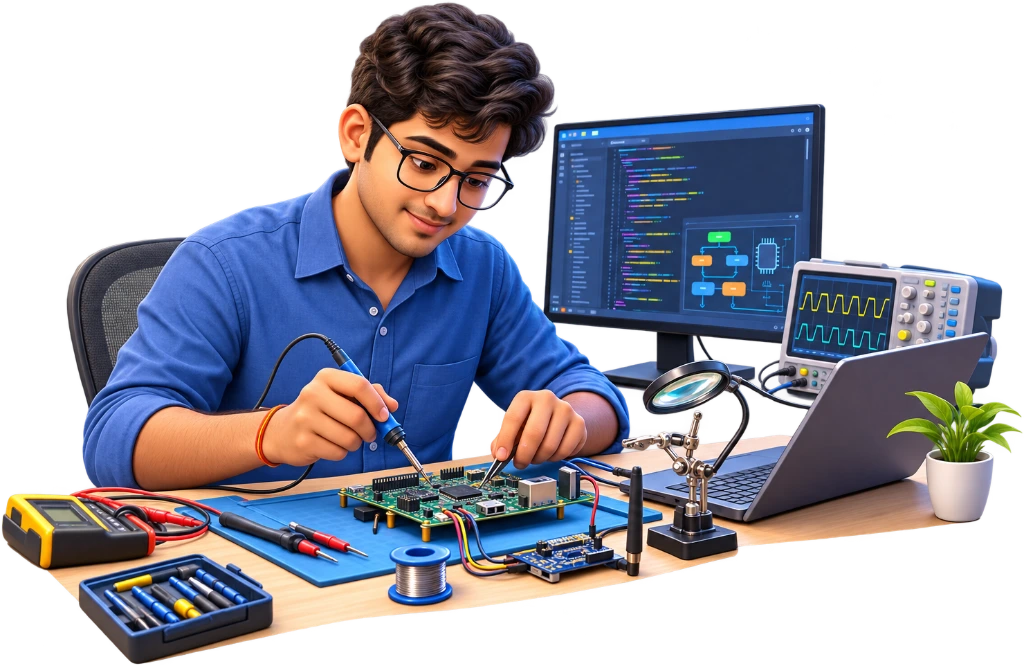
Writing the software that runs on hardware - microcontroller firmware, device drivers, real-time control and communication stacks - and debugging problems that live in the space between code and circuit.
Who this suits
Fit
Electronics and computer engineers who like working close to the metal. Connected devices, automotive electronics and industrial automation have all expanded the demand, and the skill is much harder to commoditise than general application development.
The honest reality
Read this one
Debugging is genuinely hard because a fault can be in your code, the hardware, the timing or the tools, and often nothing tells you which. Pay lags equivalent-experience web and cloud roles in India, which pulls good people away. Product cycles are long, so you may work two years before anything you wrote ships. Domain knowledge accumulates slowly and does not always transfer between industries.
What this work actually is
Understand the role
You write the code that makes a physical product behave correctly, such as a smart meter recording usage or a vehicle controller reading a sensor. Unlike an app developer, you work close to the hardware. You may write C code for a microcontroller, set up communication between chips, manage memory, and trace a fault when a board resets without warning.
Most embedded and firmware engineers work in product engineering teams, labs, factories, or office-based development centres. You sit with hardware engineers, PCB designers, test engineers and systems teams. A typical day includes reading circuit diagrams, using a debugger or oscilloscope, reviewing code, and testing a device repeatedly under heat, low power or poor network conditions.
The hard part is that small mistakes have physical effects. One timing error can drain a battery, lose sensor data or stop a device from starting. People who do well learn C properly and understand electronics, rather than treating firmware as only programming. Much of the work is patient debugging, documentation and testing after the interesting first prototype works.
Skills that actually matter
Capability
You need to write dependable C code and understand the electronics it controls, because a small mistake can stop a device from starting or make it fail in the field.
You write code that reads sensors, controls motors or displays, handles memory carefully, and runs within limited RAM and processing time. Knowing syntax is not enough. You need pointers, bit operations, interrupts, memory layout, and debugging.
How to build it. Start with C on your own computer, then buy or borrow a low-cost microcontroller board. Write drivers to blink an LED, read a button, use a timer, and send sensor values over serial. Read your code with compiler warnings turned on and fix every warning.
You need to read a circuit diagram, understand voltage and current, and connect code to real pins, buses, sensors, and power supplies. When a board does not work, you must tell whether the fault is in wiring, hardware, or code.
How to build it. Use a basic microcontroller kit, breadboard, jumper wires, resistors, LEDs, and a multimeter. Build one circuit at a time, then measure the voltage at each point and compare it with the circuit diagram. Study digital electronics and microcontrollers alongside your B.Tech subjects.
Much of the job is finding why a device resets after six hours, why one sensor gives wrong readings, or why code works in the lab but not on the production board. You need a method, not guesses.
How to build it. Keep a fault log for every project: symptom, test, result, and fix. Learn to use serial logs, a debugger, breakpoints, and a multimeter. Take a project that fails sometimes and isolate the cause before adding new features.
A wrong pin number, one missing delay, or a single bit set incorrectly can break the device. You need to check register settings, units, error cases, and the exact board version before you change code.
How to build it. Use checklists when wiring circuits and before uploading code. Ask a classmate to reproduce your project from your notes. If they cannot, improve the notes and labels instead of explaining the setup from memory.
Microcontroller and sensor datasheets tell you pin functions, timing limits, electrical limits, and register settings. Production work often starts with reading these documents closely, not writing code.
How to build it. Choose a sensor such as a temperature or motion sensor. Find its datasheet, identify its supply voltage, pinout, communication protocol, and sample code, then write your own small driver rather than copying a library unchanged.
You need to work with protocols such as UART, I2C and SPI to connect chips and modules. A device may compile perfectly yet fail because clock settings, wiring, addresses, or timing are wrong.
How to build it. Make three small projects: send text over UART, read a sensor through I2C, and use an SPI display or memory module. Capture serial output and write down the data bytes you expect at each step.
You will explain a bug to a hardware engineer, record how to reproduce it, and hand over code to another developer. Clear notes save days when a board returns from testing with an intermittent fault.
How to build it. For each project, write a one-page README with the circuit, pin connections, build steps, known faults, and test results. Put the code and notes in a public portfolio repository, after removing passwords or private data.
What separates the well paid from the average. The better-paid engineers do not only write drivers; they trace hard field failures across firmware, circuit behaviour, timing, and test evidence, then leave behind code others can safely maintain.
How people actually get in
Getting in
Most embedded and firmware engineers enter after Class 12 PCM and a four-year B.Tech, then prove they can write C and work with real hardware.
Take Physics, Chemistry and Mathematics in Classes 11 and 12, then do a B.Tech in Electronics or Electronics and Communication. During college, learn C properly and build boards or microcontroller projects where you read sensors, control outputs and find faults. Entry roles often start with testing, debugging and small firmware changes.
Usually takes About 6 years from Class 11 to B.Tech completion, plus 6 to 12 months of serious project work.
Electrical students often need to add more programming and digital electronics work than their course covers. Use projects to show C code running on hardware, such as a motor controller, data logger or sensor device. This gives recruiters evidence that you can work across circuits and code.
Usually takes About 6 years from Class 11 to B.Tech completion, plus 6 to 12 months of focused project work.
A Computer Science degree gives you programming practice, but firmware work also needs comfort with electronics and hardware faults. Learn C, work with microcontrollers and practise reading datasheets. A software-only portfolio is usually not enough for an embedded role.
Usually takes About 6 years from Class 11 to B.Tech completion, plus around 1 year learning C and hardware.
Some engineers first work on testing, support, electronics design or junior embedded tasks. Production firmware experience takes time: you may spend days reproducing a bug, checking logs and fixing a small issue without breaking an older device. After 2 to 4 years, people often move towards senior firmware, systems work or a domain specialism.
Usually takes 2 to 4 years after starting work.
What people get wrong
Read this one
This job sits between code and electronics, so the work is often slower and more hands-on than students expect.
- “It is just software development.” Firmware engineers write C, but they also read circuit diagrams, use boards and test why a sensor or chip is not behaving as expected.
- “You need to be an electronics topper.” You need to understand hardware, but careful C programming, debugging and attention to detail matter just as much.
- “The work is all about building new gadgets.” Much of the job is finding rare faults, reading old code, testing edge cases and fixing bugs without breaking a device already in use.
- “A B.Tech alone will get you hired.” A B.Tech in Electronics, ECE, Electrical or Computer Science is the usual route, but real hardware projects show that you can connect code to a board.
- “It is a dead-end backroom job.” With production firmware experience, you can move towards senior firmware, systems work or a domain specialism; pay bands recorded for this career are ₹6–30 LPA, depending on experience and role.
Where this leads
Outlook
Your next jobs usually depend on the devices and industries you learn, from small boards in a lab to firmware used in products at scale.
| Who employs | What it is like |
|---|---|
| Product engineering companies | You work on devices such as consumer electronics, industrial equipment or connected products. Deadlines rise near a product launch, and teams want clean C code, hardware debugging skill and care with testing. Pay often grows with product experience; the recorded range for this career is ₹6–30 LPA a year. |
| Automotive and mobility manufacturers | Firmware here sits inside vehicle systems and electronic control units. Testing and documentation take a large share of the work because faults are costly. Teams value patience, attention to detail and the ability to trace a bug across code, sensors and hardware. |
| Semiconductor and electronics design firms | You may write low-level software that brings up a board, tests a chip feature or supports reference hardware. The work is technical and methodical, with long debugging sessions. Employers look for strong C, electronics basics and evidence that you have built and tested real hardware. |
| Industrial automation and energy equipment makers | You work with controllers, sensors, drives, meters or factory equipment. Product cycles are often steadier than consumer-device work, but field failures need careful fixes. Employers want engineers who understand interfaces, fault handling and reliable firmware. |
| Engineering services and contract development teams | You may work on client projects across several device types. This gives broad exposure early on, though project changes and contract roles are more common. Delivery speed matters alongside clear documentation and the ability to join an existing codebase. |
| Government research bodies and PSUs | Some roles involve electronics systems, testing or embedded development for public-sector projects. Entry commonly follows the body's recruitment process or a government exam. Work tends to have clearer process and security, while openings are fewer and hiring cycles can be slow. |
Working reality
Read this one
Job availability scores 3 because entry roles usually expect you to show solid C, electronics knowledge and real hardware projects, not only a B.Tech degree.
The route in, step by step
6 steps from where you are now.
Class 12 with Physics, Chemistry and Mathematics Required
PCM for engineering.
B.Tech in Electronics, ECE, Electrical or Computer Science Required
Four years. Embedded work sits exactly between hardware and software, which is why both branches feed it.
Learn C properly, and learn the hardware Required
Embedded C, microcontroller architecture, interrupts, timers, memory and peripherals. Reading a datasheet and a schematic is a core skill and most computer science graduates cannot.
Build real hardware projects Required
Working devices on ARM Cortex or ESP platforms, with the debugging done on actual hardware rather than simulation. Oscilloscope and logic analyser competence separates embedded engineers from application programmers.
Work on production firmware Required
RTOS, communication protocols, power optimisation, bootloaders and over-the-air updates. Automotive, medical devices and industrial systems add functional safety requirements.
Senior firmware, systems, or a domain specialism Optional
Automotive electronics, medical devices, industrial IoT or defence electronics. Domain-specific standards knowledge is what makes senior embedded engineers hard to replace.
Courses that lead here
1 mapped route into this career.
The roles this becomes
2 lanes out of the same starting point.
What it pays
Indicative bands.
| Stage | Pay band | What changes |
|---|---|---|
| Any experience | ₹600,000 – ₹3,000,000 / annual | Indicative range imported from the career map. Unverified - confirm and add a source before publishing. |
These are ranges, not offers. Pay varies by city, employer size, sector and your own skill more than by job title. Treat the band as the shape of the market, not as a number you can hold anyone to.
Common questions
The ones people actually ask about this work.
What does an embedded engineer actually do?
<p>Writes the software that runs on a device rather than on a computer — the firmware inside a car's control unit, a medical monitor, an industrial controller, a smart meter or an appliance. It means working close to the hardware, with limited memory and processing, where a bug can mean a product recall rather than a patch.</p>
What should I learn, and when?
<p>C above all, and C++ for larger systems. Microcontroller architecture, interrupts, timers and peripherals. Communication protocols — UART, SPI, I2C, CAN for automotive. An RTOS. And debugging with an oscilloscope and logic analyser, which is the skill that separates people who can build from people who can only follow a tutorial. Start in the second year of the degree, because this cannot be acquired in the final semester.</p>
Is there real demand in India?
<p>Yes, and it is one of the few areas where core electronics hiring is genuinely strong. Automotive electronics, industrial automation, medical devices, consumer appliances, telecom equipment and the growing semiconductor and chip design ecosystem all need firmware engineers, and good ones are consistently hard to hire. An ECE graduate with real embedded skill is in a different market from one without.</p>
How do I build a portfolio without industry experience?
<p>Build things. A development board, a few sensors and a real problem to solve teaches more than any course. Contribute to open source embedded projects. Do your final-year project properly and document it. Employers hiring firmware engineers ask what you have built and what went wrong — being able to describe a difficult bug you found and fixed is worth more than a list of subjects.</p>
Test this against your own priorities
Pay, hours and entry route matter differently to different people. Compare this against the alternative you are actually weighing, rather than against the average.