
Embroidery and surface ornamentation
Last updated · Confirm dates, fees and eligibility on the official website before you apply.
Hand and machine embroidery, zari, beadwork and surface decoration on garments and textiles. Home-based, low capital, and one of the most widely done and most underpaid kinds of skilled work in India.
- Route in
- ITI Surface Ornamentation, a short course, or learning at home. No formal requirement 1 course lead here
- Where you work
- Your own home, a small unit, or an export house floor Flexible if working for yourself, fixed shifts in an export unit
What this is
Understand the role
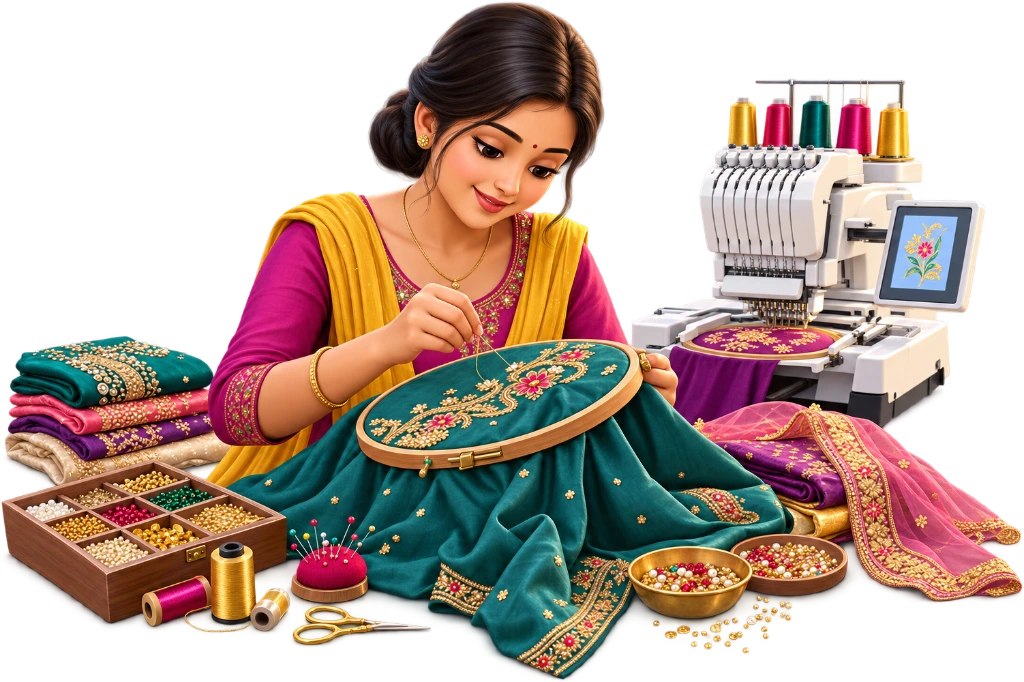
Decorating fabric by hand or machine — embroidery, zari and zardozi, beadwork, sequins, appliqué and mirror work — on garments, saris, home textiles and export pieces. It can be done at home with almost no equipment, which is why so many women already do it.
What the work is
Day to day
Working to a design and a deadline, usually paid per piece. The buyer is a local boutique or tailor, a wholesaler, an export unit contractor, or increasingly a customer found online. Machine embroidery adds speed and volume; hand work — particularly zardozi and fine thread work — commands far more per piece if the quality is there.
What you need
Capability
Nothing formal. ITI Surface Ornamentation or a short course gives structure and a certificate that helps with export units. Otherwise: needles and frames for hand work, or a machine as you grow, and samples of your own work to show.
What people get wrong
Read this one
Pricing, and this is the whole issue in this trade. Piece rates offered by middlemen are frequently below what the hours are worth, and because the work is done at home and paid per piece, the person doing it often never calculates their hourly earnings. Do that calculation once, honestly, including the hours. If the rate does not pay you properly, it is not work worth taking, and there is usually a better-paying buyer — a boutique, a designer, a direct customer — one step further up the chain.
The second thing: photograph everything you make. Selling directly, through a shop or online, pays several times what contract piece work does, and the only thing standing between the two is usually a set of decent photographs and a few customers.
Who this suits
Fit
This work suits you if you like making careful, visible improvements with your hands, often stitch by stitch for hours.
- You enjoy repeating one motif until it looks even, such as placing beads at the same distance along a neckline or filling a flower with neat threadwork.
- You notice when one sequin faces the wrong way, a zari line has bent, or the thread colour changes slightly between two sections of fabric.
- You can sit with close handwork for long stretches. Your fingers, eyes and back will feel the work, especially when an order has many identical pieces.
- You like learning by watching a skilled person, copying the hand movement, then practising it many times. A formal course is not compulsory; many people learn at home or in a karkhana.
- You are comfortable with work that often stays behind someone else’s label. A boutique, exporter or customer may show the finished garment, while you are paid for the embroidery piece or order.
- You may prefer home-based work or a small unit over travel. Export-house work means fixed shifts, while your own orders need you to speak to customers and manage deadlines.
- This is probably not for you if you need quick variety, dislike repetitive fine work, or expect skilled handwork to automatically bring high pay. This is widely done and often underpaid work in India.
How people actually get in
Getting in
Most people learn embroidery at home or in a local unit, then build speed and finish quality through paid piecework.
There is no formal course route into this. There is no formal requirement for this work. Many people enter through home learning, an assistant role or piecework in a local unit; an ITI or short course is one route, not a requirement.
Learn hand embroidery, beadwork, zari or machine work from a family member, neighbour or local worker. Start with simple borders, motifs and repairs. A karkhana, boutique or small unit then gives you repeated work, where speed, neat backsides and meeting a delivery date matter as much as design.
Usually takes 1 to 3 years to learn a technique well and gain regular work.
Take a short embroidery or surface-decoration course, practise samples, and show them when asking for assistant work. Export-house and boutique work often means following someone else's drawing, matching thread shades and finishing many similar pieces during fixed shifts.
Usually takes A short course, then 2 to 3 years of work experience.
After Class 8 or Class 10, join the one-year ITI course. Use the course to learn techniques and make samples, then seek work in a boutique, exporter or karkhana. The ITI gives practice, but regular production work teaches the pace needed for paid orders.
Usually takes 1 year for the ITI, followed by 1 to 2 years of workplace practice.
After you can finish one or two techniques reliably, take orders from local customers, boutiques or garment makers. You will need to price labour, buy materials, correct mistakes and follow up for payment. Some people later employ a few workers or sell their own embroidered products.
Usually takes Usually 2 to 5 years of learning and work before steady direct orders.
The honest part
Read this one
The hard part is not learning one stitch. It is keeping the same quality through 30 blouses or 200 garment panels, often for pay agreed before you know how many hours the design needs. Your fingers, eyes and back feel the work after a long day. In an export house or karkhana, you may repeat one border, bead pattern or zari motif for weeks. Home-based work gives flexibility, but orders can arrive late and payments may take time.
Your first two years usually go into speed, neat finishing and fixing mistakes without wasting fabric. You may start with simpler work while experienced workers handle bridal pieces or difficult patterns. Many people leave because piece-rate pay stays low, the work strains their hands, or irregular orders make household income uncertain. Some move into tailoring, boutique work, machine operation, teaching craft skills, or take direct customer orders instead of working through a contractor.
Where this leads
Outlook
Most embroidery work starts with piece-rate orders from a boutique, karkhana or export unit, then leads either to direct clients or a small unit of your own.
| Who employs | What it is like |
|---|---|
| Boutiques and dress designers | You work on blouses, bridal wear and custom garments. Orders change with wedding and festive seasons, and clients expect neat finishing, colour matching and work done by a date. Pay often follows each piece or order rather than a fixed monthly amount. |
| Garment export houses | Export houses usually offer fixed shifts on a production floor and more regular work than home orders. They want speed, repeatable quality and the ability to follow a sample exactly. Deadlines become tight when an export shipment is due. |
| Karkhanas and small embroidery units | A karkhana sends or receives batch work for garments and textiles. You may learn faster by watching skilled workers, but rates are often low and depend on how many pieces you finish. Work can be irregular between orders. |
| Home-based direct clients | You take measurements or receive garments from local clients and do the work at home. You set your own hours, but must find customers, discuss designs, buy materials and collect payment. Income varies with your order book. |
| Your own small unit or product business | After building steady orders, you can take larger jobs and give parts of the work to other embroiderers. Some people also sell embroidered dupattas, blouses or home-textile items. You handle quality checks, materials, delivery and customer complaints alongside the stitching. |
Working reality
Read this one
Pay predictability scores lowest because home-based workers and small units often depend on irregular piece-rate orders.
The route in, step by step
6 steps from where you are now.
Class 8 or Class 10 Required
Open entry, and a craft with a genuine market.
ITI Surface Ornamentation Techniques, or a craft course Required
One year for the ITI trade - hand and machine embroidery, zardozi, aari work, beadwork and finishing.
Master one or two techniques deeply Required
Zardozi, aari, mirror work, machine embroidery or beadwork. Buyers commission a technique, and depth in one earns more than familiarity with many.
Work with a boutique, exporter or karkhana Required
You learn quality standards, timelines and how work is costed by the piece. Export houses have exacting finishing standards worth learning.
Take direct orders Required
Boutiques, designers and individual customers. Bridal and occasion wear carries by far the best rates in this craft.
Build a small unit, or sell your own products Optional
Employing a few karigars and taking larger orders, or selling finished products directly online - which cuts out the layers that take most of the margin.
Courses that lead here
1 mapped route into this career.
The roles this becomes
6 lanes out of the same starting point.
Common questions
The ones people actually ask about this work.
How do I start embroidery work from home?
<p>You need a skill, some basic equipment and your first buyers. Needles, frames and thread are enough to begin hand work; a machine comes later if you scale. Buyers are local boutiques and tailors, wholesalers, export unit contractors, and increasingly customers found directly online. Make a set of samples and photograph them well — that is what gets you the first orders.</p>
How should I price embroidery work?
<p>Work out what you earn per hour, once, honestly. Take a completed piece, count the hours it actually took including preparation, and divide. Most people doing piece work have never done this calculation and are shocked by the answer. If the rate a contractor offers does not pay you a fair hourly amount, it is not work worth taking — and there is almost always a better-paying buyer one step further up the chain.</p>
Is hand embroidery or machine embroidery better paid?
<p>Machine work pays per piece and depends on volume. Fine hand work — zardozi, zari, detailed thread and bead work — commands far more per piece, because fewer people can do it well and it cannot be replicated by machine. If you can do fine hand work, do not compete on machine-work rates.</p>
Do I need a certificate to do this work?
<p>No. An ITI Surface Ornamentation course or a short skill course gives structure and a certificate that helps with export units and organised buyers, but nobody buying from you directly will ask for one. Your samples are your qualification.</p>
Test this against your own priorities
Pay, hours and entry route matter differently to different people. Compare this against the alternative you are actually weighing, rather than against the average.