
Ergonomics Consultant
Last updated · Confirm dates, fees and eligibility on the official website before you apply.
Assesses how people work and redesigns tasks, workstations and equipment to reduce injury and strain, for employers or insurers. Usually reached from occupational therapy or physiotherapy.
- Route in
- Earliest entry: Undergraduate. Also entered at: Undergraduate, Postgraduate. Direct entry. 2 courses lead here
- Entry pay
- ₹20,000 – ₹38,000 / monthly Any experience
- Where you work
- Rehabilitation centres, Special schools and early intervention centres, Corporate ergonomics consulting, Hospitals
How people get in
Getting in
Earliest entry point. Undergraduate level.
Other levels people enter from. Undergraduate, Postgraduate.
Licence or registration. Registration with the State Allied and Healthcare Council under NCAHP, where the state council has been constituted.
Where people work
Outlook
Rehabilitation centres, Special schools and early intervention centres, Corporate ergonomics consulting, Hospitals.
Indicative starting salary
Understand the role
20,000 - 38,000 per month at entry level.
This is an indicative range, not a quote. Actual pay varies with employer, city, sector and the specific role.
What this work actually is
Understand the role
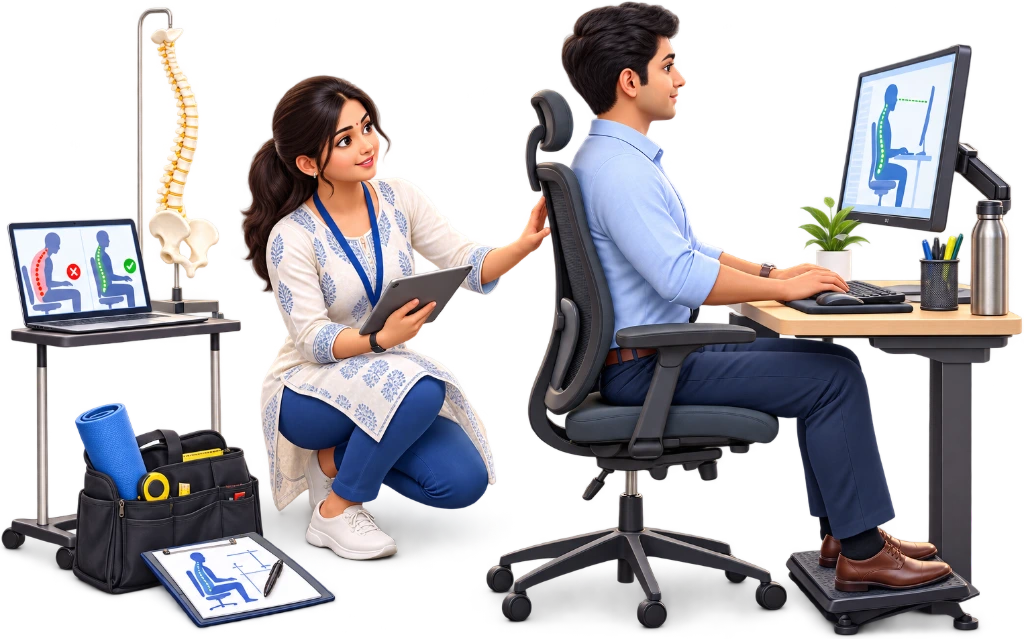
You change the work, not only treat the worker after pain starts. An ergonomics consultant studies how a person lifts, sits, reaches, uses a screen or repeats a task. You recommend changes to a workstation, tool, shift routine or manual-handling method that reduce strain and injury.
Work happens in hospitals, rehabilitation centres, special schools, early intervention centres and corporate consulting assignments. You might watch a warehouse worker move cartons, assess an office desk, or help a child use seating equipment. You work with physiotherapists, occupational therapists, doctors, HR teams, safety staff, supervisors and sometimes insurers.
Your clinical background matters because a chair adjustment is not enough if you do not understand the injury, movement and recovery plan. Much of the job involves careful observation, measurements, reports and explaining practical changes to managers who must approve them. People do well when they pair patient care with clear analysis and are willing to spend time on site, not only in a clinic.
What you actually do
Day to day
You study how a person moves through a task, then change the workstation, tool or method that is causing strain.
- Watch a worker complete a task such as lifting cartons, using a laptop or moving a patient.
- Measure chair height, desk height, screen position and the reach needed for tools.
- Ask about pain, numbness, fatigue and the point in the shift when symptoms begin.
- Photograph or sketch the workstation and note awkward postures or repeated movements.
- Suggest practical changes, such as a footrest, a different chair setting or a revised lifting method.
- Write a report linking the task, posture or equipment to the worker's reported difficulty.
- Recommend equipment changes and explain how the person should set it up.
- Set temporary work limits, such as shorter typing periods or avoiding overhead lifting, when the case needs them.
- Discuss the plan with the worker, supervisor, therapist or case manager.
- Record what was changed and arrange a follow-up review.
- Review follow-up notes on pain, comfort and ability to complete the job.
- Reassess a workstation after new equipment arrives or the worker returns from injury.
- Run a short session on desk setup, safe lifting or taking movement breaks.
- Compare several similar jobs to find a repeated injury risk in one team or department.
- Update reports when a worker's duties, symptoms or recovery plan changes.
- Review proposed desks, chairs, tools or work benches before staff start using them.
- Test whether people of different heights can reach controls, screens and materials safely.
- Observe a new manual-handling process and identify steps that need two people, a trolley or a different layout.
- Give feedback to managers on changes needed before the work area opens.
- Revisit the site after staff have used the new setup for a few weeks.
The part people are surprised by. You spend far more time watching ordinary work, measuring small distances and writing clear reports than choosing specialist equipment.
Who this suits
Fit
This work suits you if you like finding why a person’s body hurts during work, then changing the task or setup in practical ways.
- You notice that a chair is too low, a keyboard is too far away, or a worker keeps twisting to reach the same tool all day.
- You can listen carefully to someone with neck, back or wrist pain without assuming they are careless or exaggerating. You also look at their actual task before suggesting changes.
- You enjoy patient, methodical observation. Watching how a hospital worker transfers a patient or how an office employee uses a mouse may matter more than giving a quick opinion.
- You are comfortable moving between people and details: speaking with an employee about pain, then measuring a workstation and recording findings clearly for an employer or insurer.
- You do not mind repeating assessments, writing reports and explaining the same safe movement or workstation adjustment to different people. Much of the job is careful follow-up, not dramatic fixes.
- You can suggest changes that fit real limits. A small rehabilitation centre or office may not buy new equipment, so you need to work with the space, budget and tools available.
- This is not for you if you want to avoid clinical or patient-facing work entirely. The usual route begins with occupational therapy or physiotherapy, and musculoskeletal case experience matters.
Skills that actually matter
Capability
You need to spot the small work habits, poor setups and awkward movements that turn a normal shift into months of pain.
You assess the full task, not only the chair. You connect a worker’s pain with reach distance, lifting frequency, screen height, shift length and the tools they use.
How to build it. During BOT or BPT clinical postings, write down one activity step by step, such as transferring a patient or packing cartons. List where force, repetition and awkward posture occur, then suggest two changes and ask a supervisor to check your reasoning.
Workers often come after pain has already affected sleep, income or confidence. You take a useful history, observe movement without blame, and suggest changes the person can actually follow.
How to build it. Use musculoskeletal clinical postings to practise taking a pain and work history. Ask about the exact task, duration, previous injury and what happens near the end of a shift, not only where it hurts.
A few centimetres of desk height, a twisted wrist during a repeated task or a poorly placed foot pedal can change the risk. Your measurements and observation notes need to be accurate.
How to build it. Carry a simple checklist during placements. Measure chair, desk and screen positions, and make timed observations of a task. Compare your notes with those of a therapist or senior student to find what you missed.
You explain why a change matters to workers, supervisors and managers who have different concerns. A technically correct report fails if the factory floor or office team cannot use it.
How to build it. Present one workplace-change suggestion in plain language during a college case discussion. Then rewrite it as a one-page note with the problem, the change, estimated effort and how staff should use it.
A worker may fear being seen as slow or weak. You need to hear that concern and design changes that protect their body without making daily work harder.
How to build it. In rehabilitation postings, ask patients what stops them from following an exercise or positioning plan. Record their exact reason, then alter one part of the plan with your supervisor’s approval.
Many sites will not replace all equipment at once. You work out low-cost fixes, such as changing item placement, work height, break timing or lifting sequence, before asking for larger changes.
How to build it. Choose a workstation at college or home and redesign it using only existing items. Test the change for a week, note what improved and what created a new problem, then refine it.
Consulting involves observation notes, assessment reports, recommendations and later checks. Much of the work is documenting what you saw and checking if the change was actually adopted.
How to build it. After each clinical case, write a short report with the task observed, findings, recommended change and review date. Ask a faculty member or clinician to mark where your wording is vague or unsupported.
What separates the well paid from the average. Better-paid consultants turn careful observations into workable changes that reduce strain without slowing the job or demanding an unrealistic budget.
The honest part
Read this one
The first two years usually involve more clinical work than desk assessments. You may spend long days with musculoskeletal cases, measuring movement, writing notes, and learning why a person’s pain does not always match an X-ray or workstation photo. In industry, you must watch a task closely, then explain practical changes to a supervisor who worries about cost, output or staff resistance.
A good recommendation is often boring: adjust chair height, change a lifting sequence, add a break, move a screen, or alter a tool handle. You need patience to check whether people actually use the change. Reports, measurements and follow-ups take a large share of the work. Some people leave for general physiotherapy or occupational therapy, hospital roles, rehabilitation centres, safety work, or teaching, especially if they prefer regular patient contact over corporate consulting and contract assignments.
What people get wrong
Read this one
Ergonomics work is practical health work: you watch how a person works, find what causes strain, and change the task, equipment or workstation.
- “It is only about buying a better chair.” A consultant also studies lifting, reaching, repetitive hand movements, screen height, work pace and how a task is organised.
- “You can enter straight after Class 12 with a short ergonomics course.” The usual route starts with BOT or BPT, followed by musculoskeletal clinical experience and then ergonomics training.
- “You only work in offices.” Work also happens in hospitals, rehabilitation centres, special schools, early intervention centres and industry settings where people handle equipment or repeat physical tasks.
- “The job is mostly telling people the correct posture.” Much of the work is observation, measurement, notes, reports and explaining changes to managers, workers, employers or insurers.
- “It has no path beyond a hospital job.” After experience with industry, some consultants take independent consulting assignments, though building that work takes time and contacts.
Working reality
Read this one
Job availability is lower because most employers look for clinical musculoskeletal experience before hiring for this specialist role.
The route in, step by step
6 steps from where you are now.
Class 12 with Physics, Chemistry and Biology Required
The science base for a therapy degree.
BOT or BPT Required
Occupational therapy or physiotherapy, four and a half years including internship. Either works; OT tends to think in tasks and PT in tissues, and ergonomics needs both.
Clinical experience with musculoskeletal cases Required
Two or three years treating back, neck and repetitive strain problems. You cannot redesign a workstation credibly without having treated the injuries it causes.
Take an ergonomics qualification Required
A postgraduate diploma or certification in ergonomics or occupational health, covering anthropometry, workstation assessment and the relevant standards.
Work with industry Required
Manufacturing plants, IT campuses and occupational health providers. The deliverable is an assessment plus practical changes, and the persuading is harder than the measuring.
Consult independently Optional
Corporate retainers, injury-prevention programmes and expert input on workplace design. Credibility rests on demonstrable reductions in reported injury, so measure your own results.
Courses that lead here
2 mapped routes into this career.
The roles this becomes
5 lanes out of the same starting point.
What it pays
Indicative bands.
| Stage | Pay band | What changes |
|---|---|---|
| Any experience | ₹20,000 – ₹38,000 / monthly | Varies by employer |
These are ranges, not offers. Pay varies by city, employer size, sector and your own skill more than by job title. Treat the band as the shape of the market, not as a number you can hold anyone to.
Common questions
The ones people actually ask about this work.
What qualification do you need to become a Ergonomics Consultant?
The earliest entry point is undergraduate level. People also enter from: Undergraduate, Postgraduate.
Where does a Ergonomics Consultant usually work?
Rehabilitation centres, Special schools and early intervention centres, Corporate ergonomics consulting, Hospitals.
What does a Ergonomics Consultant earn to start?
20,000 - 38,000 per month is a typical entry-level range. Pay varies with employer, city and sector.
Does a Ergonomics Consultant need a licence or registration?
Registration with the State Allied and Healthcare Council under NCAHP, where the state council has been constituted.
Test this against your own priorities
Pay, hours and entry route matter differently to different people. Compare this against the alternative you are actually weighing, rather than against the average.