
EV & Automotive Engineer
Last updated · Confirm dates, fees and eligibility on the official website before you apply.
₹5–22 LPA · fast-growing
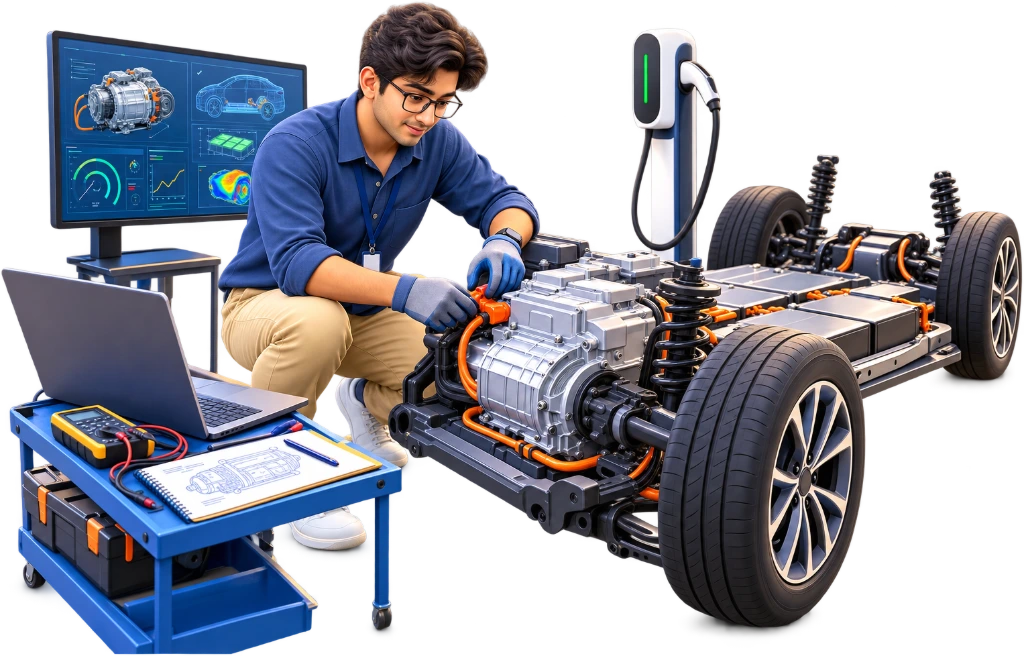
- Route in
- Typically Bachelor of Technology (B.Tech). 1 course lead here
- Entry pay
- ₹500,000 – ₹2,200,000 / annual Any experience
What the work involves
Day to day
Developing electric vehicles and their systems - battery packs and thermal management, motors and power electronics, controls software, and integrating all of it into a vehicle that has to be safe and affordable.
Who this suits
Fit
Mechanical and electrical engineers who want to work on a transition rather than a mature product. India's two and three-wheeler electrification is genuinely world-scale, and manufacturers are hiring into engineering teams that did not exist a decade ago.
The honest reality
Read this one
The field is crowded with new entrants and consolidation is already underway, so some employers will not survive - check a company's funding and volumes before joining. Cost pressure in the Indian market is severe and constrains what you can engineer. Battery cell technology is largely imported, so the deepest work happens elsewhere. Recall and safety incidents in the sector have created intense regulatory scrutiny and the pressure that comes with it.
What this work actually is
Understand the role
You work on the vehicle itself, or on the battery and charging system inside it. That sets you apart from a general mechanical engineer who might design many kinds of machines. You test parts, read sensor data, solve faults and change designs. A battery systems engineer may check heat, voltage, wiring and safety behaviour. An automotive engineer may work on motors, brakes, suspension, body parts or vehicle performance.
Most work happens in a manufacturer’s engineering centre, a supplier’s plant, a test track or a workshop with prototype vehicles. You work with mechanical, electrical and electronics engineers, technicians, software teams and production staff. Some days involve a computer, CAD drawings and test reports. Others involve measuring a component, inspecting a battery pack or finding why a vehicle failed a test.
Your degree gets you into the field, but careful problem solving decides how far you go. The work needs both mechanical aptitude and comfort with electrical systems. You must learn standards and high-voltage safety before handling EV systems. Progress often comes from becoming very good at one area, such as batteries or charging, rather than trying to know every part of a vehicle.
Skills that actually matter
Capability
You need to understand both the vehicle and its electrical system, then turn test results into design changes that work safely.
You work with voltage, current, motors, inverters, wiring, sensors and battery connections. In EV work, a loose connector or wrong reading can stop a vehicle or create a safety risk.
How to build it. Use Class 12 Physics well, then take electrical and electronics subjects during your B.Tech. Build a low-voltage battery-and-motor project first, read circuit diagrams, and learn to measure safely with a multimeter under college lab supervision.
An EV still has brakes, suspension, cooling parts, mounts, gears and a vehicle body. You need to see how parts fit, move, heat up and fail under load.
How to build it. Choose mechanical design, vehicle systems or manufacturing electives in B.Tech. Join your college vehicle team or workshop, help strip and reassemble assemblies, and make simple CAD models of brackets, housings and mounts.
You turn a requirement into drawings, part choices and testable designs. This includes designing a battery enclosure that fits the vehicle, keeps water out and allows servicing.
How to build it. Learn one CAD tool through your college lab or free student access. Build a portfolio with three small designs, such as a battery box, motor mount and charging-port bracket, showing drawings, material choice and changes after testing.
Much of the job is finding why a prototype overheats, loses range, makes noise or fails a test. You must separate guesses from evidence and test one cause at a time.
How to build it. Keep a fault log for every project. Write the symptom, possible causes, measurement, result and next change. Take part in college projects where something has gone wrong, rather than showing only polished final models.
Battery packs and charging systems need careful isolation, safe procedures and documented checks. You must follow the team’s safety process even when a test deadline is close.
How to build it. Take the high-voltage safety and standards training offered in your B.Tech, internship or employer induction. Study test reports and safety checklists used in college labs, and never handle high-voltage equipment without authorised supervision.
You read test data from batteries, motors and vehicles to find trends in temperature, efficiency, vibration or faults. A design is not finished because it looks correct on screen.
How to build it. Learn spreadsheets well, including graphs, filters and basic formulae. Use data from a college project to plot battery discharge or motor temperature over time, then write a short note on what the data changed in your design.
You explain a fault to a design engineer, technician, supplier or project manager without hiding the bad news. You also need clear notes so another person can repeat your test.
How to build it. Volunteer to present your team’s test results in class or at a project review. Write one-page test notes with photos, measurements and a clear conclusion, then ask a teacher or teammate what they could not follow.
A part that works as a one-off prototype may be hard to assemble, inspect or repair at scale. You need to consider tolerances, fastening, wiring routes and service access.
How to build it. Visit your college workshop and ask how parts are machined, welded or assembled. During an internship, spend time with production and quality teams, and revise one of your designs after watching how someone would build it.
What separates the well paid from the average. Better-paid engineers connect design choices to safety, test evidence, manufacturing cost and real vehicle failures, rather than only making a CAD model or simulation.
How people actually get in
Getting in
Most EV and automotive engineers enter after Class 12 Physics, Chemistry and Mathematics, then a four-year B.Tech in Mechanical, Electrical or Electronics engineering.
Take PCM in Classes 11 and 12, then complete a B.Tech in Mechanical Engineering. During or after college, choose projects, internships and short specialisation work in vehicle design, thermal systems, battery packs or testing. Learn high-voltage safety and relevant standards before applying to manufacturers, suppliers or startups.
Usually takes About 4 years after Class 12, plus 6 to 12 months of focused specialisation.
A B.Tech in Electrical Engineering suits work on battery systems, charging, electrical architecture and related testing. Build practical skill through lab work and projects, such as battery monitoring or charging-system design. Employers will still expect you to understand how the vehicle’s mechanical parts and electrical systems fit together.
Usually takes About 4 years after Class 12, plus 6 to 12 months of focused specialisation.
Choose Electronics Engineering if you want to work nearer to vehicle electronics and electrical systems. Use projects and internships to show technical design and problem-solving, then add EV-specific learning in standards and high-voltage safety. Entry roles may involve testing, documentation and repeated fault checks before you handle larger design work.
Usually takes About 4 years after Class 12, plus 6 to 12 months of focused specialisation.
Some engineers first work in a broader mechanical, electrical or electronics role, then shift into EVs after building relevant skills. This route often means two to four years with a manufacturer, supplier or startup, followed by a move towards battery, charging or vehicle engineering work. Your project record matters: show work that solves a real design, testing or electrical-systems problem.
Usually takes About 6 to 8 years after Class 12.
What people get wrong
Read this one
EV engineering involves electrical systems, mechanical design and safety work, not only designing a new vehicle.
- “EV engineers only work on cars” is wrong. You might work on battery packs, charging systems, thermal control, vehicle testing or parts supplied to a manufacturer.
- “A mechanical B.Tech is enough on its own” is wrong. Mechanical, electrical and electronics graduates enter this work, but you need to build skills in electrical systems, technical design, standards and high-voltage safety.
- “The job is all innovation and prototypes” is misleading. Much of the week goes into test data, fault finding, design changes, documentation and checking that a part works safely again and again.
- “EV work has no future outside big private companies” is too narrow. Manufacturers, suppliers and startups hire engineers, and battery and charging specialisation can lead to senior technical work over time.
- “Every EV engineer earns the same because the sector is growing” is false. Indicative annual pay ranges from ₹5 lakh to ₹22 lakh, with experience, specialisation and the type of employer affecting where you fall.
Where this leads
Outlook
Across EV and automotive engineering, recorded pay sits around ₹5–22 LPA a year; your design skill, electrical systems knowledge and the kind of employer move you within that range.
| Who employs | What it is like |
|---|---|
| Vehicle manufacturers | You work on vehicles from concept to production, often with long test cycles and strict release dates. Jobs tend to offer steadier teams and clearer grades, while expecting careful design records, testing and problem-solving. |
| Automotive component suppliers | Suppliers build parts such as motors, power electronics, wiring systems, brakes or thermal systems for several vehicle programmes. The pace rises near customer deadlines. Pay varies by product area and your ability to solve faults quickly. |
| Battery manufacturers and battery-pack teams | Work centres on cell selection, pack design, cooling, battery management systems and test data. You will spend plenty of time checking results, tracing failures and documenting changes. Teams look for strong electrical systems knowledge and safe working habits. |
| Charging equipment and infrastructure firms | Here you may work on chargers, connectors, power conversion, site testing or charger reliability. Field issues matter as much as lab design, especially when heat, power quality or installation quality causes failures. |
| Automotive engineering and testing centres | These teams support vehicle makers and suppliers with simulation, validation, prototype builds and test reports. Contract roles are common at the start. You need to explain test findings clearly and work to a fixed client schedule. |
Working reality
Read this one
Job availability scores 3 because most entry roles expect a B.Tech plus practical knowledge of electrical systems, high-voltage safety and automotive design.
The route in, step by step
6 steps from where you are now.
Class 12 with Physics, Chemistry and Mathematics Required
PCM for engineering.
B.Tech in Mechanical, Electrical or Electronics Required
Four years. Electric vehicles sit across all three - powertrain is electrical, vehicle is mechanical, control is electronics.
Specialise deliberately Required
Battery systems and thermal management, motors and power electronics, vehicle integration, or embedded control software. Battery engineering is the scarcest and best paid.
Learn standards and high-voltage safety Required
AIS standards for Indian vehicles, battery testing requirements, and functional safety. High-voltage systems kill, and safety competence is assessed before you touch a pack.
Work with a manufacturer, supplier or startup Required
Two and three-wheeler electric vehicles dominate Indian volumes and are where most engineering jobs actually are, whatever the passenger car headlines suggest.
Senior engineer, or battery and charging specialisation Optional
Technical leadership, or specialisation in cells, battery management systems or charging infrastructure. The field is young enough that early specialists become senior quickly.
Courses that lead here
1 mapped route into this career.
The roles this becomes
2 lanes out of the same starting point.
What it pays
Indicative bands.
| Stage | Pay band | What changes |
|---|---|---|
| Any experience | ₹500,000 – ₹2,200,000 / annual | Indicative range imported from the career map. Unverified - confirm and add a source before publishing. |
These are ranges, not offers. Pay varies by city, employer size, sector and your own skill more than by job title. Treat the band as the shape of the market, not as a number you can hold anyone to.
Common questions
The ones people actually ask about this work.
What does an EV engineer work on?
<p>Battery systems and battery management, motors and motor control, power electronics, charging systems, vehicle thermal management, and the embedded software tying it together. The chassis, suspension and body engineering is largely unchanged from conventional vehicles — the transformation is in the powertrain.</p>
I am a mechanical engineer. Can I move into EV work?
<p>Yes, and thermal management, packaging, structural design and manufacturing are all mechanical problems that the industry needs solved. What will limit you is knowing nothing about the electrical side, so add power electronics fundamentals and battery basics. The engineers in demand are the ones comfortable across both, because an EV powertrain is not cleanly one or the other.</p>
Is the internal combustion side finished?
<p>No, and planning as though it is would be a mistake. Conventional vehicles will be manufactured and serviced in India for a long time, and commercial vehicles in particular are transitioning more slowly. But the growth, the investment and the hiring are on the electric side, so an engineer whose entire depth is engine mechanics is specialising in the shrinking half.</p>
Where is the work?
<p>Vehicle manufacturers and their component suppliers around Chennai, Pune, Bengaluru and the NCR; battery and cell manufacturers; charging infrastructure companies; and the engineering services firms doing development work for global automotive clients. Two and three-wheeler electrification is where India moved first and where a lot of the volume hiring is.</p>
Test this against your own priorities
Pay, hours and entry route matter differently to different people. Compare this against the alternative you are actually weighing, rather than against the average.