
EV service technician
Last updated · Confirm dates, fees and eligibility on the official website before you apply.
new-vehicle shortage skill
- Route in
- Typically ITI Mechanic (Motor Vehicle) or Diploma in Engineering (Polytechnic). 3 courses lead here
- Entry pay
- ₹13,000 – ₹26,000 / monthly Any experience
- Where you work
- EV manufacturers and dealers, EV fleet operators, Charging infrastructure companies, Multi-brand EV service workshops
What the work involves
Day to day
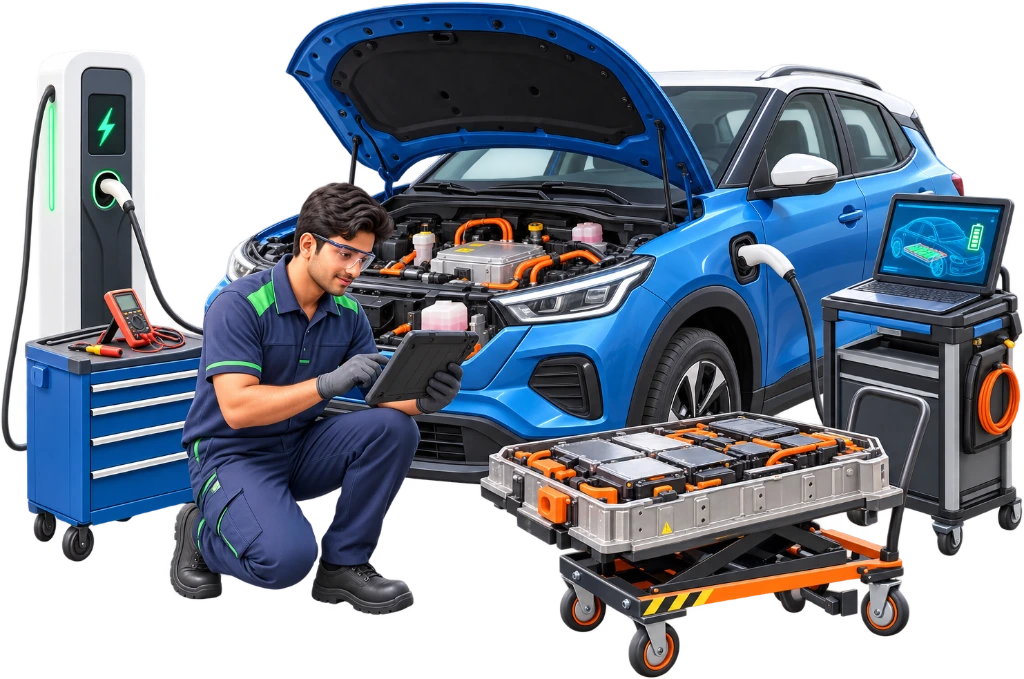
Diagnosing and servicing electric vehicles - battery packs, motor controllers, charging systems and vehicle software. The failure modes and the safety procedures are nothing like conventional vehicle repair.
Who this suits
Fit
Mechanics and ITI holders willing to retrain early into a genuine skill shortage. India's electric two and three-wheeler fleet has grown faster than the workforce able to service it, and being qualified ahead of the curve is worth real money.
The honest reality
Read this one
High-voltage systems can kill you; this is not conventional garage work and untrained handling of battery packs is genuinely dangerous. Manufacturers keep diagnostics and parts proprietary, which limits what independent workshops can legally or practically do. Training quality varies wildly and some private courses are worthless - prefer manufacturer or government-recognised programmes.
What this work actually is
Understand the role
You diagnose and repair electric vehicles, rather than mainly servicing engines, oil systems and exhaust parts. A typical job includes reading fault codes, testing wiring and sensors, checking chargers, motors and battery packs, and replacing damaged parts. You also follow high-voltage safety steps before touching an isolated battery system. Much of the work is careful fault-finding, not simply fitting parts quickly.
You may work at an EV manufacturer’s service network, a dealer workshop, a multi-brand EV garage, a fleet depot or a charging infrastructure company. In a fleet depot, you might inspect several electric two-wheelers, cars or buses before they return to service. You work with service advisers, senior technicians, battery technicians, drivers and sometimes charging-site staff. The workshop has diagnostic tools, lifts, insulated equipment and strict safety procedures.
The key trade-off is that electric vehicles have fewer routine mechanical jobs, but faults can be harder to trace. People who do well understand electrical systems, use diagnostic tools patiently and do not take shortcuts around high voltage. An ITI in Mechanic Motor Vehicle or Electrician is a common starting route, followed by EV-specific training. Your practical skill and safety record matter as much as your course certificate.
Skills that actually matter
Capability
You need safe hands, sound electrical fault-finding and the patience to trace a problem before replacing parts.
You must isolate the vehicle correctly, use the right protective equipment and treat battery cables and packs as live until proven otherwise. A rushed mistake can injure you or damage an expensive vehicle.
How to build it. Take the EV-specific and high-voltage safety training after ITI or diploma. During workshop training, practise the full isolation and lock-out procedure under supervision until you can explain each step.
You need to read basic wiring diagrams, test voltage and continuity, and understand motors, controllers, chargers, DC-DC converters and battery connections.
How to build it. Choose ITI Electrician, ITI Mechanic Motor Vehicle, or a polytechnic diploma route. Use a multimeter on supervised training boards and learn to follow one circuit from the battery to the component.
Much of the job is finding the real fault from warning lights, scan-tool codes and test readings. A code points you towards a problem; it does not always identify the failed part.
How to build it. Start with fault sheets in an EV service workshop or training centre. Write down the complaint, codes, readings, checks and final fix for each job, then review cases where the first guess was wrong.
You will remove panels, connectors, brakes, suspension parts and charging components without breaking clips, pinching wires or leaving loose fasteners.
How to build it. Use the workshop time in ITI or diploma seriously. Learn correct torque use, connector removal and cable routing on training vehicles, then take an apprentice or junior technician role in a service network.
You need to record fault codes, battery readings, parts changed and safety checks clearly. Poor job cards make the next technician repeat your work and create disputes with customers or fleets.
How to build it. Ask to fill job cards during training, even for small repairs. After each practice job, write the customer complaint, tests done, readings taken and the reason for the repair in simple language.
You often need to explain a charging issue, warning light or repair delay without using confusing technical words. Fleet supervisors also want a clear estimate of vehicle downtime.
How to build it. Practise explaining one repair to a classmate or family member in Hindi, English or your local language. At a workshop, listen to senior technicians during vehicle handover and note the questions customers ask.
Intermittent faults and charging complaints may take several checks to find. Swapping parts quickly wastes time and can leave the original problem unsolved.
How to build it. Follow a fixed order for every fault: confirm the complaint, scan, inspect, test, repair and retest. Keep a small notebook of recurring faults and the checks that ruled out each possible cause.
What separates the well paid from the average. Better-paid technicians find the fault accurately, follow high-voltage safety every time and finish clean job cards instead of changing parts by trial and error.
How people actually get in
Getting in
Most people enter through a two-year ITI, then add EV training and learn the work in a service workshop.
After Class 10, take the two-year ITI Mechanic (Motor Vehicle) course. Follow it with 3 to 6 months of EV-specific training and high-voltage safety practice. Your first job is often diagnosing faults, servicing brakes and suspension, and following safe battery isolation steps in a dealer or multi-brand workshop.
Usually takes About 2 to 3 years before your first EV service role.
An ITI Electrician gives you a base in electrical systems. Add EV and high-voltage safety training, then look for trainee work with EV fleets, charging infrastructure firms, or service networks. This route suits people who are comfortable tracing wiring faults and using test equipment.
Usually takes About 2 to 3 years before your first EV service role.
A polytechnic diploma can lead to EV service work after you learn EV diagnostics and high-voltage safety. You may start in a workshop, fleet maintenance unit, or charging infrastructure team. The course gives more engineering theory, but you still need hands-on practice with vehicles.
Usually takes Usually 3 years, plus 3 to 6 months of EV training.
A Certificate in Electric Vehicle Technology is usually most useful after ITI or a diploma, not by itself. It helps you show that you have studied batteries, motors, controllers and safety. Employers will still expect practical hand skills and careful workshop habits.
Usually takes Usually 3 to 6 months after your main technical course.
What people get wrong
Read this one
This work mixes electrical fault-finding, vehicle repair and strict safety routines.
- "EVs need almost no servicing." They have fewer engine parts, but you still diagnose wiring faults, brakes, tyres, cooling systems, chargers and battery-related issues.
- "Anyone who repairs a petrol vehicle can work on an EV straight away." Basic workshop skills help, but you need EV-specific training and proper high-voltage safety practice before working on these vehicles.
- "The job is only about changing battery packs." Much of the day involves scanning fault codes, testing electrical systems, tracing a loose connection and recording work done for the service network.
- "You need an engineering degree to enter." Many technicians start after Class 10 through ITI Mechanic Motor Vehicle or Electrician, then add EV training; a Polytechnic diploma is another route.
- "It is a dead-end workshop job." After experience, some move into senior technician work, charging infrastructure or a multi-brand EV workshop, though early roles often involve routine inspections and repeat repairs.
Where this leads
Outlook
In 2026, recorded pay for EV service technicians is ₹13,000 to ₹26,000 a month; practical diagnostics, electrical work and safe high-voltage handling usually move you towards better work.
| Who employs | What it is like |
|---|---|
| EV manufacturers and dealer service centres | You work on vehicles under a brand’s service process, with job cards, diagnostic tools and repeat fault checks. The pace rises during service peaks. They usually want ITI or diploma training, clean practical work and careful safety habits; pay often follows a fixed monthly structure. |
| EV fleet operators | Fleet work means keeping many delivery, taxi or shared vehicles on the road. Downtime matters, so you may inspect the same models repeatedly and handle quick repairs, battery checks and scheduled maintenance. Shift work is possible, and steady output matters more than showroom-facing skills. |
| Charging infrastructure companies | The work shifts from vehicle repair to chargers, cables, connectors and electrical fault finding at sites. Travel between locations may be part of the job. Employers look for electrical systems knowledge, safe isolation practices and the patience to trace faults that are not obvious. |
| Multi-brand EV service workshops | These workshops see different makes and models, often with less fixed procedure than a dealer centre. You learn by diagnosing unfamiliar faults and speaking directly with customers. Pay and job security can vary more, but broad repair skills matter a lot. |
Working reality
Read this one
Job availability scores 3 because EV workshops, dealers and fleet operators need technicians, but most openings still ask for vehicle diagnostics, electrical systems and high-voltage safety training.
The route in, step by step
6 steps from where you are now.
Class 10 Required
Entry for the ITI trade.
ITI Mechanic Motor Vehicle, or Electrician Required
Two years. Electric vehicles sit between the two trades, which is exactly why trained people are scarce.
Take EV-specific training Required
Battery systems, motors and controllers, charging infrastructure, and high-voltage safety. Automotive Skills Development Council courses and manufacturer programmes both exist and are short.
Learn high-voltage safety properly Required
Traction battery packs operate at voltages that kill. Isolation procedure, personal protective equipment and safe handling are not optional modules, and this is the part conventional mechanics most underestimate.
Work with an EV manufacturer or service network Required
Two-wheeler and three-wheeler electric vehicles dominate Indian volumes and are the most common entry. Battery diagnostics and thermal management are the recurring problems.
Senior technician, charging infrastructure, or your own workshop Optional
The field is young enough that early, properly trained entrants become the senior people quickly. Charging infrastructure installation is the adjacent and growing option.
Courses that lead here
3 mapped routes into this career.
The roles this becomes
2 lanes out of the same starting point.
What it pays
Indicative bands.
| Stage | Pay band | What changes |
|---|---|---|
| Any experience | ₹13,000 – ₹26,000 / monthly | Varies by employer |
These are ranges, not offers. Pay varies by city, employer size, sector and your own skill more than by job title. Treat the band as the shape of the market, not as a number you can hold anyone to.
Common questions
The ones people actually ask about this work.
What qualification do you need to become a EV service technician?
The earliest entry point is certificate level.
Where does a EV service technician usually work?
EV manufacturers and dealers, EV fleet operators, Charging infrastructure companies, Multi-brand EV service workshops.
What does a EV service technician earn to start?
13,000 - 26,000 per month is a typical entry-level range. Pay varies with employer, city and sector.
Test this against your own priorities
Pay, hours and entry route matter differently to different people. Compare this against the alternative you are actually weighing, rather than against the average.