
Farm machinery R&D
Last updated · Confirm dates, fees and eligibility on the official website before you apply.
Mahindra, John Deere, TAFE
- Route in
- Typically B.Tech Agricultural Engineering. 2 courses lead here
What the work involves
Day to day
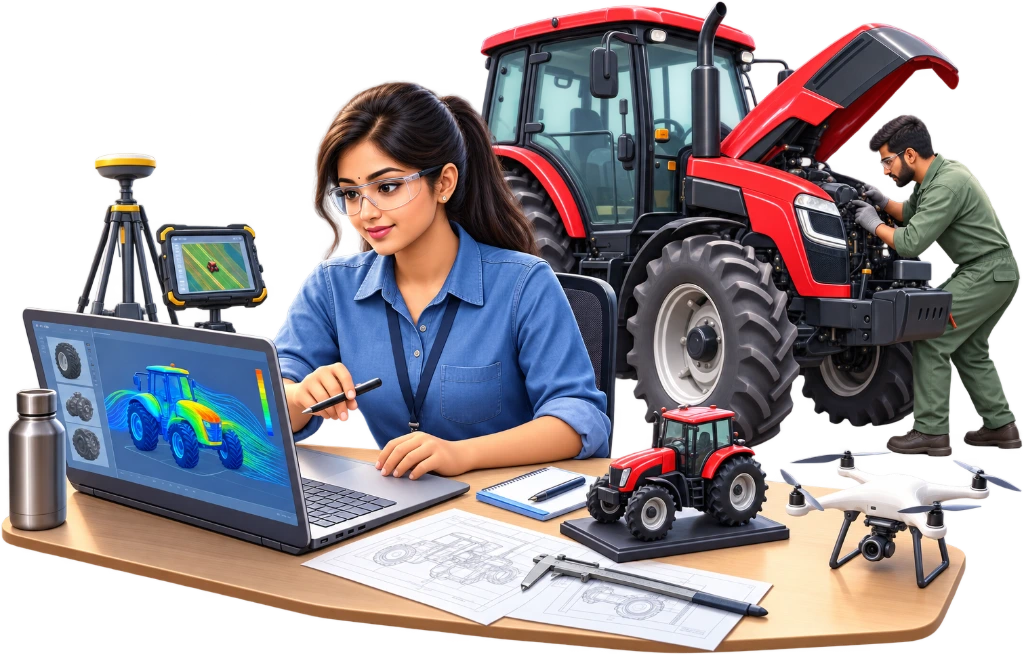
Designing and testing agricultural equipment - tractors, implements, harvesters - through design, prototyping, field trials in real conditions and durability testing before production.
Who this suits
Fit
Agricultural and mechanical engineers who want tangible engineering with field testing rather than pure desk design. India is one of the world's largest tractor markets, so the domestic manufacturing base and its engineering teams are substantial.
The honest reality
Read this one
Design cycles are long and cost pressure is severe, because the customer is highly price-sensitive - elegant engineering loses to cheap engineering routinely. Field trials mean extended periods at test sites in difficult conditions. The employer base is small and concentrated, so switching jobs within the specialisation means moving cities. Small farm holdings limit how sophisticated the machinery can afford to be.
What this work actually is
Understand the role
You design and test machines that must work in real farm conditions, not only look correct on a screen. A design engineer may alter a tractor linkage, planter metering unit or threshing part. A test engineer checks fuel use, soil performance, vibration and breakdowns. The work ends when the machine meets its target safely and repeatedly.
Most work happens in manufacturer design offices, prototype workshops, test tracks and farms. You may spend one week reviewing CAD drawings and the next watching a machine work in wet soil or crop residue. You work with mechanical engineers, production teams, suppliers, technicians and agronomy staff. Research institutes also employ people for trials and machine development.
Field feedback decides who does well. A part that works in a controlled test may fail after dust, heat, rough roads and long hours in a district farm. You need patience for repeated tests, measurements, reports and design changes. Mechanical skill matters, but understanding crops, soil and how farmers actually use equipment often separates a useful design from an expensive mistake.
Skills that actually matter
Capability
You need to design machines that suit Indian soil, crops and farm use, then prove through testing that they work safely and last.
You must turn a need, such as a better seed drill or tractor attachment, into parts, dimensions, materials and drawings that can be made in a factory.
How to build it. During B.Tech, learn engineering drawing and a CAD tool through your college lab. Redraw a simple implement, such as a cultivator or trailer hitch, then make a small working model from scrap metal or wood.
Field tests expose faults that a drawing misses: a bearing overheats, a bolt loosens, or mud blocks a moving part. You need to find the cause and alter the design.
How to build it. Join your college farm-machinery lab or project team. Keep a test sheet for each trial: soil condition, speed, load, failure, change made and result. An ITI workshop or local repair shop can also teach you how parts fail in real use.
A machine must fit the crop, soil, season and farm size. A paddy tool faces different conditions from equipment used in dryland cotton or wheat.
How to build it. Visit Krishi Vigyan Kendra demonstrations, agricultural university farms and nearby villages during sowing or harvest. Ask operators what slows them down, what breaks, and which repair they can do locally.
You compare versions of a machine using evidence, such as fuel use, field capacity, seed placement, soil disturbance and breakdown rate.
How to build it. Use your final-year project to run repeated tests, not one demonstration. Learn spreadsheets well enough to clean readings, calculate averages and make a clear graph. Read agricultural engineering project reports from public institutions.
A design that works once in a college workshop may be too costly, slow or difficult to produce in quantity. You need to understand welding, machining, casting, tolerances and assembly.
How to build it. Take a production or workshop internship, even a short one. Follow one fabricated part from drawing to cutting, welding, drilling, painting and inspection, and note where workers need to adjust the drawing.
You will need useful details from a farmer, clear feedback for a technician, and a practical explanation for a production team. Poor communication causes expensive rework.
How to build it. Present project test results to people outside your class. During field visits, write down a farmer's exact complaint before suggesting a solution. Practise making one-page test reports with photos and labelled faults.
You should be comfortable with mechanisms, gears, hydraulics, fasteners and tools. Field testing also means inspecting dirty, noisy equipment without taking unsafe shortcuts.
How to build it. Learn basic fitting, measuring and tool safety in college workshops or through the ITI Mechanic Agricultural Machinery route. Help dismantle and reassemble a pump, power tiller attachment or small implement under supervision.
What separates the well paid from the average. The stronger engineers spend enough time in fields and factories to turn farmer complaints and test data into designs that are affordable to build and simple to repair.
How people actually get in
Getting in
Most people enter farm machinery R&D after Class 12 with PCM and a B.Tech in Agricultural Engineering, then learn design and testing on the job.
Take Physics, Chemistry and Mathematics in Class 12, then complete B.Tech Agricultural Engineering. Look for early work where you help with drawings, prototypes, field tests and test reports before moving into design or test engineer work.
Usually takes 4 years after Class 12.
Mechanical Engineering is the other recorded degree route. You will need to build knowledge of farm equipment, agronomy and how machinery performs in field conditions, not only machine design.
Usually takes 4 years after Class 12.
This route gives you hands-on exposure to agricultural machinery. It is a practical starting point for work around machines and testing, though design roles usually need stronger engineering training and experience.
Usually takes Course length varies by institute.
What people get wrong
Read this one
Farm machinery R&D is engineering work tied closely to how crops, soil and farm labour actually behave.
- “It is only tractor design.” You might work on tractors, but the work also covers implements and systems that must suit crops, soil conditions and farm use.
- “You need only mechanical engineering knowledge.” Mechanical design matters, yet you also need agronomy, research and testing skills to judge whether a machine works in the field.
- “Most of the job is inventing new machines.” Much of your time goes into drawings, prototypes, measurements, test reports and fixing faults found during testing.
- “An Agricultural Engineering degree is the only route.” B.Tech Agricultural Engineering is the main route, but B.Tech Mechanical Engineering also leads into this work when you build design and testing skills.
- “It is a dead-end job away from real engineering.” With experience, you can move from design or test work to owning a product programme, or study further through an M.Tech or Ph.D.
Where this leads
Outlook
You can move from design or testing into product leadership, research, farm support, or a related engineering field as you learn how machines perform in Indian soil and crops.
| Who employs | What it is like |
|---|---|
| Farm machinery manufacturers | You work on tractors, implements, harvesters or attachments. The pace follows product deadlines and field trials. They want engineers who can turn farmer feedback into drawings, parts and test changes; pay usually grows with product responsibility. |
| Agricultural equipment suppliers | These firms make parts such as transmissions, hydraulic systems, bearings or electronics for machinery makers. Work is focused on a component and its quality. You may get steady design work, but must meet drawing, cost and delivery targets. |
| Government agricultural research institutes | Research roles focus on testing, adapting or developing equipment for crops and local conditions. Projects move more slowly than factory product work, with field data, reports and trials taking a large share of time. Security depends on the post and funding. |
| State agricultural universities and research centres | You may support machinery trials, prototype development and demonstrations for farmers. Work often connects engineering with agronomy. Permanent posts are limited, while project and contract roles are also common. |
| Farm machinery testing and evaluation centres | Testing centres measure safety, durability, fuel use and field performance. The work is methodical: setting up tests, recording failures and writing reports. They want care with measurement and the patience to repeat a trial. |
Working reality
Read this one
Job availability is lower because R&D teams are small, and entry roles usually need an Agricultural or Mechanical Engineering degree plus design or testing skills.
The route in, step by step
6 steps from where you are now.
Class 12 with Physics, Chemistry and Mathematics Required
PCM for engineering.
B.Tech Agricultural Engineering, or Mechanical Required
Four years. Agricultural engineering covers farm power and machinery specifically; mechanical engineers enter the field too and learn the agronomy afterwards.
Learn design and testing Required
CAD, finite element analysis, and the machinery testing protocols used by the Farm Machinery Training and Testing Institutes. Indian machinery must survive conditions that European designs do not anticipate.
Work with a manufacturer or research institute Required
Tractor and implement manufacturers, or ICAR institutes such as the Central Institute of Agricultural Engineering. Industry pays better; institutes give deeper research exposure.
Own a product programme Required
From field problem to prototype to testing to manufacture. Machinery for small and fragmented holdings is the defining Indian design constraint.
Senior design engineer, or M.Tech and Ph.D. Optional
Leading design programmes, or postgraduate research towards a scientist post.
Courses that lead here
2 mapped routes into this career.
The roles this becomes
2 lanes out of the same starting point.
Common questions
The ones people actually ask about this work.
Who designs farm machinery in India?
<p>Tractor and implement manufacturers, agricultural machinery companies, and the research and testing institutions in the ICAR system. India is one of the largest tractor markets in the world, so the design and development work is domestic rather than imported, which is unusual among engineering fields here.</p>
What background is needed?
<p>Agricultural engineering, or mechanical engineering with an interest in the domain. Agricultural engineering gives the soil, crop and implement knowledge that a purely mechanical background lacks — understanding why a tillage implement behaves differently in different soils is not something you can derive from first principles at a desk.</p>
What is the work like?
<p>Design and simulation, prototype building, and a great deal of field testing — machinery is proven in actual fields in actual conditions, so the job involves being out there through seasons. Testing and certification to national standards is a substantial part of bringing any machine to market.</p>
Is the field growing?
<p>Yes, in specific directions: mechanisation of smaller holdings, custom hiring and machinery-as-a-service models, precision equipment, and electric and alternative-fuel tractors. Labour shortage in agriculture is pushing mechanisation steadily, which supports the demand for people who can design for Indian conditions and Indian price points.</p>
Test this against your own priorities
Pay, hours and entry route matter differently to different people. Compare this against the alternative you are actually weighing, rather than against the average.