
Film direction & screenwriting (FTII, SRFTI)
Last updated · Confirm dates, fees and eligibility on the official website before you apply.
long apprenticeship
- Route in
- Typically Bachelor of Fine Arts (BFA) or Master of Fine Arts. 2 courses lead here
What the work involves
Day to day
Writing and directing - developing the script, shaping performance and running the creative decisions across a production. Formal training teaches craft and, as importantly, builds the collaborators you will work with for years.
Who this suits
Fit
People with something specific to say and the persistence to spend a decade getting to say it. Streaming platforms have widened what gets made in India well beyond the mainstream, and regional cinema is producing some of the country's most interesting work.
The honest reality
Read this one
The apprenticeship is long - assisting for years on modest pay before a first project, and many capable people never get one. Access is heavily shaped by industry connections and by whether you can afford unpaid years in an expensive city. Writers in particular are badly paid and frequently uncredited in India. School admission is fiercely competitive, and the qualification opens a door rather than guaranteeing anything behind it.
What this work actually is
Understand the role
Direction differs from acting or cinematography because you hold the whole film together. You turn a script into scenes, decide what the audience sees and hears, guide performances, and keep the story clear through shooting and editing. Screenwriting means building the script itself: plot, characters, dialogue, scene order, and rewrites when a scene does not work.
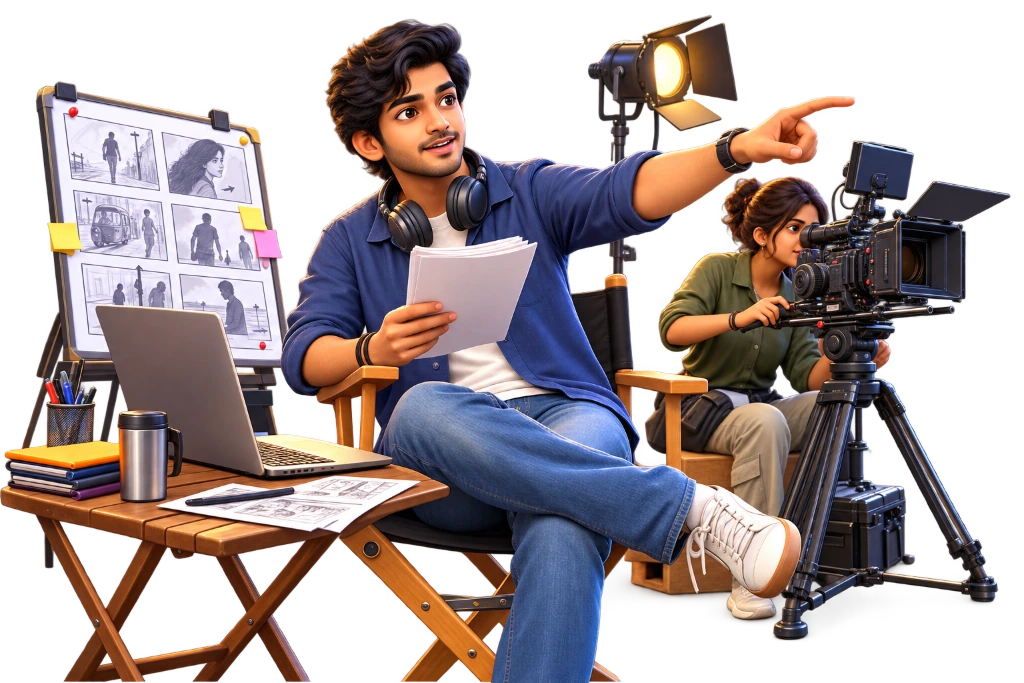
You might work on a set with actors, camera, sound, art, costume and editing teams, often through long shoot days. As an Assistant Director, you prepare call sheets, track scenes and help the set run on time. As a screenwriter, you may write alone for weeks, then meet a director or producer to discuss changes. Work often begins through assisting, short films, student projects and freelancing.
This is a long apprenticeship, not a quick route from a course to directing a feature. People do well when they keep making work, take feedback without losing their point of view, and finish scripts rather than only discussing ideas. A BFA or MFA, including study at FTII or SRFTI after the Joint Entrance Test, gives practice and contacts, but your films, scripts and reliability decide who keeps calling you back.
Skills that actually matter
Capability
You need to tell a clear story on the page, then get a small crew to make it under real limits of time, money and energy.
You must know what each scene changes, what the character wants, and why the audience should keep watching. Pretty shots do not repair a weak scene.
How to build it. Pick one 10-minute film each week. Write its story in five beats, then rewrite one scene with a different ending. Shoot two-minute stories on a phone with friends.
A screenplay needs clear action, believable dialogue and scenes that actors can perform. You will also rewrite after feedback, often many times.
How to build it. Read freely available Indian short-film scripts or scene transcripts. Write one three-page scene each week, get two people to read it aloud, and cut any dialogue they would not say naturally.
A director gives usable instructions to actors, camera, sound and art teams. On a small set, you also settle confusion without wasting the day.
How to build it. Make a three-person short film. Before shooting, prepare a shot list and divide tasks. After each take, give one precise note, such as changing a pause before a line, rather than saying 'do it better'.
You need to see where a scene starts too early, runs too long or loses feeling after a cut. Even if an editor handles the final film, the director must judge the edit.
How to build it. Use a free editor to cut the same two-minute footage into two versions, one fast and one quiet. Screen both to classmates and note exactly where they stop paying attention.
Good scenes come from noticing how people avoid a question, hide anger or speak differently at home and in public. This gives your writing and actor direction truth.
How to build it. Keep a notebook of overheard phrases, gestures and small conflicts from buses, college, family gatherings and your district. Change names and details, then turn one observation into a scene.
Most early work involves callsheets, locations, permissions, missed buses, unavailable actors and limited equipment. A good plan protects the shoot from these ordinary problems.
How to build it. For every student film, make a one-page schedule, location list, prop list and backup plan for rain or an absent actor. Shoot within a fixed amount of money, even if it is only a few hundred rupees.
Frame size, light, silence and background sound change what a viewer feels. You do not need to operate every tool, but you must know what the shot and sound should achieve.
How to build it. Watch a scene once with sound off and once with your eyes closed. Write what framing and sound tell you. Recreate a 30-second scene using daylight and phone audio, then compare the effect.
What separates the well paid from the average. The people who move ahead finish strong scripts and short films repeatedly, take feedback without defending every choice, and remain dependable through the slow assistant and rewriting years.
How people actually get in
Getting in
Most people spend years making short films, assisting on sets and writing before they direct or write professionally.
After Class 12, take a BFA and watch films seriously. Prepare for the FTII or SRFTI Joint Entrance Test, then make films while studying. Your first paid work may still be as an Assistant Director or through smaller writing assignments.
Usually takes About 7 to 11 years from Class 12 to sustained professional work.
Complete a bachelor's degree, keep making short films and build scripts you can show people. Many entrants learn set work as an Assistant Director, where much of the day involves schedules, calls, notes and solving small production problems.
Usually takes About 6 to 10 years from Class 12.
Take a bachelor's degree first, then an MFA to spend more time on writing, storytelling and film-making. Keep producing work during and after the course, because a degree alone does not replace a body of scripts or films.
Usually takes About 5 years of study, followed by 2 to 5 years of assisting and writing.
What people get wrong
Read this one
Most people underestimate how long you spend learning on small sets, short films and other people’s projects before your own work gets made.
- “Film direction means calling shots on a big set.” Early work often means assisting: making call sheets, tracking scenes, handling changes and keeping a shoot on time.
- “A film school seat makes you a director.” FTII or SRFTI entrance preparation and study take time, but you still need to make films, assist and build work after the course.
- “Screenwriters only write when inspiration comes.” You will rewrite scenes, take notes, fix weak dialogue and meet deadlines, often for a director or producer’s brief.
- “You need an expensive camera to start.” A clear short script, careful sound and actors who turn up matter more at the beginning; you can make useful practice films with limited equipment.
- “This is a dead-end unless you direct a feature film.” Some people build working careers as assistant directors or self-employed screenwriters, though the apprenticeship is long and work is often project-based.
Where this leads
Outlook
Most people spend years assisting and writing before they direct a full film or earn steadily from scripts.
| Who employs | What it is like |
|---|---|
| Film production houses | You usually enter as an assistant director, working on call sheets, locations, actor schedules and many last-minute changes. Project contracts are common, so income can stop between shoots. They want someone organised, calm on set and ready for long days. |
| Television and streaming production units | Serials and series need writers and assistant directors on tighter schedules. Work may be steadier during a running show, but deadlines are relentless and scripts often change after channel or platform notes. They look for fast, reliable writing and set experience. |
| Advertising film production companies | Commercial shoots are short and tightly planned. You may assist a director, write a treatment or help shape a script for a brand brief. Pay per project can be better than a small film, but the work depends on pitches and client approvals. |
| Independent film collectives and small producers | Small teams give you a closer view of budgeting, casting, editing and festival submissions. Budgets are often limited, and you may take on several jobs at once. They value a strong short-film portfolio and people who finish work without much supervision. |
| Your own freelance writing or directing practice | Many screenwriters work as self-employed freelancers, pitching stories, taking script assignments and building samples between paid jobs. You choose projects, but must find work, discuss fees and manage irregular payments yourself. A clear portfolio and professional contacts matter. |
Working reality
Read this one
Getting the first assistant-directing or writing assignment usually takes years of assisting, making films and building contacts.
The route in, step by step
6 steps from where you are now.
Class 12, and watch films seriously Required
Watching critically and writing about what you watch is preparation, not leisure.
A bachelor's degree Required
Required for FTII and SRFTI admission. The subject does not matter; the reading and watching do.
Clear the Joint Entrance Test for FTII or SRFTI Required
A written test on film, arts and general awareness, then orientation and interview. Intake is tiny and competition is severe. Whistling Woods and the university film departments are the paid alternatives.
Make films while you study, and after Required
Short films, documentaries, student projects. A body of work you directed is the only real currency, and film school without films made is worth little.
Assist, and write Required
Assistant director work on features, series and advertisements is the standard route in, and it is long and badly paid. Screenwriters build a portfolio of completed scripts, not ideas.
Direct, or write professionally Optional
Independent features, streaming series, advertising or documentary. Streaming has widened the market substantially, which is the single biggest change in this career in a decade.
Courses that lead here
2 mapped routes into this career.
The roles this becomes
2 lanes out of the same starting point.
Common questions
The ones people actually ask about this work.
Do I need film school?
<p>It helps considerably but is not required. FTII and SRFTI give rigorous training, equipment access and a network that lasts a career, and admission is competitive. The alternative is assisting — working under a director or writer on real productions, which teaches the craft and builds contacts, and is how a large share of working directors began.</p>
What do the early years look like financially?
<p>Difficult, and this should be said plainly. Assistant directors are paid modestly and irregularly, projects end without notice, and gaps between them are unpaid. Writers often work on spec with no guarantee of a sale. Most people who make it had some way of surviving several lean years, and planning for that is part of choosing this seriously.</p>
Has streaming changed the opportunities?
<p>Substantially. Streaming platforms commission far more content than theatrical film alone did, in more languages and more formats, which has created genuine demand for writers and directors and shortened the wait for a first credit. It has also made regional-language work commercially serious in a way it was not before.</p>
How do I actually start?
<p>Make something. Short films, a web series, anything finished with whatever equipment you have — a completed piece of work is what gets you taken seriously, and phones are sufficient to start. Write constantly and finish scripts rather than accumulating ideas. Assist on any production that will have you, including advertising, because the crafts transfer.</p>
Test this against your own priorities
Pay, hours and entry route matter differently to different people. Compare this against the alternative you are actually weighing, rather than against the average.