
B.F.Sc (Bachelor of Fisheries Science)
Last updated · Confirm dates, fees and eligibility on the official website before you apply.
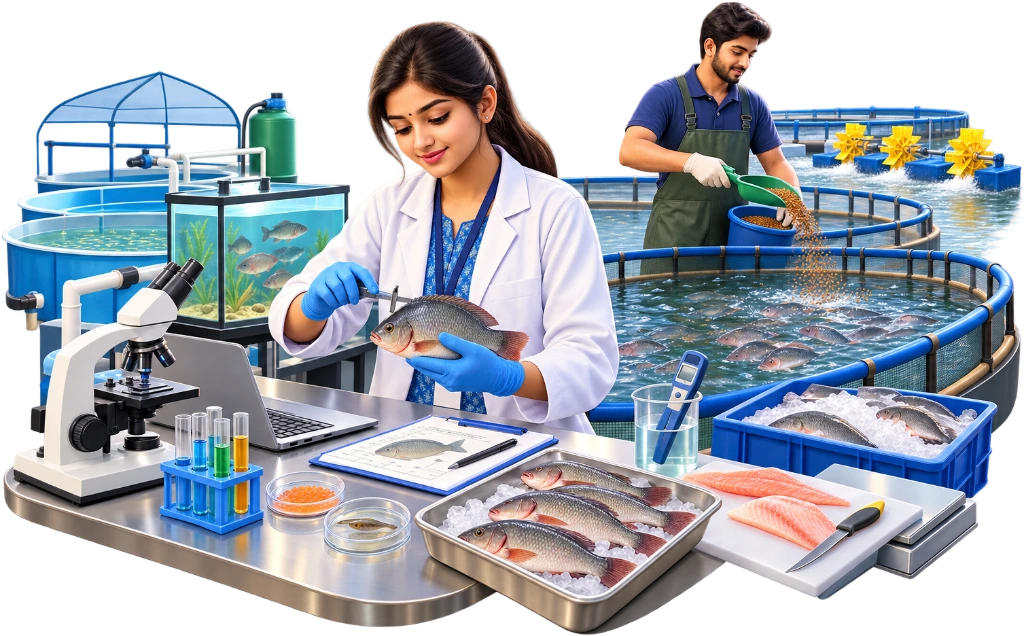
Aquaculture, fish biology, fish processing technology and fisheries management. Supported by substantial government investment in inland and coastal aquaculture through PMMSY.
- Duration
- 4 years
- Entry after
- Class 12
- Entrance exam
- Common University Entrance Test UG
- Study mode
- OnCampus
- Licence
- Not required
Course overview
Aquaculture, fish biology, fish processing technology and fisheries management. Supported by substantial government investment in inland and coastal aquaculture through PMMSY.
Eligibility and admission
Who can apply. 12th pass with Physics, Chemistry, Biology.
How you get in. ICAR AIEEA UG, State fisheries university entrance, CUET UG.
How it is studied. Full-time; distance or online mode only where the university holds specific UGC-DEB approval.
Admission rules change every year. Confirm eligibility, the entrance test and the calendar against the current official notification.
Where this can lead
Where people work.
- State fisheries departments
- Aquaculture and hatchery operations
- Seafood processing and export firms (MPEDA-registered)
- Feed manufacturers
- Research institutes (CIFE, CMFRI)
- Banks (fisheries loan roles)
What you can study next.
- M.F.Sc
- MBA Agri-Business
- ARS via ICAR NET
- Ph.D
- State PSC fisheries posts
Cost, duration and indicative earnings
Indicative total course fee. State Agricultural University: about 50,000 - 3,00,000 total; Private: about 3,00,000 - 10,00,000 total.
Indicative starting salary. 20,000 - 38,000 per month.
Typical duration. 4 years.
Fees and salaries here are indicative ranges, not quotes. Confirm the current fee with the institution and treat the salary as a starting range that varies by employer and location.
What you learn
This four-year course covers aquaculture, fish biology, fish processing technology and fisheries management.
| Stage | Core content | Alongside it |
|---|---|---|
| Year 1 | Fish biology and the science foundations needed for fisheries study. | Theory and introductory practical work. |
| Year 2 | Aquaculture, including fish production and hatchery-related work. | Practical training in aquaculture methods. |
| Year 3 | Fish processing technology and fisheries management. | Processing and management-focused practical work. |
| Year 4 | Advanced work across aquaculture, processing and fisheries management. | Project work and field-based practical exposure. |
Ask before you enrol. How many hours each week will you spend in hatcheries, ponds, processing units or fisheries field visits, and which of these facilities does the university run itself?
Who it suits
B.F.Sc suits you if you want a four-year science degree focused on fish farming, aquatic resources and fisheries work.
- You have passed Class 12 with Physics, Chemistry and Biology, or are preparing with these subjects.
- You are willing to study aquaculture, fish biology, fish processing technology and fisheries management in a full-time course.
- You want to work in areas such as hatcheries, aquaculture operations, seafood processing, feed manufacturing or a state fisheries department.
- You are prepared for admission through ICAR AIEEA UG, CUET UG or a state fisheries university entrance route.
- You are considering a government seat at a state agricultural university, where total fees are usually lower than private options.
- This course does not suit you if you want an online degree, since distance or online study is available only where the university has specific UGC-DEB approval.
What it will actually cost you
For the full four-year B.F.Sc course, budget about Rs 50,000 - 3,00,000 at a state agricultural university or Rs 3,00,000 - 10,00,000 at a private university.
| Line item | Typical | Worth knowing |
|---|---|---|
| State agricultural university fee | Rs 50,000 - 3,00,000 total | This is the indicative total course fee for four years. |
| Private university fee | Rs 3,00,000 - 10,00,000 total | This is the indicative total course fee for four years. |
Check the university prospectus and counselling notice for scholarships, reserved-category fee concessions and refund rules. These differ by university and state.
Indicative ranges, not quotations. Confirm the current fee with the institution before you pay anything.
Certifications that change what you earn
What it pays, and what changes it
In India, B.F.Sc graduates usually start at ₹20,000 to ₹38,000 a month in fisheries, aquaculture, hatcheries, seafood processing or related government-linked roles.
India
Pay changes with the employer, state, role and location. Aquaculture and hatchery work may involve field visits, pond work and seasonal pressure.
| Stage | Monthly | What it depends on |
|---|---|---|
| Entry level | ₹20,000 - ₹38,000 | Fresh B.F.Sc graduate in an aquaculture operation, hatchery, seafood processing firm, feed company, bank fisheries-loan role or state-linked role. |
| Early career | ₹30,000 - ₹45,000 | A few years of experience in farm operations, hatchery production, fish health support, processing, sales or fisheries administration. |
| Experienced | ₹40,000 - ₹60,000 | Several years in a supervisory or specialist role, often with responsibility for production, quality, extension work or a larger farming unit. |
Indicative bands for 2026, not measured salary data. What people actually earn varies by employer, state and sector.
The honest part
A B.F.Sc is a full-time four-year course, so you need to budget for both fees and time away from paid work. Total fees vary sharply: about ₹50,000 to ₹3 lakh at a state agricultural university, and roughly ₹3 lakh to ₹10 lakh at a private university. Entry-level pay is often ₹20,000 to ₹38,000 a month. Jobs may sit in government departments, hatcheries, processing units, export firms or feed companies, so the work setting is not the same everywhere.
The field has real public investment through PMMSY, especially in inland and coastal aquaculture. The degree also gives you several directions after graduation: fisheries department roles, aquaculture operations, seafood processing, research, fisheries loan work in banks, or higher study such as M.F.Sc and MBA Agri-Business. A licence to practise is not required.
Students who do well usually treat the course as preparation for a specific role, rather than collecting a degree alone. They pay attention to aquaculture, fish processing and fisheries management, then choose internships, projects or entrance preparation that match their target. If you want a government post, you need to plan for the relevant state PSC or other recruitment route. If you want industry work, practical familiarity with hatchery or processing operations matters.
Who can apply
1 route into this course.
| Qualification | Stream | Minimum | Subjects |
|---|---|---|---|
| Class 12 | Science - PCB | — | Physics, Chemistry, Biology |
Percentages are indicative. Individual universities set their own cut-offs, and reserved-category relaxations differ by state and institution.
Entrance exams for this course
An exam mapping does not mean every college accepts that exam. Check the current institution and examination notification before you apply.
Careers this course leads to
1 route mapped from this qualification.
A course supports eligibility and preparation. It never guarantees a particular job.
Common questions
Who can apply for B.F.Sc (Bachelor of Fisheries Science)?
12th pass with Physics, Chemistry, Biology. Admission is through ICAR AIEEA UG, State fisheries university entrance, CUET UG.
How long does B.F.Sc (Bachelor of Fisheries Science) take?
4 years. Full-time; distance or online mode only where the university holds specific UGC-DEB approval.
What does B.F.Sc (Bachelor of Fisheries Science) cost?
State Agricultural University: about 50,000 - 3,00,000 total; Private: about 3,00,000 - 10,00,000 total. These are indicative ranges, not quotes. Confirm the current fee with the institution.
What can I study after B.F.Sc (Bachelor of Fisheries Science)?
M.F.Sc, MBA Agri-Business, ARS via ICAR NET, Ph.D, State PSC fisheries posts.
Turn this into a decision you can defend
Compare the route, follow where it actually leads, and keep one alternative in view before you apply.