
B.Sc Nautical Science → Deck Officer
Last updated · Confirm dates, fees and eligibility on the official website before you apply.
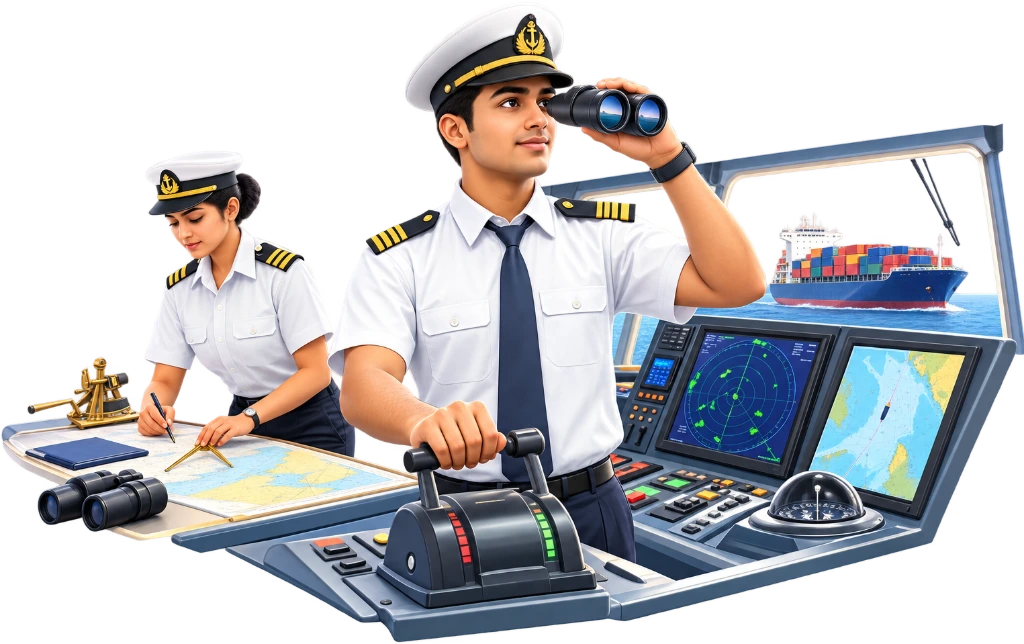
A three-year degree that puts you on a merchant ship's bridge rather than in its engine room. Entry is Class 12 with PCM through IMU CET or an approved institute; the ceiling is Captain.
- Duration
- 3 years
- Entry after
- Class 12
- Indicative fee
- ₹150,000 – ₹1,500,000total, varies by institution
- Entrance exam
- IMU CET
- Study mode
- OnCampus
- Licence
- Certificate of Competency (CoC) from DG Shipping plus a valid Continuous Discharge Certificate and STCW certificates
What this course is
A pre-sea degree leading to a deck officer career in the merchant navy - navigation, cargo work, ship stability and maritime law - followed by sea time and the certificates of competency that lead ultimately towards command.
What you study
Navigation and chartwork, ship construction and stability, cargo handling and stowage, meteorology and oceanography, maritime law and regulation, marine communication, and mandatory survival, firefighting and first aid training.
Who this suits
People who genuinely want to go to sea, want responsibility young, and are drawn to earnings that are difficult to match ashore at the same age. Progression to Master is a clear, defined ladder rather than a matter of office politics.
The honest reality
Only Directorate General of Shipping approved institutes lead anywhere - verify approval before paying, since this sector has a long record of institutes taking fees for training that cannot be used. Medical and eyesight standards, including colour vision, are strict and disqualify many. Contracts mean months away with limited contact, and the isolation is the part people underestimate rather than the work. Cadet berths depend on shipping cycles and are not guaranteed by the degree.
Eligibility and admission
Who can apply. 12th pass with Physics, Chemistry, Maths, minimum 60%; medical fitness and eyesight standards.
How you get in. IMU CET, institute entrance, sponsorship by shipping companies.
How it is studied. Full-time residential training; distance mode not applicable.
Licence to practise. Certificate of Competency (CoC) from DG Shipping plus a valid Continuous Discharge Certificate and STCW certificates.
Admission rules change every year. Confirm eligibility, the entrance test and the calendar against the current official notification.
Where this can lead
Where people work.
- Merchant shipping companies (international and Indian)
- Shipping corporations
- Port authorities
- Marine surveying firms
- Maritime training institutes
What you can study next.
- Certificate of Competency examinations (Second Mate, Chief Mate, Master)
- MBA Shipping
- Marine surveying certification
Cost, duration and indicative earnings
Indicative total course fee. About 1,50,000 - 15,00,000 total depending on programme; company-sponsored candidates may pay substantially less.
Indicative starting salary. 60,000 - 150,000+ (at sea) per month.
Typical duration. 3 years.
Fees and salaries here are indicative ranges, not quotes. Confirm the current fee with the institution and treat the salary as a starting range that varies by employer and location.
What it will actually cost you
For the full three-year course, budget about Rs 1,50,000 - 15,00,000 in total, with the biggest difference coming from the programme and sponsorship arrangement.
| Line item | Typical | Worth knowing |
|---|---|---|
| Course fee | Rs 1,50,000 - 15,00,000 total | This covers the recorded fee range for the three-year B.Sc Nautical Science programme. Company-sponsored candidates may pay substantially less. |
Company sponsorship may reduce what you pay. Check the institute’s written fee-refund rules before accepting a seat, especially if your admission or sponsorship is still pending.
Indicative ranges, not quotations. Confirm the current fee with the institution before you pay anything.
Certifications that change what you earn
After your degree, DG Shipping credentials decide the rank you can sail at. You also need a valid Continuous Discharge Certificate and STCW certificates to serve as a deck officer.
| Certification | What it proves | What it changes |
|---|---|---|
| DG Shipping Certificate of Competency, Second Mate | You have passed the DG Shipping competency examination for a junior navigating officer rank. | Lets you progress from deck cadet work to watchkeeping deck-officer duties. |
| DG Shipping Certificate of Competency, Chief Mate | You meet the competency standard for senior deck-officer responsibility. | Opens Chief Mate roles and a higher rank on merchant ships. |
| DG Shipping Certificate of Competency, Master | You meet the DG Shipping standard for command of a merchant ship. | Opens Captain or Master roles, where earnings rise substantially with rank. |
| Continuous Discharge Certificate | Your seafaring service record and discharge history are formally recorded. | Required alongside the CoC and STCW certificates for deck-officer practice. |
| STCW certificates | You hold the required Standards of Training, Certification and Watchkeeping safety training. | Required with a valid CoC and Continuous Discharge Certificate to serve at sea. |
What it pays, and what changes it
At sea, a Deck Cadet or junior deck officer usually starts around ₹60,000 to ₹1,50,000+ a month. Pay rises sharply after sea time and DG Shipping Certificate of Competency examinations move you towards Second Mate, Chief Mate and Master.
India
Merchant ship pay depends heavily on rank, ship type, company and time at sea. Sea-going income may be tax-advantaged when you qualify as an NRI seafarer.
| Stage | Monthly | What it depends on |
|---|---|---|
| Deck Cadet / junior officer | ₹60,000–₹1,50,000+ | First sea-going role after training, with valid Continuous Discharge Certificate and STCW certificates. |
| Second Mate | ₹1,50,000+ | Sea time completed and DG Shipping Second Mate Certificate of Competency obtained. |
| Chief Mate | ₹1,50,000+ | Further sea service and the Chief Mate Certificate of Competency. |
| Master Mariner / Captain | ₹1,50,000+ | Master Certificate of Competency, substantial sea-going experience and appointment as Master. |
Indicative bands for 2026, not measured salary data. What people actually earn varies by employer, state and sector.
Who can apply
1 route into this course.
| Qualification | Stream | Minimum | Subjects |
|---|---|---|---|
| Class 12 | Science - PCM | — |
Percentages are indicative. Individual universities set their own cut-offs, and reserved-category relaxations differ by state and institution.
Entrance exams for this course
An exam mapping does not mean every college accepts that exam. Check the current institution and examination notification before you apply.
Careers this course leads to
2 routes mapped from this qualification.
A course supports eligibility and preparation. It never guarantees a particular job.
Before and after this course
Courses that lead here
Common questions
Who can apply for B.Sc Nautical Science → Deck Officer?
12th pass with Physics, Chemistry, Maths, minimum 60%; medical fitness and eyesight standards. Admission is through IMU CET, institute entrance, sponsorship by shipping companies.
How long does B.Sc Nautical Science → Deck Officer take?
3 years. Full-time residential training; distance mode not applicable.
What does B.Sc Nautical Science → Deck Officer cost?
About 1,50,000 - 15,00,000 total depending on programme; company-sponsored candidates may pay substantially less. These are indicative ranges, not quotes. Confirm the current fee with the institution.
What can I study after B.Sc Nautical Science → Deck Officer?
Certificate of Competency examinations (Second Mate, Chief Mate, Master), MBA Shipping, Marine surveying certification.
Does B.Sc Nautical Science → Deck Officer need a licence or registration to practise?
Certificate of Competency (CoC) from DG Shipping plus a valid Continuous Discharge Certificate and STCW certificates.
Turn this into a decision you can defend
Compare the route, follow where it actually leads, and keep one alternative in view before you apply.