
B.Sc Optometry
Last updated · Confirm dates, fees and eligibility on the official website before you apply.
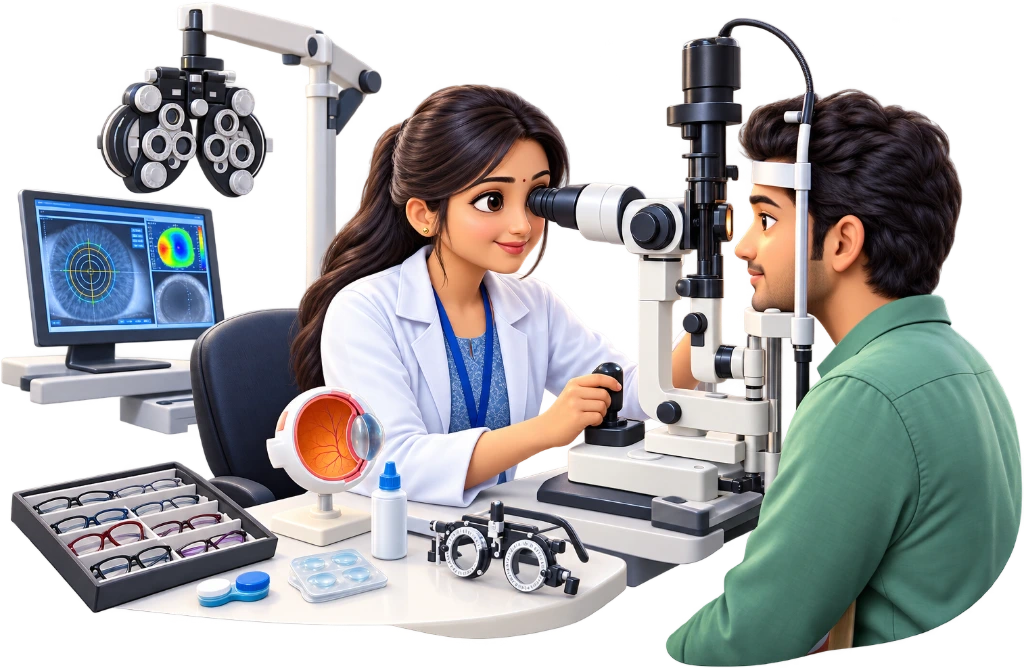
Vision assessment, refraction, contact lenses and binocular vision. Rapid organised optical retail expansion has created substantial structured employment alongside clinical roles.
- Duration
- 4 years
- Entry after
- Class 12
- Entrance exam
- Common University Entrance Test UG
- Study mode
- OnCampus
- Licence
- Registration with the State Allied and Healthcare Council under NCAHP, where the state council has been constituted
Course overview
Vision assessment, refraction, contact lenses and binocular vision. Rapid organised optical retail expansion has created substantial structured employment alongside clinical roles.
Eligibility and admission
Who can apply. 12th pass with Physics, Chemistry, Biology/Maths.
How you get in. State counselling, CUET UG, institute admission (LVPEI, AIIMS).
How it is studied. Full-time only. UGC does not permit this programme in distance or online mode, as it requires laboratory, clinical or studio training.
Licence to practise. Registration with the State Allied and Healthcare Council under NCAHP, where the state council has been constituted.
Admission rules change every year. Confirm eligibility, the entrance test and the calendar against the current official notification.
Where this can lead
Where people work.
- Eye hospitals (Aravind, LVPEI, Shankara Nethralaya)
- Optical retail chains (Lenskart, Titan Eye+)
- Contact lens companies
- Community eye health programmes
- Own optical practice
What you can study next.
- M.Optom
- Ph.D
- Specialised clinical fellowships
- Overseas practice
Cost, duration and indicative earnings
Indicative total course fee. Govt/University: about 10,000 - 80,000 total; Private: about 1,50,000 - 6,00,000 total.
Indicative starting salary. 18,000 - 35,000 per month.
Typical duration. 4 years (including internship).
Fees and salaries here are indicative ranges, not quotes. Confirm the current fee with the institution and treat the salary as a starting range that varies by employer and location.
What you learn
Over four years, including internship, you learn to assess vision, perform refraction, fit contact lenses and examine binocular vision.
| Stage | Core content | Alongside it |
|---|---|---|
| Throughout | Vision assessment, refraction, contact lenses and binocular vision. | Laboratory, clinical or studio training required for this full-time programme. |
Ask before you enrol. How many hours of supervised clinical training and internship work will I complete, and where will I practise vision assessment and refraction?
Who it suits
B.Sc Optometry suits you if you want a four-year, full-time allied health course focused on testing vision and helping people use the right glasses or contact lenses.
- You have passed Class 12 with Physics, Chemistry and Biology or Maths.
- You are comfortable with clinical training in eye hospitals, labs and optical settings. This is not an online or distance course.
- You want to learn refraction, contact lens fitting and binocular vision rather than general nursing or medicine.
- You are open to jobs in eye hospitals, optical retail chains, contact lens companies or community eye-health programmes.
- You can plan for four years of study, including internship, before starting full-time work.
- It does not suit you if you want a course without patient-facing clinical work or a quick route to earning within a year.
What it will actually cost you
For the full four-year B.Sc Optometry course, budget about Rs 10,000 - 80,000 at a government or university institution, or Rs 1,50,000 - 6,00,000 at a private institution.
| Line item | Typical | Worth knowing |
|---|---|---|
| Government or university institution fee | Rs 10,000 - 80,000 total | This is the indicative fee for the complete four-year course, including internship. |
| Private institution fee | Rs 1,50,000 - 6,00,000 total | This is the indicative fee for the complete four-year course, including internship. |
Government seats may have lower fees and reserved-category concessions, depending on the institution and state rules. Check the college prospectus before counselling, including its fee-refund rules if you withdraw after admission.
Indicative ranges, not quotations. Confirm the current fee with the institution before you pay anything.
Certifications that change what you earn
State Allied and Healthcare Council registration is the only post-course credential recorded for B.Sc Optometry. It matters where the state council has been constituted.
| Certification | What it proves | What it changes |
|---|---|---|
| Registration with the State Allied and Healthcare Council under NCAHP | You are registered as an allied healthcare professional after completing the required optometry qualification. | Supports lawful professional practice in states where the council has been constituted; employers may ask for it for clinical roles. |
What it pays, and what changes it
In India, B.Sc Optometry graduates usually start at ₹18,000 to ₹35,000 a month in eye hospitals, optical retail or community eye-health work.
India
Pay varies by city, employer and clinical responsibility.
| Stage | Monthly | What it depends on |
|---|---|---|
| Entry level | ₹18,000–₹35,000 | After B.Sc Optometry, in a supervised clinical, hospital or optical retail role. |
| Early career | ₹25,000–₹40,000 | With experience in refraction, contact lenses or optical retail. |
| Experienced | ₹35,000–₹55,000 | With several years of clinical work, stronger patient handling and a role in a larger eye hospital or organised optical chain. |
Indicative bands for 2026, not measured salary data. What people actually earn varies by employer, state and sector.
The honest part
The fee gap is large. A government or university seat may cost about ₹10,000 to ₹80,000 in total, while private study can cost about ₹1.5 lakh to ₹6 lakh. The programme is full-time for four years, including internship, so you cannot treat it like an online degree alongside another course or regular job. Starting pay of ₹18,000 to ₹35,000 a month also needs to be weighed against the fee and living costs.
There is steady work beyond eye hospitals. Organised optical retail, contact lens work and community eye health programmes need people who can test vision, perform refraction and guide patients on lenses. A degree also gives you routes into M.Optom, clinical fellowships or, later, your own optical practice. Registration with the State Allied and Healthcare Council applies where that council has been constituted.
Students who do well take the clinical and retail sides seriously. They practise refraction until their results are consistent, learn binocular vision and contact-lens fitting properly, and speak clearly to children, older patients and first-time spectacle users. They also choose a college by checking its laboratory, clinical training and internship arrangements, not only its fee or brochure.
Who can apply
1 route into this course.
| Qualification | Stream | Minimum | Subjects |
|---|---|---|---|
| Class 12 | Science - PCMB | — | Physics, Chemistry, Biology/Maths |
Percentages are indicative. Individual universities set their own cut-offs, and reserved-category relaxations differ by state and institution.
Entrance exams for this course
An exam mapping does not mean every college accepts that exam. Check the current institution and examination notification before you apply.
Careers this course leads to
1 route mapped from this qualification.
A course supports eligibility and preparation. It never guarantees a particular job.
Before and after this course
What you can study next
Common questions
Who can apply for B.Sc Optometry?
12th pass with Physics, Chemistry, Biology/Maths. Admission is through State counselling, CUET UG, institute admission (LVPEI, AIIMS).
How long does B.Sc Optometry take?
4 years (including internship). Full-time only. UGC does not permit this programme in distance or online mode, as it requires laboratory, clinical or studio training.
What does B.Sc Optometry cost?
Govt/University: about 10,000 - 80,000 total; Private: about 1,50,000 - 6,00,000 total. These are indicative ranges, not quotes. Confirm the current fee with the institution.
What can I study after B.Sc Optometry?
M.Optom, Ph.D, Specialised clinical fellowships, Overseas practice.
Does B.Sc Optometry need a licence or registration to practise?
Registration with the State Allied and Healthcare Council under NCAHP, where the state council has been constituted.
Turn this into a decision you can defend
Compare the route, follow where it actually leads, and keep one alternative in view before you apply.