
Certificate in Mushroom Cultivation
Last updated · Confirm dates, fees and eligibility on the official website before you apply.
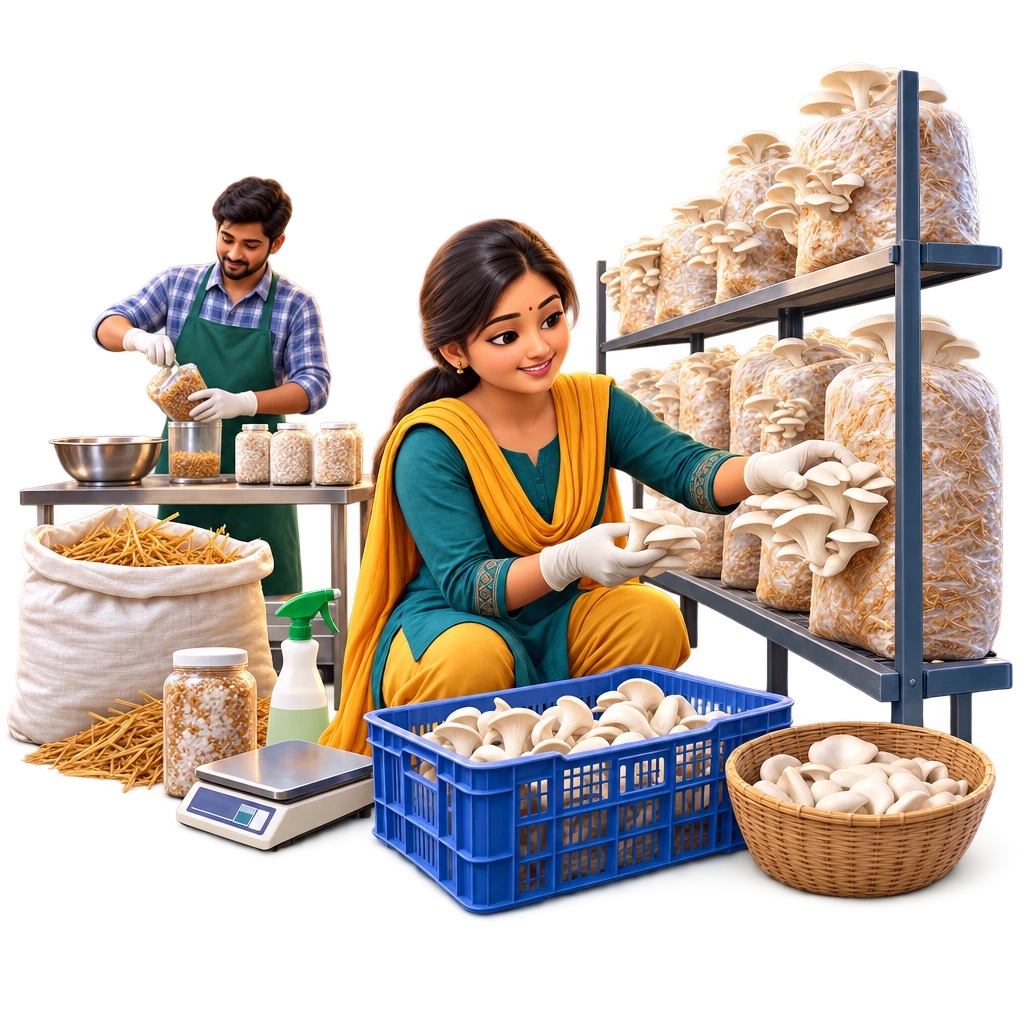
Short, practical programme on spawn, substrate, growing conditions and marketing. Low land requirement and quick crop cycles make it a popular micro-enterprise for landless and small farmers.
- Duration
- 0.1–0.3 years
- Entry after
- Class 8and 1 other route
- Indicative fee
- ₹5,000 – ₹60,000total, varies by institution
- Entrance exam
- None
- Study mode
- OnCampus
- Licence
- Not required
Course overview
Short, practical programme on spawn, substrate, growing conditions and marketing. Low land requirement and quick crop cycles make it a popular micro-enterprise for landless and small farmers.
Eligibility and admission
Who can apply. 8th or 10th pass; no formal barrier at most KVKs.
How you get in. Direct enrolment (KVKs, state agricultural universities, DMR Solan).
How it is studied. Full-time or part-time; many providers offer online or blended delivery.
Admission rules change every year. Confirm eligibility, the entrance test and the calendar against the current official notification.
Where this can lead
Where people work.
- Own cultivation unit
- Agri cooperatives and FPOs
- Mushroom processing firms
- Retail and hospitality supply
What you can study next.
- Advanced mushroom production training
- Food processing certification
- Diploma in Agriculture
Cost, duration and indicative earnings
Indicative total course fee. About 5,000 - 60,000 total; varies widely by provider and duration.
Indicative starting salary. 8,000 - 20,000 per month.
Typical duration. 1 - 3 months.
Fees and salaries here are indicative ranges, not quotes. Confirm the current fee with the institution and treat the salary as a starting range that varies by employer and location.
What you learn
This 1 to 3 month course focuses on the practical steps from spawn and substrate preparation to crop management and selling mushrooms.
| Stage | Core content | Alongside it |
|---|---|---|
| Throughout | Spawn, substrate, growing conditions and mushroom cultivation. | Marketing and planning a small cultivation unit or micro-enterprise. |
Ask before you enrol. How many hours will I spend in practical cultivation, including preparing substrate and managing a crop, and will the institute provide the spawn and growing materials?
Who it suits
This course suits you if you want to learn mushroom growing quickly and use it for a small cultivation or supply business.
- You have passed Class 8 or Class 10 and want a course that usually takes one to three months.
- You have little or no farmland, but can arrange a small growing space for a cultivation unit.
- You want practical training in spawn, substrate, growing conditions and marketing.
- You plan to sell mushrooms through local retail, hospitality supply, a cooperative or an FPO.
- It does not suit you if you want a long academic agriculture course with extensive theory from the start.
What it will actually cost you
Expect to pay about Rs 5,000 - 60,000 in total for this 1-3 month certificate, depending on the provider and course duration.
| Line item | Typical | Worth knowing |
|---|---|---|
| Course fee | Rs 5,000 - 60,000 total | Fees vary widely by training provider and duration. |
Indicative ranges, not quotations. Confirm the current fee with the institution before you pay anything.
Certifications that change what you earn
What it pays, and what changes it
In India, paid entry roles linked to mushroom cultivation usually start around ₹8,000 to ₹20,000 a month. Your income rises when you handle production, processing or regular supply to buyers.
India
Pay depends on the employer, local demand and whether you work in cultivation, processing or supply.
| Stage | Monthly | What it depends on |
|---|---|---|
| Entry-level cultivation or support role | ₹8,000–₹20,000 | After the certificate, in a cultivation unit, cooperative, FPO, processing firm or supply role. |
| Skilled production or processing worker | ₹15,000–₹25,000 | After hands-on experience with spawn, substrate, growing conditions, harvesting and basic quality control. |
| Experienced production or supply role | ₹20,000–₹35,000 | After regular experience managing crop cycles, packing, buyer supply or a small production team. |
Self-employed
Income comes from sales, not a fixed salary. It depends on crop output, spoilage, local buyers and the cost of spawn, substrate and growing space.
| Stage | Monthly | What it depends on |
|---|---|---|
| Small cultivation unit | ₹8,000–₹20,000 | When you sell small batches locally and have steady crop production. |
| Regular local supply | ₹15,000–₹30,000 | When you supply retailers, hospitality buyers, cooperatives or local markets across repeated crop cycles. |
| Established micro-enterprise | ₹25,000–₹50,000 | When you maintain regular buyers, manage production well and add packing, processing or wider supply. |
Indicative bands for 2026, not measured salary data. What people actually earn varies by employer, state and sector.
The honest part
Mushroom cultivation needs daily attention to substrate, spawn and growing conditions. A short certificate does not remove the work of finding buyers, handling spoilage or maintaining regular supply. Fees range from about ₹5,000 to ₹60,000, so compare what each provider includes before paying. Entry-level jobs linked to this work may start around ₹8,000 to ₹20,000 a month.
The route suits someone who wants to start small. You need little land, and quick crop cycles let you learn from a small cultivation unit before spending more. Work is available through your own unit, cooperatives and FPOs, processing firms, and retail or hospitality supply. No licence is required to practise.
People who do well treat the certificate as a starting point, not the whole plan. They learn each step properly, keep track of growing conditions, and build local buyers before increasing production. They also use the training to decide if they want advanced mushroom production, food processing training, or a Diploma in Agriculture.
Who can apply
2 routes into this course.
| Qualification | Stream | Minimum | Subjects |
|---|---|---|---|
| Class 8 | Any | — | |
| Class 10 | Any | — |
Percentages are indicative. State directorates and individual institutes set their own cut-offs, and reserved-category relaxations differ by state.
Careers this course leads to
1 route mapped from this qualification.
A course supports eligibility and preparation. It never guarantees a particular job.
Before and after this course
What you can study next
Common questions
Who can apply for Certificate in Mushroom Cultivation?
8th or 10th pass; no formal barrier at most KVKs. Admission is through Direct enrolment (KVKs, state agricultural universities, DMR Solan).
How long does Certificate in Mushroom Cultivation take?
1 - 3 months. Full-time or part-time; many providers offer online or blended delivery.
What does Certificate in Mushroom Cultivation cost?
About 5,000 - 60,000 total; varies widely by provider and duration. These are indicative ranges, not quotes. Confirm the current fee with the institution.
What can I study after Certificate in Mushroom Cultivation?
Advanced mushroom production training, Food processing certification, Diploma in Agriculture.
Turn this into a decision you can defend
Compare the route, follow where it actually leads, and keep one alternative in view before you apply.