
Aerospace Engineer
Last updated · Confirm dates, fees and eligibility on the official website before you apply.
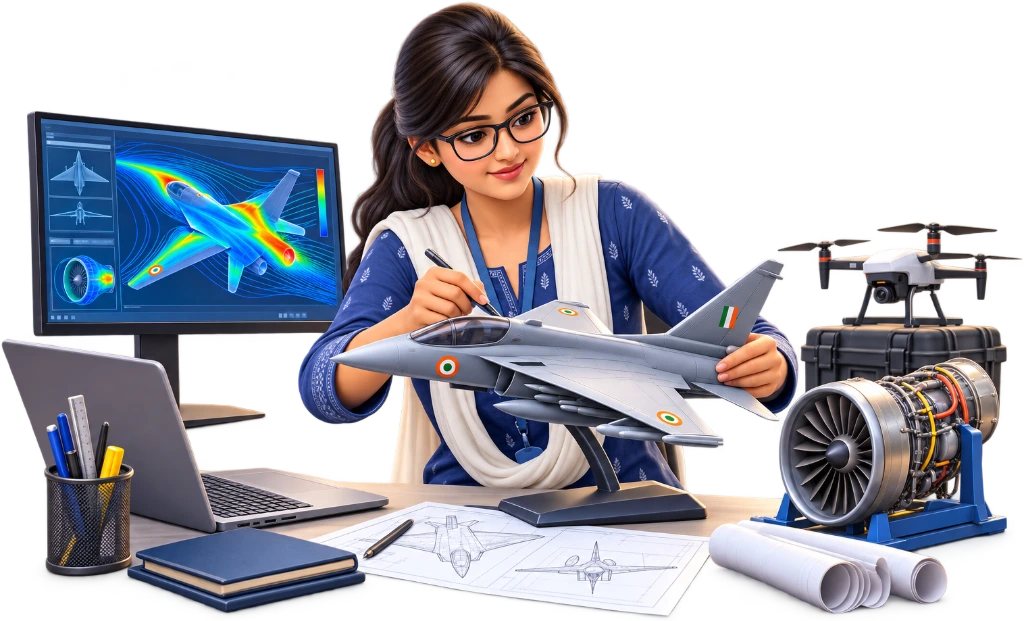
Designs, analyses and tests aircraft, spacecraft and related structures, propulsion or control systems.
- Route in
- Aerospace, aeronautical, mechanical or related engineering education is common. Strong mathematics, physics, simulation and rigorous testing are essential. 3 courses lead here
- Entrance
- Joint Entrance Examination Main
- Entry pay
- ₹500,000 – ₹2,200,000 / annual 0–10 yrs
- Where you work
- Aerospace and defence organisations, airlines, research laboratories, manufacturing and specialised suppliers. Usually regular technical hours; test programs and projects may extend schedules.
Overview
What this career is, in plain terms.
Aerospace Engineer overview
Understand the role
Eligibility and preparation
Fit
Work environment
Capability
Reality check
Read this one
What you actually do
Day to day
You spend much of the job checking, calculating and documenting how an aircraft or spacecraft part will behave before anyone builds or tests it.
- Read drawings, material data and operating requirements for the part you are working on.
- Build or update simulation models for loads, heat, airflow, vibration or movement.
- Check calculations against safety limits and record any assumptions used.
- Review design changes with manufacturing, materials, propulsion or controls engineers.
- Write test notes, analysis reports and drawing comments that another engineer can trace later.
- Attend design reviews and explain why a component passes, fails or needs more analysis.
- Compare test readings with simulation results and investigate large differences.
- Check whether a proposed material, fastener or shape change affects weight, strength or temperature limits.
- Work with manufacturing teams or specialised suppliers to clarify tolerances and assembly issues.
- Update issue lists, test plans and technical records for the project.
- Help prepare test procedures for a component, structure, propulsion system or control system.
- Check instrument readings during ground tests, vibration tests or other planned trials.
- Stop and document a test if readings exceed the agreed limits or equipment behaves unexpectedly.
- Examine failed or damaged parts with the test and materials teams.
- Revise the model or design after test results show a weakness.
- Prepare technical evidence for internal design approval.
- Trace each requirement to a calculation, drawing, test result or inspection record.
- Present risks, open defects and design trade-offs to project leads.
- Estimate how a change will affect weight, cost, manufacturing time and the test schedule.
The part people are surprised by. The named engineering skill matters, but a great deal of your time goes into records, reviews and proving that every calculation and test result can be checked later.
How people actually get in
Getting in
Most aerospace engineers enter after an engineering degree, then show practical skill in design, simulation or testing.
After Class 12 with mathematics and physics, complete a BE or B.Tech in aerospace or aeronautical engineering. During college, build evidence of your work through design projects, simulation work, test reports and internships. Entry roles may involve checking drawings, analysing loads or supporting test programmes.
Usually takes Usually 4 years after Class 12.
Many people enter from mechanical engineering because aircraft structures, propulsion, manufacturing and testing need the same foundations. Choose aerospace-related projects where possible, learn simulation tools and apply to aerospace, defence, manufacturing or specialised supplier roles after graduation.
Usually takes Usually 4 years after Class 12.
A related engineering education can lead in when your work matches the team’s need, such as control systems, electronics, materials or manufacturing. Your project record matters. Show careful calculations, documented testing and attention to detail, rather than only a list of courses.
Usually takes Usually 4 years after Class 12.
Some graduates first complete aerospace, mechanical or another related engineering degree, then take a postgraduate aerospace specialisation. This route suits people aiming for deeper work in areas such as propulsion, structures, flight control or research. It does not replace the need for verified practical ability.
Usually takes Usually 5 to 6 years after Class 12.
The honest part
Read this one
The work is slow when safety, weight and reliability matter. You may spend days checking simulation results, test data or a small design change before anyone approves it. A calculation that looks fine on screen still needs rigorous testing. Test programmes can stretch your hours, and you will usually need to work at the site rather than from home.
In your first two years, expect less original aircraft design and more drawing checks, documentation, data analysis, failure reports and support for senior engineers. You need patience with detail and the confidence to ask when a result does not make sense. Some people leave because projects move slowly, security and process rules limit what they can share, or they prefer faster product work. Others shift into mechanical design, manufacturing, software, simulation or research roles.
What people get wrong
Read this one
Aerospace engineering needs patient technical work, and the common myths hide both its limits and its options.
- “You must study only aerospace engineering.” Aerospace, aeronautical, mechanical and related engineering routes can lead here, provided you build strong mathematics, physics, simulation and testing skills.
- “The work is mostly flying aircraft or watching launches.” Much of the job happens at a desk, in a lab or on a factory floor: checking loads, modelling a system, reading test data and documenting faults.
- “It is a glamorous job with easy hours.” Test programmes and project deadlines can stretch your schedule, and the recorded stress level is high at 4 out of 5.
- “There are no proper jobs unless you become a pilot or go abroad.” Aerospace and defence organisations, airlines, research laboratories, manufacturers and specialised suppliers employ engineers in India, including government design roles.
- “A government aerospace design role pays the same throughout your career.” Indicative annual pay for an Aerospace Design Engineer in government roles is ₹5 lakh to ₹22 lakh across 0 to 10 years; experience, role and organisation affect where you fall in that band.
Where this leads
Outlook
Your route can lead to government design work, aircraft manufacturing, test facilities, airline engineering, research laboratories or specialist suppliers.
| Who employs | What it is like |
|---|---|
| Government aerospace and defence organisations | You work on long programmes with formal reviews, drawings, analysis and test records. An Aerospace Design Engineer in government has an indicative annual pay band of ₹5 lakh to ₹22 lakh across 0 to 10 years. Entry often depends on the organisation’s selection process, and project deadlines can stretch hours. |
| Aircraft and aerospace manufacturing organisations | The pace follows production schedules and quality checks. Teams want engineers who can turn a design into a part that can be made repeatedly, then investigate failures without guessing. Pay and security differ by site, contract and role. |
| Research laboratories | Work is methodical: modelling, experiments, test data and written reports. Projects may run for years, but a test campaign can mean long days at the facility. Employers look for strong mathematics, careful simulation work and patience with verification. |
| Airlines and aviation maintenance organisations | The work sits close to aircraft operations, reliability and maintenance planning. Safety paperwork and repeated checks take a large share of the day. Shifts or irregular hours are possible around flight schedules, and travel depends on the role. |
| Specialised aerospace suppliers | Smaller teams make components, structures, electronics or test equipment for larger programmes. You may handle a wider slice of a problem early, but deadlines are often tied to a customer’s delivery date. They value precise documentation and practical fault-finding. |
Working reality
Read this one
Job availability scores 2 because aerospace roles are specialised, with fewer openings than general engineering and many jobs tied to specific defence, research, manufacturing or test projects.
The route in, step by step
5 steps from where you are now.
Understand the real work Required
Explore the daily responsibilities, work environment and constraints of Aerospace Engineer before choosing a course.
Complete an eligible recognised pathway Required
Aerospace, aeronautical, mechanical or related engineering education is common. Strong mathematics, physics, simulation and rigorous testing are essential.
Build verified practical ability Required
Use laboratories, projects, supervised training, internships or portfolio work appropriate to the profession.
Enter a suitable role Required
Apply through the relevant recruitment, campus, portfolio, examination, registration or professional process.
Develop specialisation Optional
Choose advanced study or certification after confirming recognition, eligibility, cost and relevance to the intended role.
Courses that lead here
3 mapped routes into this career.
Exams on the way
What is required, and what is optional.
Exam rules and eligibility are revised regularly. Check the current official notification for your admission year before you act on anything here.
The roles this becomes
1 lane out of the same starting point.
What it pays
Indicative bands.
| Stage | Pay band | What changes |
|---|---|---|
| Aerospace Design Engineer | ₹500,000 – ₹2,200,000 / annual | Broad indicative annual range only; actual pay varies substantially by skill, experience, location, employer and role scope. |
These are ranges, not offers. Pay varies by city, employer size, sector and your own skill more than by job title. Treat the band as the shape of the market, not as a number you can hold anyone to.
Who can enter
1 route into this work.
| Qualification | Stream | Minimum | Subjects |
|---|---|---|---|
| Graduation | Any | — |
Common questions
The ones people actually ask about this work.
What does a Aerospace Engineer do?
Designs, analyses and tests aircraft, spacecraft and related structures, propulsion or control systems.
How can I become a Aerospace Engineer?
Aerospace, aeronautical, mechanical or related engineering education is common. Strong mathematics, physics, simulation and rigorous testing are essential.
Where does a Aerospace Engineer work?
Aerospace and defence organisations, airlines, research laboratories, manufacturing and specialised suppliers. Usually regular technical hours; test programs and projects may extend schedules.
Is Aerospace Engineer a good career in India?
It can be suitable when your aptitude, interests, eligibility and preferred work conditions align with the role. Compare recognised pathways, real tasks, costs and current opportunities before deciding.
Test this against your own priorities
Pay, hours and entry route matter differently to different people. Compare this against the alternative you are actually weighing, rather than against the average.