
Aquaculture farm / hatchery business
Last updated · Confirm dates, fees and eligibility on the official website before you apply.
shrimp exports
- Route in
- Typically B.Sc Fisheries. 1 course lead here
- Entry pay
- ₹200,000 – ₹2,500,000 / annual Any experience
What the work involves
Day to day
Producing fish or shrimp commercially - pond or hatchery management, water quality, seed and feed, disease control and harvest scheduling for processors or export buyers.
Who this suits
Fit
Fisheries graduates and entrepreneurs in coastal and inland aquaculture belts. Returns per acre can be very high, export demand for shrimp is substantial, and the technical knowledge from the degree is directly usable.
The honest reality
Read this one
Disease can destroy an entire crop with almost no warning, and shrimp farming in India has repeatedly seen exactly that. Prices are set by export markets and swing hard. Antibiotic residue rejections can close a buyer permanently. There are real environmental consequences - salinisation, effluent, mangrove loss - and regulation is tightening. Capital at risk per cycle is high, and this is the most volatile enterprise on this list.
What this work actually is
Understand the role
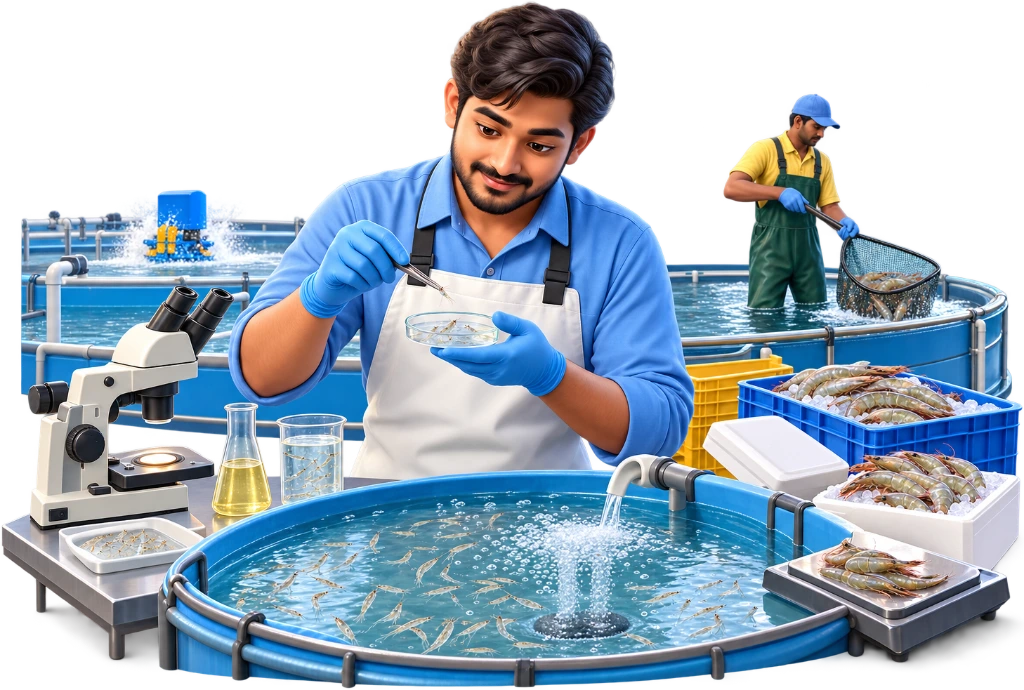
A farm owner grows shrimp or fish for sale. A hatchery manager produces healthy seed, such as shrimp post-larvae, for farms to stock. This is not crop farming with a pond added. You monitor water quality, feed, growth, disease signs, mortality and harvest timing. You also keep records, check seed quality, manage workers and make sure the stock meets buyer requirements.
Most work happens beside ponds, tanks, hatchery rooms and pump systems, often in coastal districts for shrimp farming. You work with technicians, pond workers, feed and equipment suppliers, transporters, buyers and sometimes fisheries officials during approvals or inspections. At harvest, the work may start before dawn. A failed aerator, sudden rain or poor water reading needs attention that day.
Your results depend heavily on control and judgement, not only on owning land or buying tanks. Disease, poor seed, weak water management and a fall in export prices can wipe out a season’s margin. People who do well usually learn on an operating farm first, then begin with one pond or unit instead of expanding on borrowed money too early.
Skills that actually matter
Capability
You need to keep stock alive, water safe and costs under control every day, because a missed check can wipe out a pond or a hatchery batch.
You test and act on dissolved oxygen, pH, salinity, temperature and ammonia before shrimp or fish show stress. Aerators, water exchange and feeding plans depend on these readings.
How to build it. Join a farm or hatchery as a trainee after Class 12 or during B.Sc Fisheries. Ask to maintain the daily water-testing log for one pond or tank, then compare readings with survival and feed records.
You spot weak feeding, unusual swimming, mortality and disease signs early. You also handle stocking, grading, feeding and biosecurity without spreading problems between ponds or tanks.
How to build it. Work through a full crop cycle on a farm or hatchery. Learn the daily feeding and mortality routine from staff, and keep a notebook of signs seen, action taken and results.
Profit depends on feed use, seed survival, electricity, labour and harvest weight. You need clean records to know which pond is losing money, not only which one looks healthy.
How to build it. Make a simple spreadsheet or ruled register for one unit. Enter daily feed, power, labour, water tests, mortality and sales, then calculate the cost and output at harvest.
For a hatchery, this means checking seed quality, hygiene and batch records. For a farm, it means handling harvest cleanly and maintaining traceable records for buyers and export-linked supply chains.
How to build it. During farm work, volunteer for harvest-day grading, packing and batch documentation. Follow the hygiene steps exactly, including cleaning nets, tanks and equipment between batches.
Pond work happens in heat, rain and mud. You need to inspect bunds, inlet screens, pumps, pipes and aerators, and deal with a failed aerator quickly.
How to build it. Start with one pond or unit under an experienced operator. Learn to clean aerators, check electrical connections safely and inspect ponds at dawn, when low oxygen problems often show up.
An owner chooses the crop size, buys seed and feed, plans cash for the full cycle and decides when to sell. A good technical result still fails if money runs out before harvest.
How to build it. Before starting your own unit, prepare a one-cycle budget using local seed, feed, power and labour quotes. Work on a farm for one or two years to see actual losses, delays and buyer payment cycles.
You give clear daily instructions to workers and maintain practical relationships with seed suppliers, technicians and buyers. At harvest, poor coordination can reduce quality or delay transport.
How to build it. On a farm placement, take responsibility for explaining one daily task list and checking it at the end of the shift. Practise reporting pond readings and stock issues in short, clear messages.
What separates the well paid from the average. The better-paid owners and hatchery managers control survival, feed cost and records well enough to catch a problem early, rather than discovering the loss at harvest.
How people actually get in
Getting in
Most people first learn the daily work on a farm or hatchery, then start with one pond or unit when they understand stock, water quality and buyers.
Take science in Class 12, complete B.Sc Fisheries, then work for one to two years on a farm or hatchery. You learn routine checks, feed records, disease losses and harvest handling before putting your own money into one pond or unit. Registration and approvals usually come before you begin.
Usually takes About 5 to 7 years from Class 11.
A six-month to four-year aquaculture course can give you the basics, but farm work matters most here. Start as a worker or assistant, learn water testing, seed handling and quality control, then register a small unit after one to two years of experience.
Usually takes About 2 to 6 years after Class 12.
Some people start directly on a family farm or as a worker at a pond or hatchery. They build skill through fieldwork, often beginning with feed, stock checks and pond maintenance. After learning the business side and getting approvals, they take on one pond or unit themselves.
Usually takes Usually 2 to 4 years before starting a unit.
A hatchery needs more specialised control of breeding and seed quality. Most people reach this step after running a farm or working in a hatchery, rather than starting there. It is often an expansion route once you understand quality control and have experience with seed.
Usually takes Usually several years after entering aquaculture.
What people get wrong
Read this one
Aquaculture is a business where daily care, water quality and sale planning matter as much as fish or shrimp production.
- “It is only about feeding fish or shrimp.” You also check water, manage stock health, maintain records, control quality and deal with buyers, seed suppliers and approvals.
- “A big farm is the only way to start.” Many people begin with one pond or unit, learn the losses and costs, then expand or move towards a hatchery and seed business.
- “A B.Sc Fisheries degree alone makes you ready to own a farm.” The degree or aquaculture training helps, but one to two years working on a farm or hatchery teaches the routine that textbooks do not.
- “This is easy money because shrimp exports are strong.” Export sales do not remove the risk of stock loss, poor water conditions, quality rejection or a bad selling season.
- “It is a dead-end farm job.” You can build towards running your own unit, managing a hatchery, or expanding into seed production, if you can handle fieldwork and business decisions.
Where this leads
Outlook
Most people start by learning on an existing farm or hatchery, then take the risk of running one pond or unit themselves.
| Who employs | What it is like |
|---|---|
| Your own aquaculture farm | You earn from the stock you sell rather than a fixed monthly salary. Security depends on how well you control stock health, water quality and sales. The work follows daily farm checks and becomes intense around stocking and harvest. |
| Shrimp hatcheries | A hatchery job usually gives more regular pay than owning a pond. The pace is close to the production cycle, with careful checks on seed quality. They look for people who can follow hygiene and quality-control routines without cutting corners. |
| Commercial aquaculture farms | These farms employ staff for pond work, feeding, stock observation and records. Pay is usually fixed for the role, while the work is practical and often outdoors. Employers want field experience and someone who notices a problem before stock losses grow. |
| Seafood processing and export businesses | These businesses buy or handle shrimp after harvest. Work tends to follow delivery schedules, quality checks and export orders. They value people who understand farm production and can keep clear records of source and quality. |
| State fisheries departments and fisheries projects | Government work offers a different route from farm ownership, with structured posts or project roles where available. The pace includes field visits, farmer support and paperwork. Entry depends on the post and its government recruitment process. |
Working reality
Read this one
Job availability scores lowest because most recorded roles involve self-employment, so you usually need farm experience, approvals and money to start a pond or hatchery rather than finding a standard salaried post.
What it pays
Indicative
These are estimated annual owner earnings after routine farm costs, not turnover; a poor crop can leave you with no income or a loss.
What decides where you land in the range. Your income moves most with pond or hatchery scale, disease control, survival rate, feed and seed costs, local water conditions, and the price buyers offer at harvest.
The route in, step by step
6 steps from where you are now.
Class 12 with science Required
The science base.
B.F.Sc, or aquaculture training Required
Four years for the degree. Shorter training through fisheries departments and ICAR institutes is the practical alternative.
Work on a farm or hatchery Required
Water quality, feed management, disease and stocking density. Aquaculture fails suddenly and completely when water quality slips, and that judgement is only built by doing it.
Register and get the approvals Required
Coastal Aquaculture Authority registration for coastal shrimp farming, state fisheries department registration for inland, and pollution control consent where applicable. Coastal regulation is enforced.
Start with one pond or unit Required
PMMSY schemes support pond construction, hatcheries and equipment. Learn the cycle economics on a small unit before committing to scale.
Expand, or move into hatchery and seed Optional
More ponds, or seed production - which has better margins and is less exposed to grow-out disease risk.
Courses that lead here
1 mapped route into this career.
The roles this becomes
2 lanes out of the same starting point.
What it pays
Indicative bands, 2 ways to read them.
| Stage | Pay band | What changes |
|---|---|---|
| 1–3 yrs | ₹200,000 – ₹600,000 / annual | One or two successful crop cycles and steadier buyers. |
| 3–6 yrs | ₹400,000 – ₹1,200,000 / annual | Several ponds or a better-managed seed and grow-out operation. |
| 6–12 yrs | ₹700,000 – ₹2,500,000 / annual | Larger farm, hatchery work, repeat buyers and stronger biosecurity. |
| Specialisation | Pay band | What changes |
|---|---|---|
| Aquaculture Farm Owner | ₹200,000 – ₹2,500,000 / annual | Depends heavily on pond area, crop survival, feed costs and sale price. |
| Hatchery Manager | ₹400,000 – ₹1,800,000 / annual | Depends on seed output, survival rate, broodstock access and seasonal orders. |
These are ranges, not offers. Pay varies by city, employer size, sector and your own skill more than by job title. Treat the band as the shape of the market, not as a number you can hold anyone to.
Common questions
The ones people actually ask about this work.
What does it take to start a fish farm?
<p>Land or leased ponds with reliable water, seed stock, feed, and working capital to cover the months until harvest. Species choice, water quality management and disease control decide whether it works. State fisheries departments provide technical support and run subsidy schemes, and using them is worth the paperwork.</p>
Is aquaculture profitable?
<p>It can be, and it is also where inexperienced entrants lose money fast. Disease outbreaks, water quality failures and price swings at harvest all hit hard. The people who do well start small, learn the specific species and local conditions properly, and expand from cash flow rather than from a loan taken on optimistic projections.</p>
Do I need a fisheries degree?
<p>No, and many successful farmers have none. A B.F.Sc helps considerably with disease management, feed and water chemistry, and it opens the government and technical side. For a farm, practical experience with someone already doing it is worth more than a certificate.</p>
Where do I sell?
<p>Local markets and traders, processing and export firms for shrimp and certain species, and increasingly direct sales. Export-oriented shrimp farming pays more and carries more risk and more compliance. Establish the buyer before scaling production, not after.</p>
Test this against your own priorities
Pay, hours and entry route matter differently to different people. Compare this against the alternative you are actually weighing, rather than against the average.