
B.Sc Fisheries
Last updated · Confirm dates, fees and eligibility on the official website before you apply.
aquaculture & marine
- Duration
- Varies
- Entry after
- Class 12
- Entrance exam
- None
- Study mode
- OnCampus
What this course is
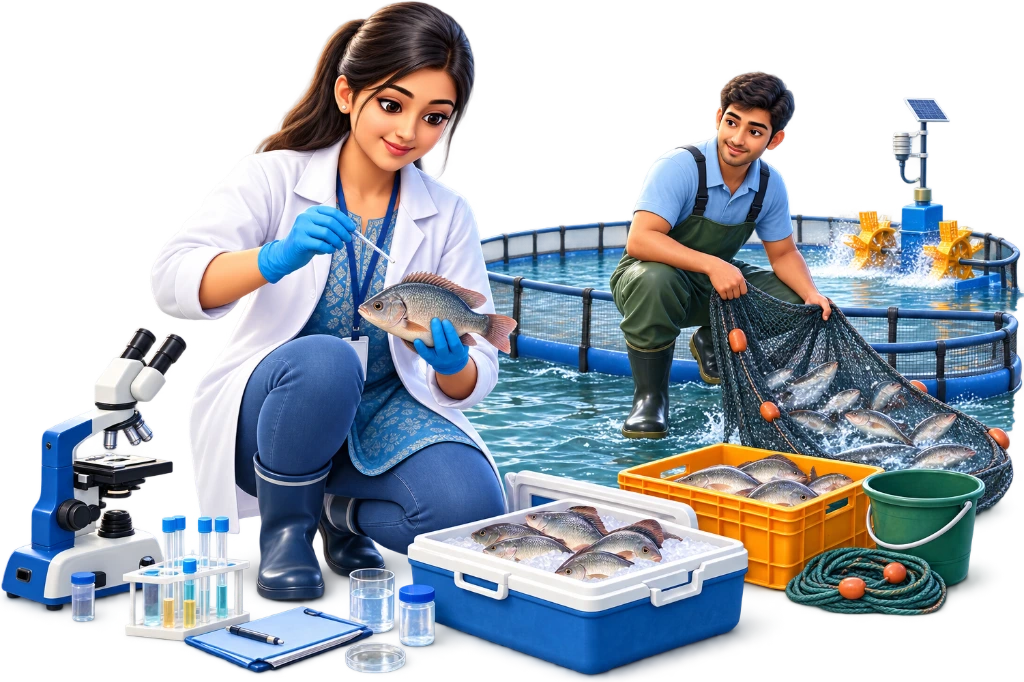
A four-year professional degree in fisheries science covering aquaculture, fish biology, harvest and post-harvest technology, and fisheries management. It includes substantial field, hatchery and processing plant work rather than classroom study alone.
What you study
Aquaculture and hatchery management, fish nutrition and genetics, aquatic ecology and water quality, fishing craft and gear technology, fish processing and preservation, and fisheries economics and extension.
Who this suits
Students in coastal and inland fishery states who want a professional science degree with both government and enterprise routes. It is markedly less crowded than agriculture, and inland aquaculture is expanding with policy support behind it.
The honest reality
Employment is concentrated in fishery states, so where you are from shapes your options more than in most degrees. Government posts are limited and reached through competitive examinations with irregular vacancies. Private aquaculture work means wet, hot field conditions. If you go into your own farm or hatchery, understand that disease can destroy a crop with little warning and export prices swing hard - it is the most volatile enterprise in the sector.
Eligibility and admission
You need Class 12 with Agriculture for B.Sc Fisheries, according to the recorded eligibility rule.
- Class 12 passed — You must have passed Class 12.
- Agriculture background — Your Class 12 qualification must include Agriculture.
Certifications that change what you earn
What it pays, and what changes it
The source data does not record indicative pay bands for B.Sc Fisheries.
Indicative bands for 2026, not measured salary data. What people actually earn varies by employer, state and sector.
Where this can lead
A B.Sc Fisheries can lead to fish-farm and hatchery work, fisheries development roles, or quality assurance in seafood processing and export.
Where the work is
What comes next
Aquaculture farm or hatchery work Best first move
Start in fish-farm or hatchery operations and build hands-on experience in aquaculture.
Seafood processing and export QA
Work in quality assurance for seafood processing and export.
Fisheries Development Officer roles
Move towards fisheries development work in government fisheries services.
Who can apply
1 route into this course.
| Qualification | Stream | Minimum | Subjects |
|---|---|---|---|
| Class 12 | Agriculture | — |
Percentages are indicative. Individual universities set their own cut-offs, and reserved-category relaxations differ by state and institution.
Careers this course leads to
3 routes mapped from this qualification.
A course supports eligibility and preparation. It never guarantees a particular job.
Turn this into a decision you can defend
Compare the route, follow where it actually leads, and keep one alternative in view before you apply.