
B.Sc Cardiac Care / Cardiovascular Technology
Last updated · Confirm dates, fees and eligibility on the official website before you apply.
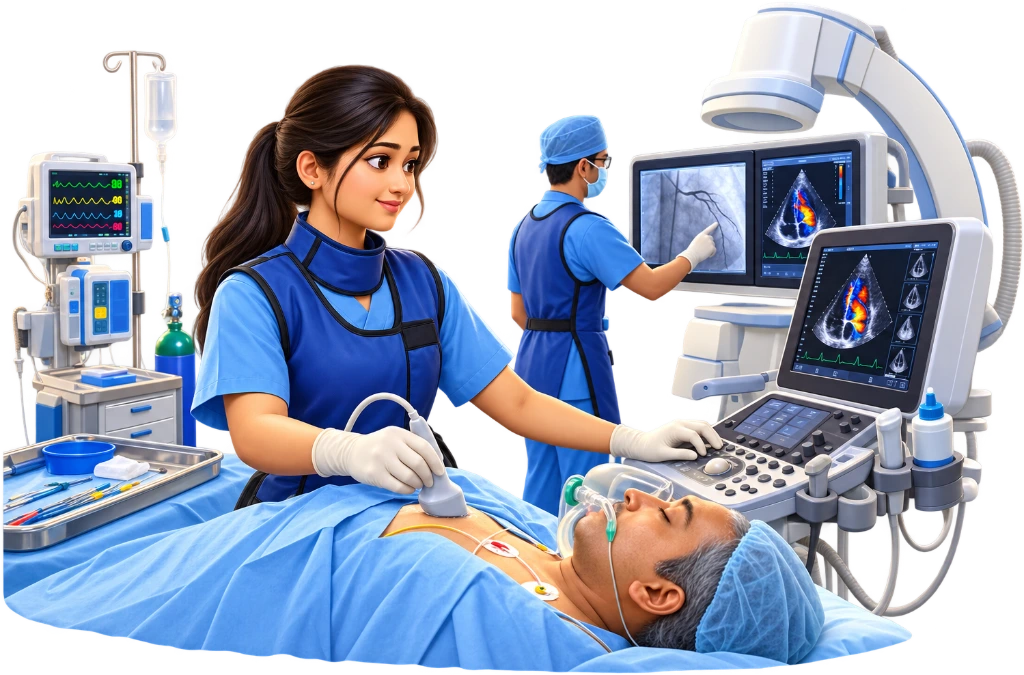
Cardiac diagnostics, catheterisation lab assistance and cardiac critical care. India's high cardiovascular disease burden and cath lab expansion support strong, specialised demand.
- Duration
- 3–4 years
- Entry after
- Class 12
- Entrance exam
- Common University Entrance Test UG
- Study mode
- OnCampus
- Licence
- Registration with the State Allied and Healthcare Council under NCAHP, where the state council has been constituted
Course overview
Cardiac diagnostics, catheterisation lab assistance and cardiac critical care. India's high cardiovascular disease burden and cath lab expansion support strong, specialised demand.
Eligibility and admission
Who can apply. 12th pass with Physics, Chemistry, Biology.
How you get in. State counselling, Institute admission, CUET UG.
How it is studied. Full-time only. UGC does not permit this programme in distance or online mode, as it requires laboratory, clinical or studio training.
Licence to practise. Registration with the State Allied and Healthcare Council under NCAHP, where the state council has been constituted.
Admission rules change every year. Confirm eligibility, the entrance test and the calendar against the current official notification.
Where this can lead
Where people work.
- Cardiac hospitals and heart institutes
- Multi-specialty hospital cath labs
- Cardiac device companies (Medtronic, Abbott)
- Diagnostic centres
- Cardiac ICUs
What you can study next.
- M.Sc Cardiac Care Technology
- Perfusion technology specialisation
- Advanced cath lab training
Cost, duration and indicative earnings
Indicative total course fee. Govt/University: about 10,000 - 80,000 total; Private: about 1,50,000 - 6,00,000 total.
Indicative starting salary. 20,000 - 40,000 per month.
Typical duration. 3 - 4 years (including internship).
Fees and salaries here are indicative ranges, not quotes. Confirm the current fee with the institution and treat the salary as a starting range that varies by employer and location.
What you learn
You learn cardiac diagnostics, catheterisation lab assistance and cardiac critical care through laboratory and clinical training.
| Stage | Core content | Alongside it |
|---|---|---|
| Throughout | Cardiac diagnostics, catheterisation lab assistance and cardiac critical care. | Laboratory and clinical training. |
Ask before you enrol. How many supervised hours will you spend in a cath lab and cardiac ICU, and what equipment will you use during training?
Who it suits
This course suits you if you want a full-time allied health role in cardiac testing, cath lab work and cardiac critical care after Class 12 Science.
- You studied Physics, Chemistry and Biology in Class 12 and meet the PCB eligibility requirement.
- You are ready to spend 3 to 4 years, including internship, in laboratory and clinical training.
- You want to work around cardiac diagnostics, catheterisation labs or cardiac ICUs.
- You are comfortable with admission through state counselling, institute admission or CUET UG.
- You need an online or distance degree. This course does not suit you, because it is full-time only.
- You are willing to register with the State Allied and Healthcare Council where it has been constituted.
What it will actually cost you
For the full 3 to 4-year course, budget about Rs 10,000 - 80,000 at a government or university institution, or Rs 1,50,000 - 6,00,000 at a private institution.
| Line item | Typical | Worth knowing |
|---|---|---|
| Government or university institution fee | Rs 10,000 - 80,000 total | This is the indicative total course fee for the full programme, including the internship period where applicable. |
| Private institution fee | Rs 1,50,000 - 6,00,000 total | This is the indicative total course fee for the full programme, including the internship period where applicable. |
Government seats may have lower fees and category-based concessions under the rules used for admission in that state or institution. Check the fee notice and refund rules before paying, especially if you are waiting for a later counselling round.
Indicative ranges, not quotations. Confirm the current fee with the institution before you pay anything.
Certifications that change what you earn
The meaningful post-course credential in the source data is state registration under NCAHP, where your state has formed its Allied and Healthcare Council.
| Certification | What it proves | What it changes |
|---|---|---|
| Registration with the State Allied and Healthcare Council under NCAHP | You are registered as an allied healthcare professional in a state where the council has been constituted. | Supports lawful professional practice where state registration is required. |
What it pays, and what changes it
In India, a cardiac care technologist usually starts at ₹20,000 to ₹40,000 a month. Pay rises with hands-on work in cardiac diagnostics, cath labs and cardiac ICUs.
India
Cardiac hospitals, multi-specialty hospital cath labs, diagnostic centres, cardiac ICUs and cardiac device companies are common employers.
| Stage | Monthly | What it depends on |
|---|---|---|
| Entry level | ₹20,000–₹40,000 | After the degree and internship, in an entry cardiac diagnostics, cath lab assistance or cardiac ICU role. |
| Early career | ₹20,000–₹40,000 | With experience in a cardiac hospital, multi-specialty hospital cath lab or diagnostic centre. |
| Experienced | ₹20,000–₹40,000 | With sustained clinical experience in cardiac diagnostics, catheterisation lab assistance or cardiac critical care. |
Indicative bands for 2026, not measured salary data. What people actually earn varies by employer, state and sector.
The honest part
This is full-time clinical work, not a course you can finish online. You will spend time in labs, cardiac ICUs and catheterisation settings, where accuracy matters and routine work may feel repetitive. Fees vary sharply: government or university programmes may cost about ₹10,000 to ₹80,000 in total, while private programmes may cost about ₹1.5 lakh to ₹6 lakh. Starting pay is often ₹20,000 to ₹40,000 a month, so compare the fee with likely early earnings before choosing a college.
There is a real need for trained staff in cardiac diagnostics, cath labs and cardiac critical care as heart-care services expand. The work is specialised, and it puts you close to doctors, nurses and patients during investigations and treatment. Still, your first role depends on your clinical training, the hospital's hiring needs and the local job market.
Students who do well take their internship seriously instead of treating it as attendance. They learn ECG and diagnostic workflows carefully, follow infection-control and safety rules, keep calm around unwell patients, and ask staff to explain each procedure. They also check whether their state has constituted an Allied and Healthcare Council, because registration applies where that council exists.
Who can apply
1 route into this course.
| Qualification | Stream | Minimum | Subjects |
|---|---|---|---|
| Class 12 | Science - PCB | — | Physics, Chemistry, Biology |
Percentages are indicative. Individual universities set their own cut-offs, and reserved-category relaxations differ by state and institution.
Entrance exams for this course
An exam mapping does not mean every college accepts that exam. Check the current institution and examination notification before you apply.
Careers this course leads to
1 route mapped from this qualification.
A course supports eligibility and preparation. It never guarantees a particular job.
Common questions
Who can apply for B.Sc Cardiac Care / Cardiovascular Technology?
12th pass with Physics, Chemistry, Biology. Admission is through State counselling, Institute admission, CUET UG.
How long does B.Sc Cardiac Care / Cardiovascular Technology take?
3 - 4 years (including internship). Full-time only. UGC does not permit this programme in distance or online mode, as it requires laboratory, clinical or studio training.
What does B.Sc Cardiac Care / Cardiovascular Technology cost?
Govt/University: about 10,000 - 80,000 total; Private: about 1,50,000 - 6,00,000 total. These are indicative ranges, not quotes. Confirm the current fee with the institution.
What can I study after B.Sc Cardiac Care / Cardiovascular Technology?
M.Sc Cardiac Care Technology, Perfusion technology specialisation, Advanced cath lab training.
Does B.Sc Cardiac Care / Cardiovascular Technology need a licence or registration to practise?
Registration with the State Allied and Healthcare Council under NCAHP, where the state council has been constituted.
Turn this into a decision you can defend
Compare the route, follow where it actually leads, and keep one alternative in view before you apply.