
B.Tech Electronics and Communication Engineering
Last updated · Confirm dates, fees and eligibility on the official website before you apply.
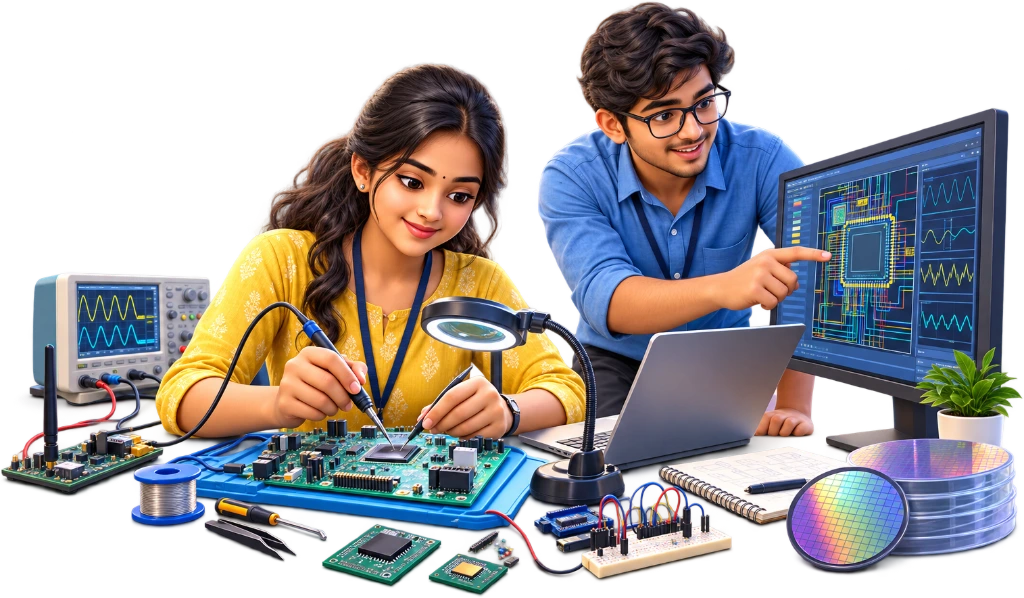
Electronics circuits, communication systems, signal processing, VLSI and embedded systems. India's semiconductor mission is creating new VLSI and chip design opportunities, though many graduates still move into software roles.
- Duration
- 4 years
- Entry after
- Class 12
- Entrance exam
- 3 routes
- Study mode
- OnCampus
- Licence
- Not required
Course overview
Electronics circuits, communication systems, signal processing, VLSI and embedded systems. India's semiconductor mission is creating new VLSI and chip design opportunities, though many graduates still move into software roles.
Eligibility and admission
Who can apply. 12th pass with Physics, Chemistry and Maths.
How you get in. JEE Main, JEE Advanced, State CETs, BITSAT.
How it is studied. Full-time only. UGC does not permit this programme in distance or online mode, as it requires laboratory, clinical or studio training.
Admission rules change every year. Confirm eligibility, the entrance test and the calendar against the current official notification.
Where this can lead
Where people work.
- Semiconductor and VLSI firms
- Telecom operators and equipment makers
- Consumer electronics manufacturers
- Defence electronics (DRDO, BEL)
- IT services
- Embedded product companies
What you can study next.
- M.Tech (GATE)
- MS abroad
- MBA
- VLSI and embedded specialisation certifications
- Ph.D
Cost, duration and indicative earnings
Indicative total course fee. Govt/State: about 1,00,000 - 6,00,000 total; IIT/NIT: about 6,00,000 - 10,00,000 total; Private: about 4,00,000 - 25,00,000 total.
Indicative starting salary. 22,000 - 50,000 per month.
Typical duration. 4 years.
Fees and salaries here are indicative ranges, not quotes. Confirm the current fee with the institution and treat the salary as a starting range that varies by employer and location.
What you learn
Over four years, you study electronic circuits, communication systems, signal processing, VLSI and embedded systems.
| Stage | Core content | Alongside it |
|---|---|---|
| Year 1 | Electronics circuits. | |
| Year 2 | Communication systems and signal processing. | |
| Year 3 | VLSI and embedded systems. | |
| Year 4 | VLSI, chip design and embedded systems. |
Ask before you enrol. How many hours of laboratory work will you get each week for circuits, communication systems, VLSI and embedded systems, and which equipment will you use?
Who it suits
This course suits you if you want to study electronics, communication and computing systems through a four-year, full-time engineering degree.
- You have passed Class 12 with Physics, Chemistry and Maths, or will meet that requirement before admission.
- You are ready to prepare for JEE Main, JEE Advanced, BITSAT or your state CET, depending on the college you target.
- You want to work with circuits, signals, embedded systems, VLSI or communication equipment.
- You are comfortable spending time in laboratories and on campus. This programme is not offered in distance or online mode.
- You are open to software roles too, because many ECE graduates move into IT services after graduation.
- It does not suit you if you want a quick course and to start earning within a year.
What it will actually cost you
For the four-year B.Tech in Electronics and Communication Engineering, total fees usually range from Rs 1,00,000 - 6,00,000 at government or state institutions, Rs 6,00,000 - 10,00,000 at IITs and NITs, and Rs 4,00,000 - 25,00,000 at private institutions.
| Line item | Typical | Worth knowing |
|---|---|---|
| Government or state institution fee | Rs 1,00,000 - 6,00,000 total | This is the indicative fee band for the full four-year course. |
| IIT or NIT fee | Rs 6,00,000 - 10,00,000 total | This is the indicative fee band for the full four-year course. |
| Private institution fee | Rs 4,00,000 - 25,00,000 total | This is the indicative fee band for the full four-year course. |
Fee concessions, scholarships and reserved-category support depend on the institution, state rules and the category under which you take admission. Check the college fee notice and refund rules before accepting a seat through counselling.
Indicative ranges, not quotations. Confirm the current fee with the institution before you pay anything.
Certifications that change what you earn
This degree has no statutory licence or registration after graduation. The recorded next-step credential with a clear career effect is the GATE score.
| Certification | What it proves | What it changes |
|---|---|---|
| Graduate Aptitude Test in Engineering (GATE) | Your tested knowledge in engineering subjects at a national level. | Makes you eligible for M.Tech admissions through GATE and PSU engineer recruitment routes where GATE scores are used. |
What it pays, and what changes it
In India, a B.Tech Electronics and Communication Engineering graduate usually starts at ₹22,000 to ₹50,000 a month. Pay depends heavily on the role, college placements, city and whether you enter electronics, telecom, embedded products or IT services.
India
Semiconductor and VLSI firms, telecom companies, electronics manufacturers, defence electronics, embedded product companies and IT services recruit ECE graduates.
| Stage | Monthly | What it depends on |
|---|---|---|
| Entry level | ₹22,000–₹50,000 | First job after B.Tech, often through campus placements or entry-level recruitment. |
| Early career | ₹22,000–₹50,000 | After building relevant experience in electronics, telecom, embedded systems, VLSI or software roles. |
| Experienced | ₹22,000–₹50,000 | Experience in a specialist role, such as VLSI, chip design, embedded systems or defence electronics. |
Indicative bands for 2026, not measured salary data. What people actually earn varies by employer, state and sector.
The honest part
ECE is a four-year full-time course with labs, circuit work, maths and programming. It is not available through distance or online mode. Fees range widely, from about ₹1 lakh to ₹25 lakh in total depending on the college. Many graduates enter IT services instead of core electronics. A first job may start around ₹22,000 to ₹50,000 a month, so compare the fee with likely outcomes before choosing a costly seat.
There are real routes into semiconductor, VLSI, embedded products, telecom, consumer electronics and defence electronics. India’s semiconductor mission is creating chip-design opportunities. The degree also keeps software roles open, and you can later pursue M.Tech through GATE, an MS abroad or an MBA. No licence is needed to work after the degree.
Students who do well usually build skills alongside the syllabus. They spend time in labs, understand circuits and signal processing instead of memorising them, and learn to write and test code for embedded systems. For VLSI or PSU work, they prepare early for GATE and choose projects that show actual design, debugging and documentation work.
Who can apply
1 route into this course.
| Qualification | Stream | Minimum | Subjects |
|---|---|---|---|
| Class 12 | Science - PCM | — | Physics, Chemistry and Maths |
Percentages are indicative. Individual universities set their own cut-offs, and reserved-category relaxations differ by state and institution.
Entrance exams for this course
An exam mapping does not mean every college accepts that exam. Check the current institution and examination notification before you apply.
Careers this course leads to
1 route mapped from this qualification.
A course supports eligibility and preparation. It never guarantees a particular job.
Before and after this course
What you can study next
Common questions
Who can apply for B.Tech Electronics and Communication Engineering?
12th pass with Physics, Chemistry and Maths. Admission is through JEE Main, JEE Advanced, State CETs, BITSAT.
How long does B.Tech Electronics and Communication Engineering take?
4 years. Full-time only. UGC does not permit this programme in distance or online mode, as it requires laboratory, clinical or studio training.
What does B.Tech Electronics and Communication Engineering cost?
Govt/State: about 1,00,000 - 6,00,000 total; IIT/NIT: about 6,00,000 - 10,00,000 total; Private: about 4,00,000 - 25,00,000 total. These are indicative ranges, not quotes. Confirm the current fee with the institution.
What can I study after B.Tech Electronics and Communication Engineering?
M.Tech (GATE), MS abroad, MBA, VLSI and embedded specialisation certifications, Ph.D.
Turn this into a decision you can defend
Compare the route, follow where it actually leads, and keep one alternative in view before you apply.