B.Tech Dairy Technology
Last updated · Confirm dates, fees and eligibility on the official website before you apply.
Engineering-oriented programme on milk processing, dairy plant design, product technology and quality assurance. The organised dairy sector offers structured career progression with good placement rates.
- Duration
- 4 years
- Entry after
- Class 12
- Entrance exam
- Joint Entrance Examination Main
- Study mode
- OnCampus
- Licence
- Not required
Course overview
Engineering-oriented programme on milk processing, dairy plant design, product technology and quality assurance. The organised dairy sector offers structured career progression with good placement rates.
Eligibility and admission
Who can apply. 12th pass with Physics, Chemistry, Maths/Biology.
How you get in. ICAR AIEEA UG, State entrance, JEE Main (some institutes).
How it is studied. Full-time only. UGC does not permit this programme in distance or online mode, as it requires laboratory, clinical or studio training.
Admission rules change every year. Confirm eligibility, the entrance test and the calendar against the current official notification.
Where this can lead
Where people work.
- Dairy cooperatives (Amul, Mother Dairy, Nandini)
- Private dairy processors
- Ice cream and dairy product manufacturers
- Food safety authorities
- Dairy equipment suppliers
What you can study next.
- M.Tech Dairy Technology
- MBA
- ARS via ICAR NET
- Ph.D
- Food technology specialisation
Cost, duration and indicative earnings
Indicative total course fee. Govt/State: about 1,00,000 - 6,00,000 total; IIT/NIT: about 6,00,000 - 10,00,000 total; Private: about 4,00,000 - 25,00,000 total.
Indicative starting salary. 25,000 - 45,000 per month.
Typical duration. 4 years.
Fees and salaries here are indicative ranges, not quotes. Confirm the current fee with the institution and treat the salary as a starting range that varies by employer and location.
What you learn
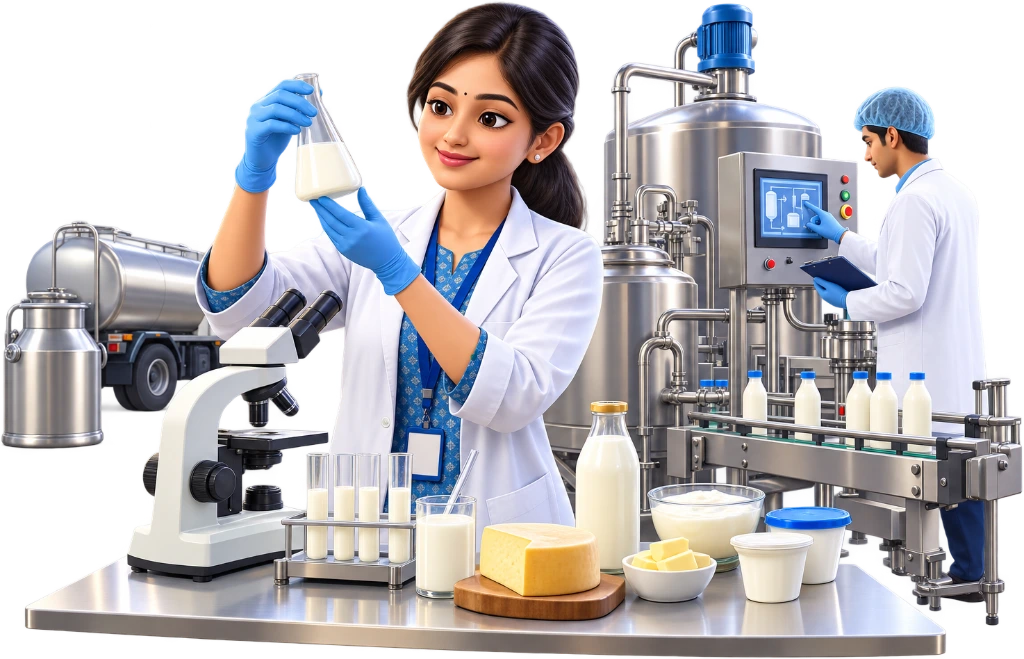
Across the four-year programme, you study milk processing, dairy plant design, dairy product technology and quality assurance, with laboratory training.
| Stage | Core content | Alongside it |
|---|---|---|
| Throughout the 4 years | Milk processing, dairy plant design, dairy product technology and quality assurance. | Laboratory training required for this full-time programme. |
Ask before you enrol. How many hours each week will you spend in dairy processing and quality-testing laboratories, and which milk processing equipment will you operate yourself?
Who it suits
This course suits you if you want to work with milk processing, dairy products and the engineering side of a dairy plant.
- You have passed Class 12 with Physics, Chemistry and Maths or Biology.
- You are ready for a four-year, full-time on-campus degree with laboratory training.
- You want to learn dairy plant design, production work and quality assurance.
- You are comfortable preparing for ICAR AIEEA UG, a state entrance exam or JEE Main where an institute accepts it.
- You want roles such as production manager, quality assurance manager or dairy plant manager in the organised dairy sector.
- It does not suit you if you need a distance or online course, because this programme is full-time only.
What it will actually cost you
For the four-year course, government and state institutions usually cost less than private colleges, while IIT or NIT fees sit in a higher band.
| Line item | Typical | Worth knowing |
|---|---|---|
| Government or state institution fee | Rs 1,00,000 - 6,00,000 total | This is the indicative total course fee for the full four years. |
| IIT or NIT fee | Rs 6,00,000 - 10,00,000 total | This is the indicative total course fee for the full four years. |
| Private institution fee | Rs 4,00,000 - 25,00,000 total | This is the indicative total course fee for the full four years. |
Ask the college during counselling about scholarships, reserved-category fee concessions and fee-refund rules. These vary by institution and admission category.
Indicative ranges, not quotations. Confirm the current fee with the institution before you pay anything.
Certifications that change what you earn
What it pays, and what changes it
In India, B.Tech Dairy Technology graduates commonly start at ₹25,000 to ₹45,000 a month in dairy processing, production or quality roles.
India
Pay rises with plant responsibility, quality experience and work in the organised dairy sector.
| Stage | Monthly | What it depends on |
|---|---|---|
| Entry level | ₹25,000–₹45,000 | Graduate trainee, production, quality assurance or dairy plant role after B.Tech. |
| Early career | ₹35,000–₹55,000 | Experience in milk processing, product production or quality systems. |
| Experienced | ₹50,000–₹75,000 | Several years in a dairy plant, with responsibility for a production line, quality function or shift team. |
| Managerial | ₹70,000–₹1,00,000+ | Plant, production or quality management responsibility in an organised dairy processor or cooperative. |
Indicative bands for 2026, not measured salary data. What people actually earn varies by employer, state and sector.
The honest part
Dairy Technology is full-time laboratory and plant-based study, not a distance or online course. You will handle processing, quality testing and plant-related work, alongside engineering subjects. Fees vary sharply: government or state options may cost about ₹1 lakh to ₹6 lakh in total, while private colleges can reach ₹25 lakh. Starting pay is commonly around ₹25,000 to ₹45,000 a month, so compare the fee with likely early earnings before choosing a college.
The organised dairy sector does offer structured roles in cooperatives, private processors, ice-cream manufacturers, equipment suppliers and food safety work. The degree gives you a clear technical base in milk processing, product technology, quality assurance and dairy plant design. You do not need a licence to practise after graduation. A strong government seat can make the financial side far more sensible.
Students who do well usually treat practical work seriously, rather than seeing it as a break from theory. They learn to read quality results, understand production steps and communicate clearly with plant and quality teams. They also use internships and placements to learn which work suits them: production, quality assurance, equipment or management. Later, some build broader business skills through an MBA or continue into dairy or food technology specialisation.
Who can apply
1 route into this course.
| Qualification | Stream | Minimum | Subjects |
|---|---|---|---|
| Class 12 | Science - PCMB | — | Physics, Chemistry, Maths/Biology |
Percentages are indicative. Individual universities set their own cut-offs, and reserved-category relaxations differ by state and institution.
Entrance exams for this course
An exam mapping does not mean every college accepts that exam. Check the current institution and examination notification before you apply.
Careers this course leads to
4 routes mapped from this qualification.
A course supports eligibility and preparation. It never guarantees a particular job.
Before and after this course
Courses that lead here
What you can study next
Common questions
Who can apply for B.Tech Dairy Technology?
12th pass with Physics, Chemistry, Maths/Biology. Admission is through ICAR AIEEA UG, State entrance, JEE Main (some institutes).
How long does B.Tech Dairy Technology take?
4 years. Full-time only. UGC does not permit this programme in distance or online mode, as it requires laboratory, clinical or studio training.
What does B.Tech Dairy Technology cost?
Govt/State: about 1,00,000 - 6,00,000 total; IIT/NIT: about 6,00,000 - 10,00,000 total; Private: about 4,00,000 - 25,00,000 total. These are indicative ranges, not quotes. Confirm the current fee with the institution.
What can I study after B.Tech Dairy Technology?
M.Tech Dairy Technology, MBA, ARS via ICAR NET, Ph.D, Food technology specialisation.
Turn this into a decision you can defend
Compare the route, follow where it actually leads, and keep one alternative in view before you apply.